
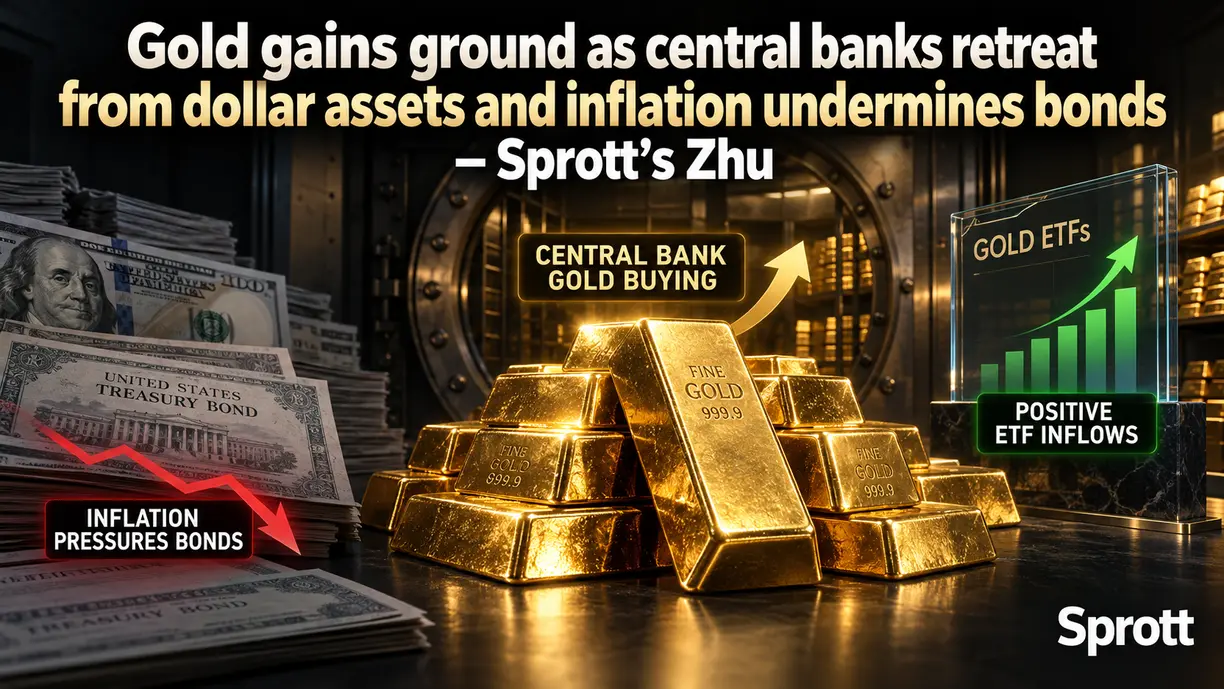
(Kitco News) – Gold’s ability to maintain its trading range and attract fresh ETF inflows despite soaring bond yields suggests its next move could be to the upside, while central banks’ shift away from dollar assets continues to bolster the longer-term bullish outlook, according to Kenny Zhu, Director of Research and Investment Strategy at Sprott.
In an interview with Kitco News, Zhu explained why the inflation and currency concerns driving yields higher could ultimately strengthen gold’s appeal, and how either a soft landing or a sharper economic downturn could ease the pressure on precious metals — with a sudden Fed pivot potentially supercharging gains in gold.
“Given the inflation pressures, the flows have remained positive,” he noted. “They're not as strong as they were in August because that was a strong rally, but it's still positive inflows. To me, that suggests that potentially there is interest in gold at these levels.”
“I think that the fact that gold has essentially maintained this trading range, plus the fact that you're still seeing some nominal level of inflows going into gold ETFs, suggests that we're at a point of indecision,” Zhu said. “And we would argue that potentially tilts more towards the upside. I think there's an argument that some investors are using this opportunity to potentially step into this trade, if not increasingly allocate to this segment.”
“Am I going to say that people are going to go all out on this sector? I don't know about that,” he cautioned “I don't know if I'd be that aggressive. But you consider it in terms of like the dialogue that you've seen in the media, and folks have been talking about gold.”
“But, at the same time, who else has been jumping up and down out there? It's been the fixed income guys, because bond yields are at levels that we haven't seen in years, if not decades.”
Zhu said that one of the structural growth narratives that has continued to underpin gold prices – even through the summer lows – has been ongoing central bank buying.
“I would say that this is a trend that actually predates 2022,” he said, “but the Russian invasion of Ukraine accelerated it. What happened as a result of that? The United States government went out and sanctioned Russia, essentially forced it out of the international payment system. And that illustrates the level of leverage that the United States has over its currency. So you have a shift and an acceleration of central bank buying attributable to that event, from that point on.”
Zhu said the sanctions policy also resulted in something economists and analysts had been warning about for years: a Chinese move away from the U.S. dollar, with the developing world following.
“We were always talking about fears that China would start selling treasuries and reallocating to something else, and that something else has been gold,” he said. “But Russia was also moving into gold. I think from that point on, you really started to see a lot of the emerging market central banks start to go into gold as well.”
Zhu believes there are strong arguments in favor of this move away from the greenback and into gold, even if you set the war aside.
“The argument there is maybe de-leveraging risk exposures to the U.S.,” he said “The other is you really need to defend your currency when the dollar appreciates. If the US dollar is rallying, what happens to your currency? It starts to weaken. Maybe that's not really as big of an issue for a developed market, but in a country like Turkey, for example, that can be a big factor; you can see some pretty big swings. So what you do in those situations is you sell what you have. Gold would be one of them, but treasuries, namely.”
“If you look at the trend from 2022 to today – again, this is a trend that's been in the making but it's accelerated – you look at what proportion of central bank reserves worldwide is held in gold, and you compare that to what proportion of global central bank reserves is held in treasuries and U.S.-denominated assets, you'll actually see that the dollar-denominated assets have been falling, and the ratio of gold has been rising.”
Zhu acknowledged that sky-high bond yields are a significant headwind for gold prices, but said when rising yields reflect worries about sovereign risk and currency debasement, gold begins to look like a better bet even without a yield.
“When inflation rises, bonds get hit,” he said,” because maybe bonds don't do what you need them to do, which is hedge those [equity downturns]. You have to understand the drivers, why the yields are rising. If you think about the drivers of that trade over the past few months, if not couple of years, it's the debasement factor, flooding the market with liquidity. The Federal Reserve back in the day, in a zero-interest-rate environment, being too slow to hike, basically allowing liquidity to flow for longer than it needed to. There's an inflation story there as well.”
Zhu referred to inflation as “probably bonds' biggest Achilles' heel.”
“When inflation takes off, and they're going to raise rates, and the market rates are going to rise relative to the bonds in your portfolio, that really tamps down on your bonds’ value,” he said. “If you actually hold the bond to maturity, you're still going to take the hit, because assuming the inflation impact remains in effect, you're going to erode the value of those coupons that you're collecting over time, because those coupons are, generally speaking, fixed.”
Looking ahead, Zhu pointed to two potential scenarios that he could see playing out for gold in this environment.
“You either have a soft landing, where the Fed doesn't have to hike that much, they start to see the data shift, and hopefully they're able to pivot in time,” he said. “In that environment, the headwinds that have been weighing on gold potentially ease off, and that allows the price to go back to that structural longer-term trend.”
“The other is, maybe there's a surprise in the economy,” he said. “There's a black swan event, a hard landing happens, and there's that big pivot that everybody keeps talking about.”
“In that scenario, not only do the pressures on precious metals abate, but they could potentially even juice the move in gold and silver.”
See live precious metals prices for gold, silver, platinum and palladium — in USD, CAD and 12 more currencies.
