
(Kitco News) - Inflation hit 3.7% and gold fell as much as $80. The former London bond broker, who bought his first gold in 2002, says the 40-year bond bull market is over and savers will pay for it
Mario Innecco bought his first gold in 2002. He spent about two decades in London brokering government bond futures, and he started following Kitco’s price charts, with their little time-zone markers.
Around 1:20 to 1:30 in the afternoon, London time, gold and silver would be sold off, according to Innecco. That, he said, is when regular trading opens on the COMEX in New York.
“That was the first time I realized there was something fishy going on in the precious metals market,” Innecco told Kitco News. “I thought this is weird because the bond market, yes, we do sell off and stuff, but it doesn’t happen always at the same time.”
He still thinks someone is leaning on the market.
The September inflation report came in hot Wednesday, and gold fell anyway. The consumer price index rose 3.7% over the past 12 months, up from 3.4% in August, the Bureau of Labor Statistics reported. Gasoline jumped 9.1% in a single month and accounted for more than half of the monthly increase.
Spot gold fell as much as $82 an ounce from the previous close, to a low of $4,078.80, according to Kitco data. Silver fell more than 5% at its low. As of 10:55 a.m. ET, gold was at $4,090.10, down $70.60 on the day, and silver was at $56.02, down 5.13%.
Treasury yields rose after the report. The 2-year yield climbed 15 basis points to 4.94%, and the 10-year rose 11 basis points to 5.32%, according to market data. Futures traders’ odds of a Federal Reserve rate hike on Oct. 28 more than doubled in a day, to roughly 50%, according to CME Group’s FedWatch tool.
Professional traders read hot inflation as a sign the Fed will tighten further, according to Innecco, which raises the cost of holding gold instead of Treasurys or bank deposits.
“The markets, they do the opposite of what the layman thinks it should be,” he said.
The bond market turned
Innecco, who now hosts the maneco64 YouTube channel, thinks the bigger story is in bonds.
In August 2020, the 10-year Treasury yield hit an all-time low of 0.52%, and gold topped $2,000 an ounce for the first time. The yield hit 5.36% on Oct. 7, its highest since 2002, according to market data. Gold is still above $4,000.
“From 1981 to 2021, when the bond market was in a bull market, interest rates kept going lower,” Innecco said. “That allowed debt holders like the government, people with mortgages, to always be able to refinance at lower costs, and that kept things going. But now, in my opinion, we are in a bear market in bonds.”
The 10-year yield could drop back to around 4.5%, “or even four and a quarter,” over the next three to six months in what he called a counter-trend rally, then climb toward 6%, according to Innecco. Savers who want higher yields should stick to Treasurys that mature in a year or less, he said. A 10-year note bought at 5.3% would be worth about 94 cents on the dollar two years later if yields rose to 6.25%, according to a Kitco News calculation.
“Back in the ’70s, they used to call bonds certificates of confiscation, and I think it’s going to be the same thing again,” Innecco said. “I think the U.S. government and the Fed don’t mind that, because it writes off the debt.”
Rising yields, he said, mean “the Fed is losing control of the currency, and it’s becoming worth less and less.”

‘They’re leaning on it’
“I think they’re leaning on it,” Innecco said. “They’re leaning especially on silver because silver is easier to bash around.”
Traders “push the paper price around” and “know the levels where people will come in,” he said. Later in the interview, he said “the bullion banks are still trying to keep the gold price under control.”
He pointed to China’s Golden Week holiday, Oct. 1 to Oct. 7, when Chinese markets were closed.
“Over the years, I’ve always heard that during Golden Week, it’s a good week for the bullion banks to smash gold and silver,” he said.
Regulators have penalized manipulation in these markets before. In September 2020, JPMorgan Chase agreed to pay more than $920 million to resolve U.S. investigations into spoofing in precious metals and Treasury futures over at least eight years. At the time, it was a record penalty for the Commodity Futures Trading Commission.
Few people are selling their physical metal, according to Innecco. “If anything, this is probably an opportunity to keep backing up the truck and loading up on gold and silver,” he said.
Who loses first
Innecco defines inflation as growth in the supply of money and credit, not the CPI. On his channel, he estimated that M2, a broad money measure, is growing at an annualized pace near 6.7% this year. Asked whether he trusts the official number, he said, “Not really.”
He pointed to how the government substitutes cheaper goods in the CPI basket and adjusts for quality improvements, a practice known as hedonics. The BLS says quality adjustments are meant to separate price changes from changes in what consumers are getting.
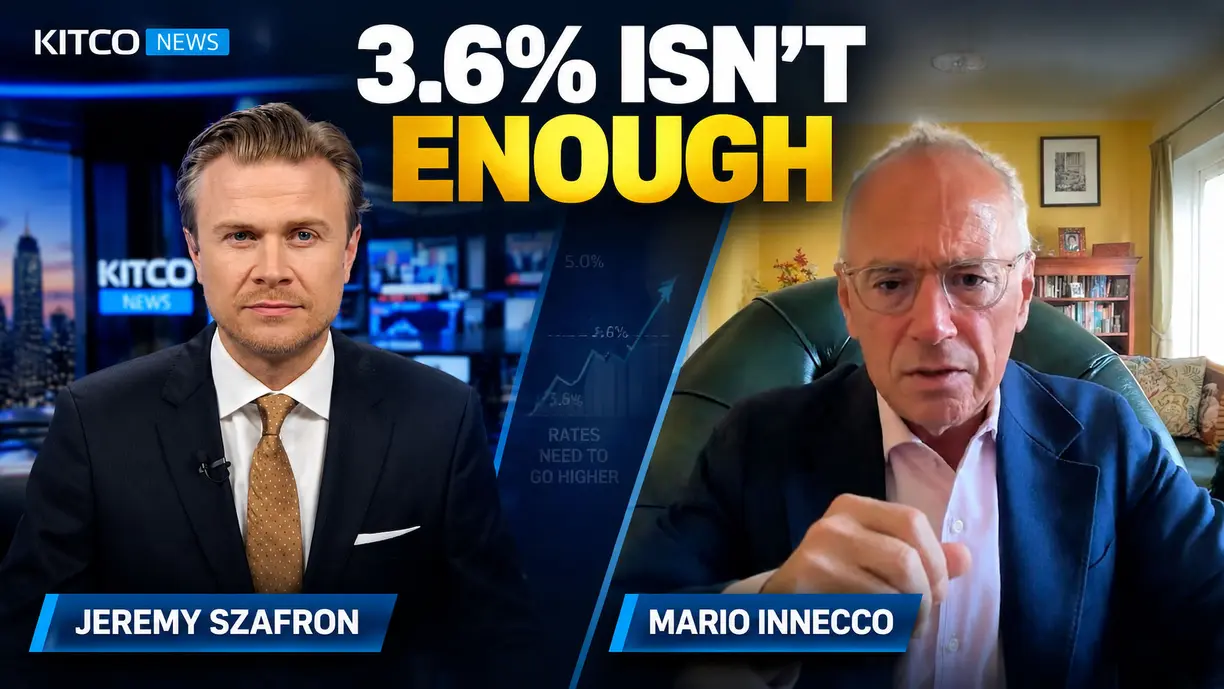
On the same morning, the Social Security Administration announced a 3.6% cost-of-living adjustment for 2027. The estimated average retired worker’s monthly check rises about $75, to $2,170, starting in January, according to the agency. The adjustment is based on the CPI-W, an index for wage earners that rose 3.9% over the 12 months to September, according to the BLS.
By Innecco’s measure, the raise falls well short.
“They’re going to be losing out, these people getting 3.6,” he said.
New money benefits Wall Street and big corporations first, according to Innecco.
“By the time it reaches the bottom 50% or even more, that currency’s been debased and you can buy a lot less,” he said.
Earlier in the interview, he put it more bluntly. “Inflation is a tax, and it is an unfair tax.”
‘Impossible to do a Volcker now’
“In my opinion, the Fed is the purveyor of inflation,” Innecco said. “What they fight is managing the public’s perception of inflation.”
The Fed raised its target range to 3.75% to 4% on Sept. 16, its first hike since July 2023 and the first under Chair Kevin Warsh. Innecco called Warsh “relatively independent” and said, “I wouldn’t be surprised if they hike.”
A hike big enough to break inflation would break the economy, according to Innecco. Federal debt was about a third of the size of the U.S. economy in 1981, when Paul Volcker drove interest rates toward 20%, according to Federal Reserve Bank of St. Louis data. Gross federal debt passed $40 trillion in August, according to Treasury data, more than the economy’s annual output.
“I think it’s impossible to do a Volcker now,” Innecco said.
Instead, he expects the printing to continue until people lose faith in the currency.
“One day there will be a trigger where people realize this, and they will want anything but the currency,” he said.
A $1 trillion revaluation
The Treasury values its 261.5 million ounces of gold at the statutory price of $42.2222 an ounce, about $11 billion on paper, according to the Treasury’s gold reserve report. At market prices, the same gold is worth more than $1 trillion.
Congress would have to approve a new price, according to Innecco, and the Treasury could collect about $1 trillion while keeping the gold.
“Nobody really technically pays anything,” he said. He added that it would be inflationary “because they’ll have more money to spend.”
Congress raised the official price twice in the 1970s, to $38 in 1972 and $42.22 in 1973. Each time, according to Innecco, it created “a floor for the gold price.”
The Treasury named Judy Shelton a counselor to Treasury Secretary Scott Bessent on Oct. 9. Shelton has proposed 50-year Treasury bonds redeemable in dollars or gold at maturity, which she argues would lower borrowing costs. Innecco, who has interviewed her on his channel, called the idea “just another futures contract, basically, because you can only take delivery of the gold at maturity.”
He also pointed to 1933, when President Franklin Roosevelt ordered Americans to turn in their gold at $20.67 an ounce and later revalued it to $35. Change can come quickly, he said.
“Oh, it could happen fast, over a weekend,” Innecco said. “I think a lot of people got tricked back in ‘33.”
After 24 years of stacking, he said, what surprised him most is “how long they’ve been able to drag this.” He credits the 40-year bond bull market.
“Now we’re sailing windward, against the wind,” he said. “It’s going to be a lot harder.”
See live precious metals prices for gold, silver, platinum and palladium — in USD, CAD and 12 more currencies.