
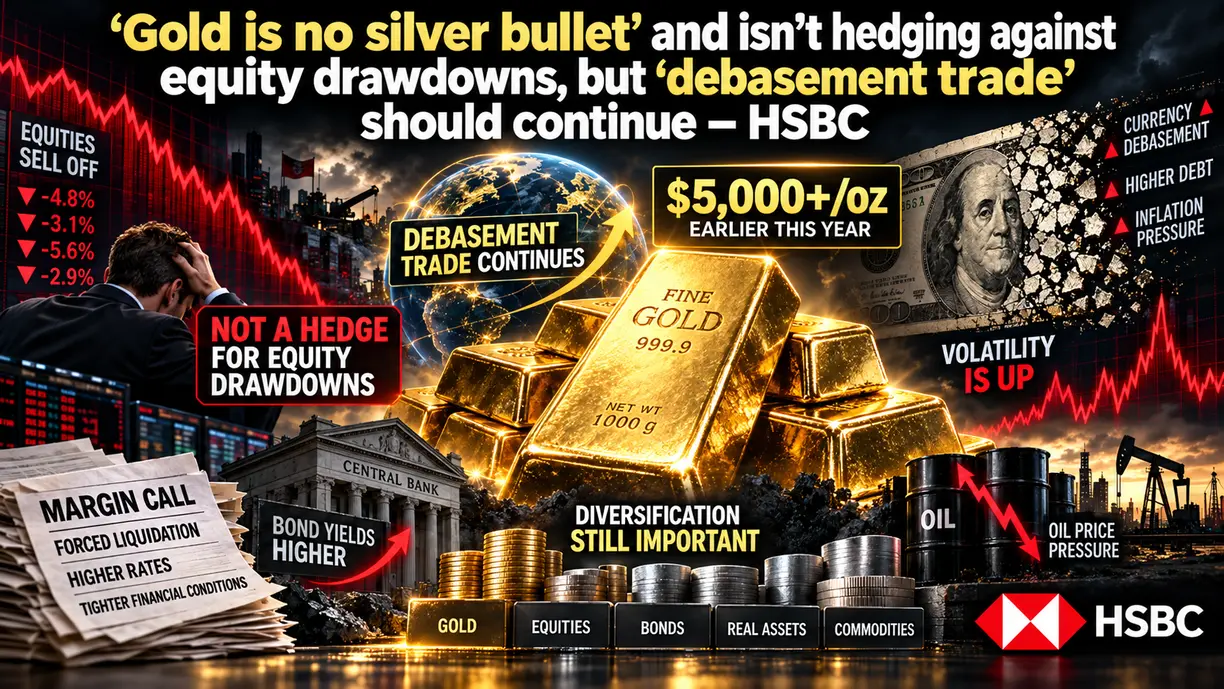
(Kitco News) – Gold will continue to benefit from the debasement trade despite its recent weakness, but precious metals investors would do well to diversify, as the yellow metal hasn’t provided effective protection against recent stock market pullbacks, according to market strategists at HSBC Asset Management.
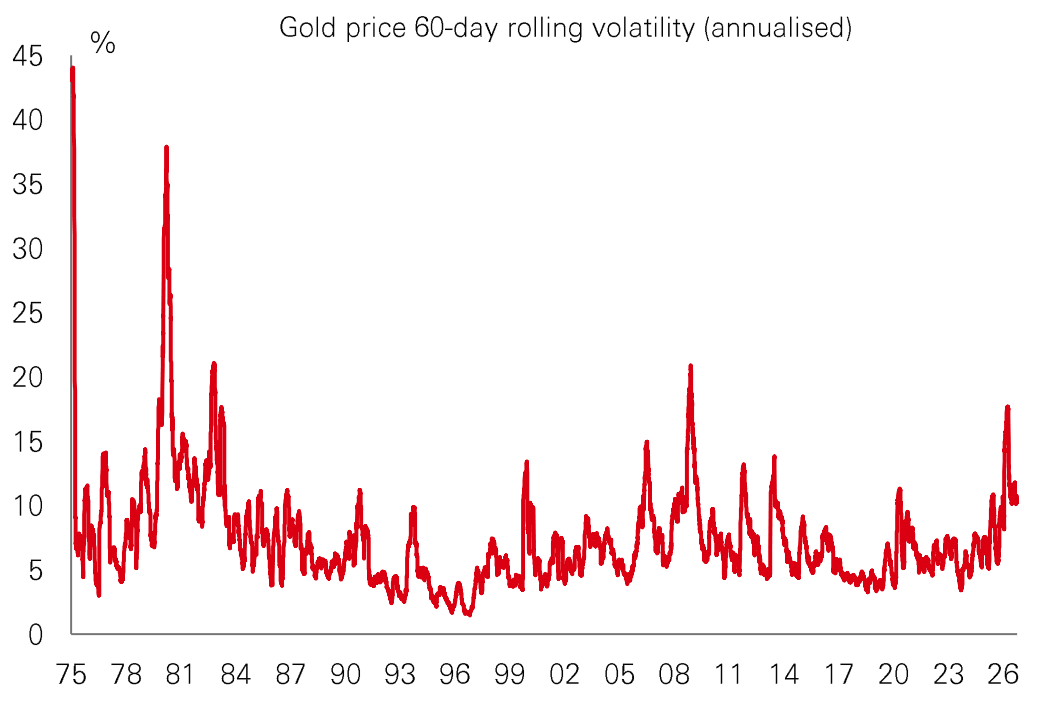
“Gold’s spectacular bull run, which saw prices climb to well above USD5,000 per ounce earlier this year, has fizzled out,” they said in a recent report. “Prices are down and volatility is up. Should investors throw in the towel?”
The strategists caution that while gold has underperformed since the early-year rally amid sky-high oil prices, rising rates, and soaring bond yields, “there is still a compelling strategic rationale for the metal in portfolios as geopolitical fragmentation and central bank reserve diversification keep demand supported.”
“The ‘debasement trade’ of shifting capital into ‘hard assets’ such as gold can continue as concerns over debt and inflation linger,” they wrote. “And although volatility has spiked, it doesn’t look that bad compared to history.”
HSBC warned, however, that recent market action shows gold has failed to perform as an effective hedge against equity drawdowns.
“With leveraged capital crowded into gold, tumbling stocks trigger margin calls that force investors to unwind positions to raise cash,” they noted. “So although gold looks to be a robust hedge against systemic risks in a “multi -polar” world, it’s not guaranteed to work as a short-term volatility dampener.”
“It’s a reminder that no single asset can weather every type of market stress, and why diversifying the diversifiers remains a crucial strategy for investors right now.”
In July, HSBC said that despite higher Treasury yields and a stronger dollar, growing diversification demand, central bank buying and ETF inflows should support further price gains for gold through the end of 2026.
"Gold did not rally during the Middle East conflict and has largely moved in tandem with equities,” HSBC Global Chief Investment Officer Willem Sels and Global Head of Wealth Insights Lucia Ku wrote. “Our analysis indicates that US yields are the primary driver of gold prices. We believe gold may remain range-bound in the near term amid elevated real yields and a stronger USD. However, demand for portfolio diversification, central bank buying and steady ETF inflows should support gold prices over the medium term.”
“We continue to view gold as an effective diversifier against broader portfolio risks."
Sels and Ku said their analysis indicates that U.S. Treasury yields are currently acting as the primary driver of gold’s price action. “When yields rise, the opportunity cost of holding a non-yielding asset increases, putting pressure on gold prices,” they said. “Moreover, gold has been less effective as an equity hedge in 2026, having largely moved in tandem with equities.”
HSBC believes gold will likely remain rangebound in the near term in the face of elevated real yields and a strong U.S. dollar. “However, demand for portfolio diversification, central bank purchases and steady ETF inflows continue to support our bullish view on gold and its role as a diversifier against broader portfolio risks,” they said.
“We anticipate further upside for gold by year-end."
And back in May, James Steel, Chief Precious Metals Analyst at HSBC, said that gold has performed exactly as it should throughout the Iran conflict.
“The demand has been good out of China,” Steel said. “The Shanghai Gold Exchange premium – the difference between the domestic price in China and the global price – is around $20, indicating strong domestic demand in China, which is mostly on the institutional side. It's interesting; it's less on jewelry and coins and small bars, which we have seen traditionally, and more on the large bars, more for institutions, because we had some regulatory reform in both China and India. Now the top insurance companies in China are allowed to accumulate bullion, and asset managers in India are allowed to accumulate it as well.”
Steel was asked what he learned from gold’s peak around $5,400 per ounce in late January, and its subsequent decline amid the Middle East conflict.
“Well, I think the run up was a little robust,” he said. “We were bringing in a lot of money that had not been in the market for quite some time, or had not traded gold at all. One could argue that the market had become overly long, particularly when you look at CFTC data and other things we have available now.”
“There's been a lot of critics of the bullion market saying that the decline since the strikes on Iran and escalating oil prices, [claiming] that gold is not a safe haven, that it’s failed in some sense,” Steel said. “I would argue exactly the opposite, because as the oil went up and we got restoked inflationary fears, and bond yields rose, and the dollar rose, equities declined. In that atmosphere, ready cash was needed. And that's what gold provides you.”
“We did see liquidation in the gold market, but mostly as a reaction to the financial market,” he added. “In a sense, gold was an insurance policy, and that insurance policy was being cashed in.”
Steel was also questioned on his views of gold’s historical relationship with oil prices.
“Well, that's interesting, because I'm old enough to remember when it was a positive relationship,” he replied. “We've done some work on this. In the 1970s, gold was positively correlated with oil: Oil ran up, and so did gold. In the 1980s, that was the same; oil fell and gold also fell.”
“Now, that correlation seemed to break apart as we got into the 90s, as oil was a less significant part of the global economy,” he said. “That correlation is now only about 0.15, or even negative at times… It's negative at the moment.”
Finally, Steel was asked whether he views gold as one of several alternative assets within investor portfolios, or whether he sees it as a standalone asset.
“Well, I think you could argue that it is an alternative asset,” he said. “It’s certainly quite unique, in the sense that it's a hard asset and it's also highly liquid. It doesn't correlate to Apple or Nvidia, it tends not to, over the long run anyway. Things like Canadian farmland, for instance, that's also a hard asset, but you can't liquidate it quickly. And that's the beauty of gold. It's both a hard asset, and it's highly liquid, highly traded.”
“But what you have touched on, and I think we will see it back again, is many asset managers who never before have included gold in their portfolio are beginning to do that, because they're looking for alternatives.”
See live precious metals prices for gold, silver, platinum and palladium — in USD, CAD and 12 more currencies.
