

(Kitco NewsWire) - Spot gold and silver prices were sharply lower in late U.S. trading Thursday, as renewed Middle East tensions sent crude oil prices higher, reinforcing inflation concerns and expectations for additional Federal Reserve tightening. A sharp selloff in technology shares and falling Treasury yields failed to generate sustained safe-haven demand for bullion, while silver faced additional pressure from concerns about industrial demand and slowing economic activity. At the time of the latest verified late-afternoon reading, spot gold was trading near $4,021.20 an ounce, down $119.10, or 2.88%, while spot silver was trading near $54.440, down $3.410, or 5.90%.
Market positioning remains divided between persistent inflation pressure, weaker economic activity and growing financial-market instability. September consumer inflation increased 0.6% on the month and 3.7% annually, while producer prices rose 1.3% and 6.3%, respectively. Fed funds futures continue to favor no change at the Oct. 27-28 Federal Reserve meeting, with recent pricing indicating approximately an 84% probability of a pause and a 16% probability of a 25-basis-point increase. December tightening remains the central market expectation, although the precise probabilities have fluctuated as traders reassess growth risks and the inflationary impact of elevated energy prices. Treasury yields declined Thursday as selling in technology shares encouraged demand for government bonds. However, falling yields failed to support gold, suggesting that precious metals positioning, liquidation pressure and the outlook for further monetary tightening remained dominant considerations.
The Federal Reserve remains in its premeeting communications blackout, shifting attention to Friday's preliminary October manufacturing and services purchasing managers' indexes at 9:45 a.m. EDT and the final University of Michigan consumer sentiment survey at 10 a.m. EDT. The reports will provide further evidence on business activity, consumer confidence and inflation expectations before next week's monetary policy decision.
The Fed's Oct. 27-28 meeting and the subsequent release of September personal consumption expenditures inflation data on Oct. 29 will provide more substantial tests of market expectations for December tightening. Softer activity readings and easing inflation expectations could reduce pressure on yields and improve gold's outlook, while stronger economic data and persistent price pressures would reinforce the prospect of additional interest rate increases.
The Strait of Hormuz and U.S.-Iran situation remained a significant source of financial-market uncertainty Thursday as renewed attacks on commercial shipping and energy infrastructure increased concerns about regional escalation. Reports of damaged vessels and threats to maritime traffic were accompanied by renewed security concerns involving Saudi Arabian energy facilities, while Washington and Tehran remained divided over the conditions for reopening normal commercial shipping through the strait. Diplomatic contacts have not produced a confirmed settlement, and uncertainty about possible additional military action has complicated efforts to stabilize the corridor. Although alternative pipelines, rerouting and ship-to-ship transfers have helped restore aggregate Middle Eastern oil exports, direct tanker movements through Hormuz remain substantially disrupted. The continuing security threat has sustained an elevated geopolitical risk premium in crude oil prices despite the partial recovery in regional exports.
For gold, the escalation presents competing influences. The prospect of further military confrontation supports defensive demand, but rising crude oil prices threaten to prolong inflation and increase pressure on the Fed to maintain restrictive monetary policy. Thursday's decline in gold despite lower Treasury yields highlights the limited effectiveness of traditional safe-haven support during the latest liquidation. Silver underperformed as the broader precious metals selloff coincided with weakening equity markets and concerns about industrial demand. The combination of high energy costs, slowing interest rate-sensitive activity and persistent inflation risks continues to complicate the outlook for both metals.
North American equity markets finished mixed to sharply lower Thursday as renewed selling in artificial intelligence-related shares overwhelmed gains in other sectors. The Dow Jones Industrial Average edged up 11.89 points, or less than 0.1%, to close at 52,867.98, while the S&P 500 lost 93.74 points, or 1.21%, to 7,663.43, its largest daily decline since July. The Nasdaq Composite tumbled 694.00 points, or 2.60%, to 26,008.86, pressured by renewed concerns about the financing and profitability of artificial intelligence investment. The Russell 2000 gained 3.01 points, or approximately 0.11%, to 2,784.03. The contrast between heavy technology-sector losses and gains across a majority of individual stocks indicated that selling remained concentrated in highly valued growth shares rather than extending uniformly across the U.S. equity market.
European equity markets closed lower Thursday, pressured by rising crude oil prices, weaker corporate earnings sentiment and concerns about government finances. The pan-European Stoxx 600 declined approximately 1.05%, while Germany's DAX lost around 1.1%. France's CAC 40 fell approximately 1.4%, reflecting continuing fiscal uncertainty and pressure on French financial assets. The U.K.'s FTSE 100 declined approximately 0.3%, outperforming continental benchmarks, while Italy's FTSE MIB dropped roughly 2.5% and Spain's IBEX 35 lost approximately 2.1%. Banks, miners and other economically sensitive shares were among the weakest sectors as investors assessed the implications of higher energy prices and elevated borrowing costs for European economic growth.
The key outside markets see crude oil prices higher as renewed attacks and military threats involving Iran increase concerns about Middle Eastern energy exports. Brent crude traded above $113.00 a barrel during the U.S. session, while WTI approached $100.00. The yield on the benchmark 10-year U.S. Treasury note declined as demand for government bonds strengthened during the equity selloff. The U.S. dollar remained comparatively firm, while expectations for restrictive Fed policy continued to limit gold's ability to benefit from lower bond yields.(Kitco Global Index shows how much of today's gold move is the dollar versus the gold market itself.)
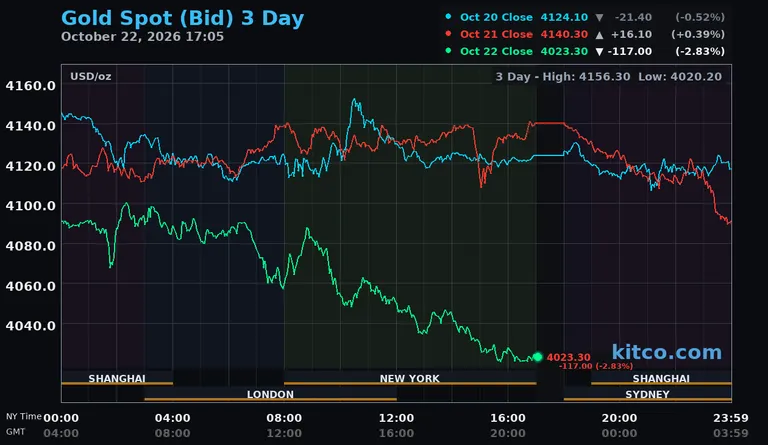
Technically, spot gold bulls' next upside price objective is to push prices back above the $4,068.00 to $4,079.00 resistance zone, with a sustained recovery targeting $4,124.25 and then $4,142.00. Bears' next near-term downside price objective is a break below $4,038.00, with additional downside risk if selling pressure persists. First resistance is seen at $4,068.00 and then at $4,079.00. First support is seen at $4,038.00, followed by the psychologically important $4,000.00 area.
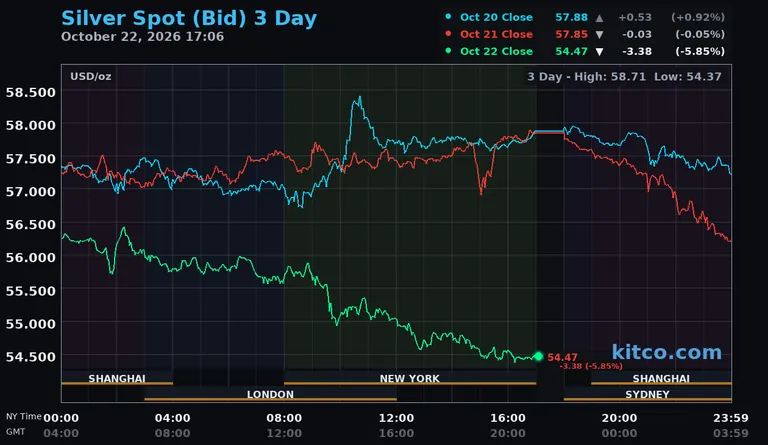
Spot silver bulls' next upside price objective is to drive prices back above the $56.340 to $56.920 resistance zone, with a sustained move targeting $57.390 and then $57.870. The next downside price objective for the bears is a recovery failure below $54.750, with continued selling pressure leaving the metal vulnerable to additional weakness. First resistance is seen at $55.410 and then at $56.340. Next support is seen at $54.750, while additional downside support has yet to be established following the latest selloff.
See live precious metals prices for gold, silver, platinum and palladium — in USD, CAD and 12 more currencies.

