
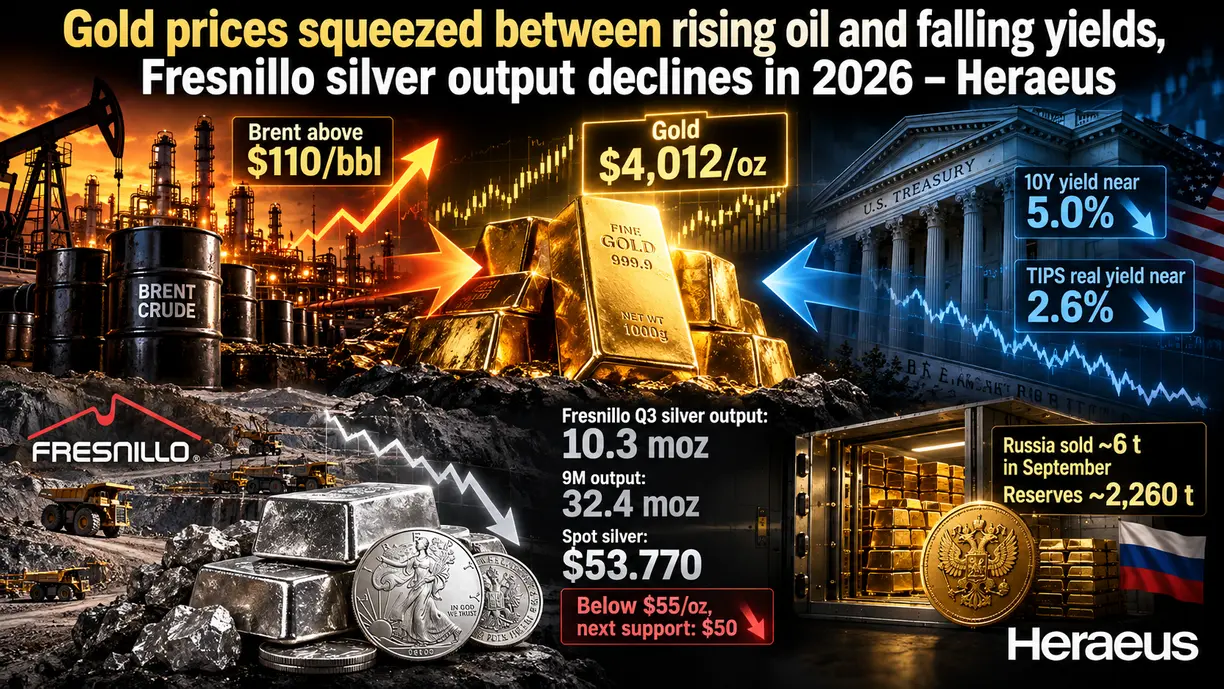
(Kitco News) – Gold prices are being stymied by rising oil prices even as they gain support from falling real yields, while the world’s largest primary silver producer saw output slide over the first three quarters of 2026, according to precious metals analysts at Heraeus.
In their latest update, the analysts noted that gold prices are trapped between rising oil prices and falling Treasury yields.
“Brent crude has climbed back above $110/bbl following renewed Houthi attacks in Saudi Arabia, while Iran’s floating oil stocks, which had continued to supply Chinese refiners despite the US blockade, ran out in mid-October,” they noted. “Oil for delivery in a year’s time is trading around $89/bbl, suggesting the market sees a significant short-term risk premium along with disruption lasting into next year. For gold, elevated near-term oil prices continue to raise inflation risks and keep a December Fed rate hike firmly priced in, offsetting the traditional safe-haven support from geopolitical uncertainty.”
The analysts said that while the decline in Treasury yields has counteracted some of the impacts of rising oil, it hasn’t been enough to boost gold prices. “The 10-year yield has retreated towards 5.0%, from around 5.35% earlier this month, as concerns over stretched AI valuations, heavy financing requirements and returns on investment have driven investors towards government bonds,” they wrote. “The inflation-protected (TIPS) real yield has also reduced from above 2.9%, down to nearly 2.6%.”
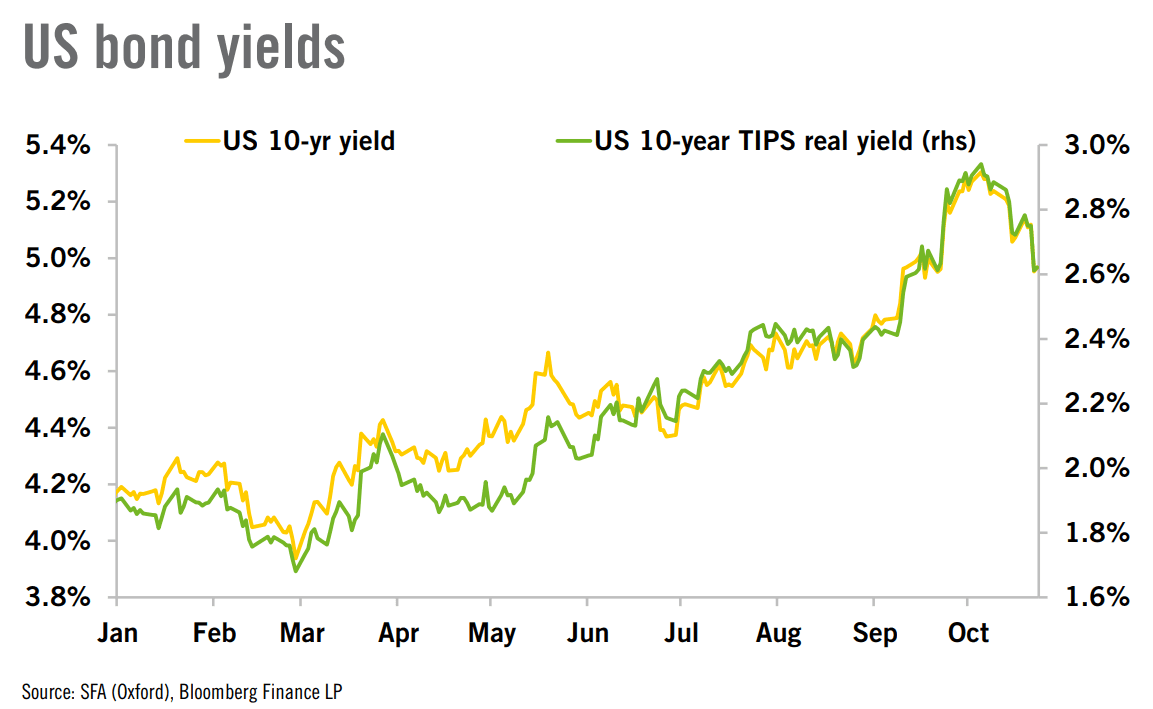
“Lower yields reduce the opportunity cost of holding gold, but Treasuries are also competing directly for safe-haven flows at yields that remain historically high while the dollar remains elevated,” the analysts said. “The gold price has consequently slipped back towards $4,000/oz despite the bond rally. A sustained easing in oil prices alongside lower Treasury yields would provide a more supportive combination for gold, whereas continued strength in Brent crude would keep the inflation and interest-rate headwinds in place.”
And Russia continued to sell off its gold reserves to mitigate the pressure on its federal budget. “The Central Bank of Russia sold approximately 6 tonnes in September, its 10th consecutive month of sales, taking its reserves to around 2,260 tonnes and their lowest level since 2019,” they noted. “Holdings have fallen by around 62 tonnes since December, already more than the net decline of around 50 tonnes in 1998, the year of Russia’s financial crisis.”
“Between January and August, 170 tonnes of net central bank buying was reported, despite selling by Russia and Turkey, the analysts said. “Russia remains an exception to the broader trend of central-bank accumulation, with its need to mobilise reserve assets increasingly outweighing the incentive to hold gold.”
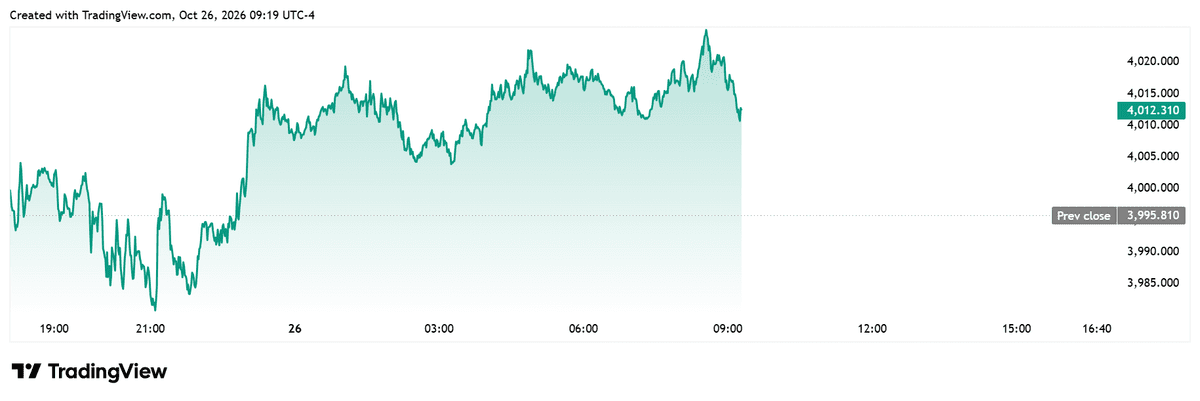
Spot gold continued to trade not far from session highs just before the North American market open, and last traded at $4,012.31 per ounce for a gain of 0.41% on the daily chart.
Turning to silver, Heraeus analysts pointed out that Fresnillo’s silver production dipped in the third quarter.
“Attributable silver production totalled 10.3 moz, down 5.5% quarter-on-quarter from 10.9 moz and 11.6% year-on-year from 11.7 moz,” they noted. “Lower grades at Juanicipio, Saucito and San Julián contributed to the decline, while the year-on-year comparison was also affected by the end of the Silverstream contribution. Juanicipio was particularly weak, with attributable silver output falling by 26% year-on-year to 1.8 moz, although production at the Fresnillo mine increased by 5% to 2.5 moz.”
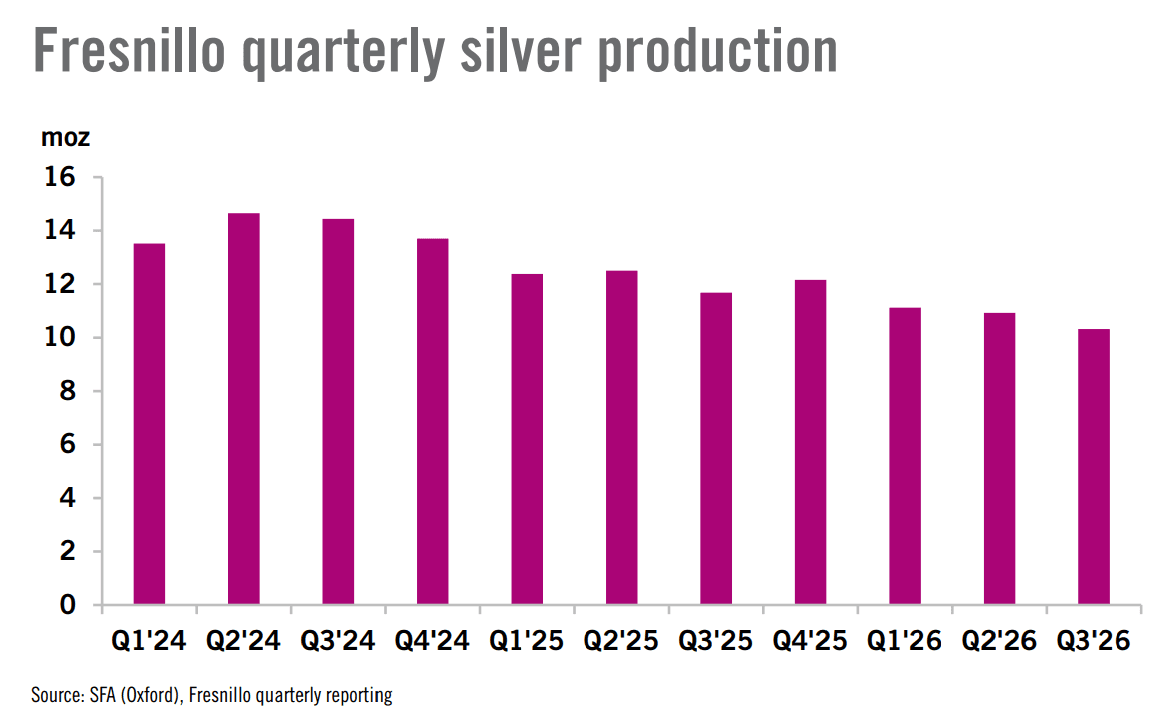
The world's largest primary silver miner produced 32.4 million ounces in the first nine months of the year, a drop of 11.5% from the same period last year. “With full-year guidance remaining at 42.0- 46.5 moz, 9.6 moz is required in Q4 to reach the lower end of the range,” they said. “At that level, Fresnillo’s output would be equivalent to around 5% of global mined silver supply, which totalled 846.6 moz in 2025.”
Looking at the price action, Heraeus analysts pointed out that the silver price dropped below $55 per ounce, breaching the lows recorded in July. “This leaves silver over 20% below its late-August rebound high near $70/oz as the previous week's recovery was short-lived,” they said. “If the move below $55/oz is sustained, it would mark a further deterioration in the price trend. Below this, the $50/oz psychological level provides the next obvious support band.”
Silver was giving back its early gains on Monday morning as prices slid back below $54 per ounce on the session.
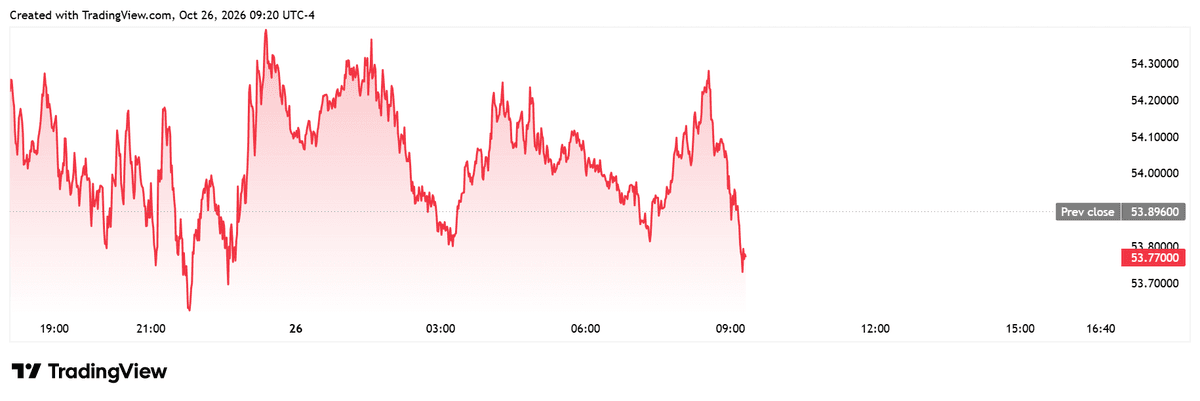
Spot silver last traded at $53.770 per ounce for a loss of 0.24% on the daily chart.
See live precious metals prices for gold, silver, platinum and palladium — in USD, CAD and 12 more currencies.
