

(Kitco News) - Gold prices are trading at session highs after the latest data showed an improving picture of the attitudes of U.S. consumers this month.
The Consumer Confidence Index rose to 91.7 in October, above economists’ consensus forecast for an 81 reading and also above the upwardly revised 84.2 print from September, the Conference Board announced on Tuesday.
The Present Situation Index—based on consumers' assessment of current business and labor market conditions—increased by 8.6 points to 120.4. The Expectations Index—based on consumers' short-term outlook for income, business, and labor market conditions—recovered by 6.9 points to 72.6, only partially reversing three consecutive monthly declines. The survey period for this month's preliminary results was October 1 - 21.
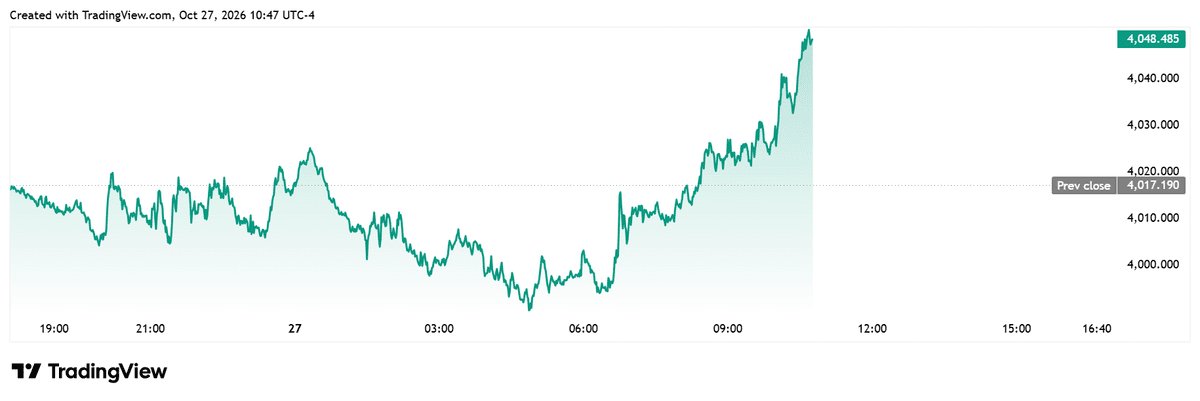
Gold prices were setting fresh session highs in the wake of the 10 am ET data release, with spot gold last trading at $4,048.48 per ounce at the time of writing for a gain of 0.78% on the daily chart.
“Consumer confidence advanced in October, driven primarily by improved perceptions of current and expected business conditions,” said Fergus McCormick, Senior Economist, Global Indicators at The Conference Board. “The recovery was in line with retail gasoline prices easing from September to October. Yet, despite the increase in October, consumer confidence remained on the long-term downward trend that's persisted over the past few years. Consumers planned less spending on services and durable goods over the next six months. This likely reflected higher price levels and persistent inflation, which eroded consumers' purchasing power.”
“Among write-in responses in October, consumers continued to express frustration with rising costs,” he added. “References to prices, the high cost of food and groceries, and oil and diesel prices rose. Comments about war and conflict eased for a second straight month but remained elevated. Mentions of jobs and employment as an area of concern also ticked up, though to a lesser extent.”
“On a six-month moving average basis, only consumers under age 35 and those with a household income of $100k or more expressed an increase in confidence,” the report noted. “By generation, confidence amongst Gen X, Baby Boomers, and the Silent Generation continued to trail significantly behind Gen Z and Millennials, widening a sharp generational divide that has emerged over the past two years. In October, confidence improved across all political affiliations—but much more so for Republicans.”
Consumers' average 12-month inflation expectations declined in October but remained elevated at 5.8%,” the Conference Board said. “Consumers still expected higher interest rates over the next 12 months. Overall, more consumers in October expected stock prices to increase rather than decrease in the next 12 months.”
Jeffrey Roach, Chief Economist at LPL Financial, noted that business conditions and discretionary spending both improved in October.
"Business conditions are the best since April when consensus believed the war with Iran would be short-lived, inflation was less sticky, and the AI-trade dominated headlines," he said. "Even more noteworthy, the top five spending plans included restaurants and movies. Several discretionary sectors are vibrant, although consumers said they will cut back on hotels and airfare."
Roach pointed out that employment opportunities also appeared more plentiful, and home buying plans improved for the third consecutive month.
"Consumers may be tightening their belts, but some experiences are still a priority," he said. "Given the other data on core capital shipments, auto sales, and broader consumer spending, Q3 economic growth will likely be above 3% as the economy plows ahead, elevating annual growth to 2.2% for the full year."
