

(Kitco NewsWire) - Spot gold was steady and spot silver prices were weaker in late U.S. trading Wednesday, as the Federal Reserve left interest rates unchanged while acknowledging persistent inflation and resilient economic activity. The central bank's decision was widely anticipated, but dissenting votes in favor of an immediate increase reinforced expectations that further monetary tightening remains possible before year-end. Renewed Middle East tensions and higher crude oil prices added to inflation concerns, limiting buying interest in precious metals despite a softer U.S. dollar. At the time of writing, spot gold was trading near $4,056.80 an ounce, down $2.50, or 0.06%, while spot silver was trading near $53.720, down $0.580, or 1.07%.
The Federal Reserve left its benchmark interest rate unchanged at 3.75% to 4.00% Wednesday, in a 10-2 decision that highlighted continuing disagreements over the appropriate monetary policy response to elevated inflation. Fed Governor Lisa Cook and Cleveland Fed President Beth Hammack dissented in favor of a 25-basis-point increase. The Federal Open Market Committee maintained that economic activity is expanding at a strong pace, with resilient domestic spending, robust capital investment and relatively stable labor-market conditions. Policymakers also acknowledged that inflation remains elevated, leaving the door open to further tightening as additional economic information becomes available. The decision marked another pause in the Fed's tightening cycle rather than a clear shift toward easier monetary policy.
Market positioning remains focused on the possibility of another interest rate increase in December. Futures markets were assigning approximately an 83% probability to a 25-basis-point increase at the Dec. 8-9 meeting, little changed from expectations immediately before Wednesday's decision.
Attention now turns to Thursday's advance third-quarter gross domestic product estimate, September personal consumption expenditures inflation report and weekly initial jobless claims, all scheduled for 8:30 a.m. EDT. The PCE report will be particularly important following Wednesday's Fed decision, as policymakers assess whether underlying inflation is moderating sufficiently to reduce the need for further tightening. Stronger-than-expected GDP growth or persistent inflation could reinforce December rate hike expectations and lift Treasury yields, creating additional headwinds for gold. Conversely, softer inflation readings or evidence of deteriorating economic activity could temper tightening expectations and support bullion through lower yields and a weaker dollar. The European Central Bank and Bank of Japan are also scheduled to announce monetary policy decisions this week, adding to uncertainty surrounding global interest rates and currencies.
The Strait of Hormuz and U.S.-Iran situation remained a significant source of uncertainty Wednesday as renewed threats to Gulf energy infrastructure lifted crude oil prices and complicated the global inflation outlook. Iranian-aligned Houthi forces claimed responsibility for a ballistic missile attack targeting Saudi Arabia's Ras Tanura refinery, one of the kingdom's major petroleum processing and export facilities. The claim followed diplomatic contacts in Tehran involving representatives from Saudi Arabia, Turkey and Pakistan aimed at reducing tensions and preventing renewed regional escalation. Saudi authorities had not confirmed a major operational disruption at the facility, leaving uncertainty about the direct impact on petroleum production and exports. However, the incident reinforced concerns about the vulnerability of regional energy infrastructure and the continuing threat to maritime commerce through the Strait of Hormuz.
Diplomatic efforts have yet to produce a confirmed settlement between Washington and Tehran, with disagreements over sanctions, maritime access and regional security continuing to obstruct a broader agreement. Alternative export routes have helped mitigate some of the disruption to Persian Gulf oil shipments, but tanker security risks, elevated insurance costs and uncertainty about potential renewed military action remain significant constraints. The latest escalation pushed crude oil prices higher after Tuesday's decline, with Brent futures trading above $115.00 a barrel. For gold, the unresolved confrontation supports defensive demand, but higher oil prices also reinforce inflation expectations and the prospect of additional Fed tightening. Silver faces similar monetary policy headwinds, with its industrial exposure adding sensitivity to elevated energy costs and uncertainty about economic growth.
North American equity markets finished mostly higher Wednesday as investors assessed the Federal Reserve's decision and continued positioning for major technology-sector earnings. The Dow Jones Industrial Average gained approximately 138 points, or 0.26%, to finish near 52,516, while the S&P 500 rose approximately 0.20% to 7,738. The Nasdaq Composite was little changed near 26,479, as gains in selected technology shares were offset by continued concerns about artificial intelligence investment spending, financing requirements and valuations. Canada's S&P/TSX Composite Index also advanced, gaining approximately 0.23% to close near 36,255, supported by gains across several major sectors. The relatively restrained reaction to the Fed's decision reflected the market's expectation that rates would remain unchanged, with investors focusing increasingly on December policy expectations and the upcoming inflation data.
European equity markets finished mixed Wednesday as investors weighed corporate earnings against higher crude oil prices, elevated borrowing costs and Thursday's European Central Bank decision. The pan-European Stoxx 600 edged up 0.07% to close at 644.14. Germany's DAX advanced approximately 0.4% to around 25,700, while France's CAC 40 finished little changed near 7,887. The U.K.'s FTSE 100 posted a modest gain of less than 0.1%, finishing near 10,695. European banking shares were mixed following quarterly earnings from major lenders, while mining and media stocks underperformed. Deutsche Bank benefited from stronger-than-expected quarterly profits, although weakness in other financial shares limited broader sector gains. Investors also continued to assess France's fiscal uncertainty and the implications of elevated energy costs for European inflation and monetary policy.
The key outside markets see Nymex WTI crude oil futures higher and trading near $101.89 a barrel, while Brent crude was near $115.36, reflecting renewed concerns about Middle East energy supplies. The yield on the benchmark 10-year U.S. Treasury note remained near the 5.0% area, while the two-year yield was above 4.76%. The U.S. dollar index was softer as traders assessed the Fed's decision, although the decline provided limited support for precious metals amid persistent inflation concerns and expectations for additional monetary tightening. (Kitco Global Index shows how much of today's gold move is the dollar versus the gold market itself.)
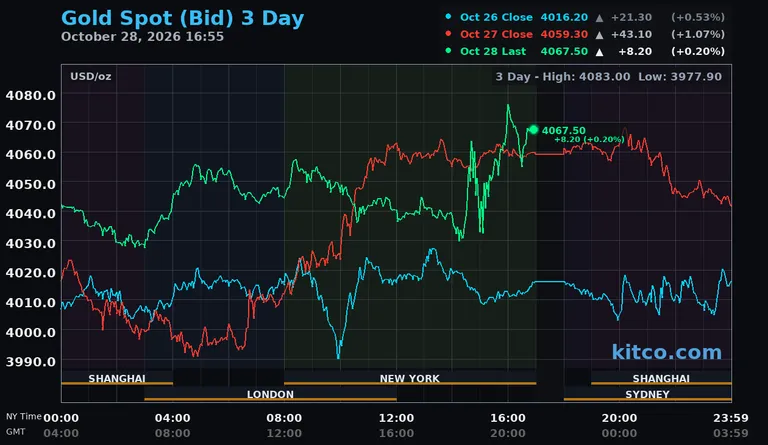
Technically, gold gold bulls' next upside price objective is to push prices back above the $4,079.00 to $4,103.00 resistance zone, with a sustained move targeting the 20-day moving average near $4,124.00 and then $4,190.00. Bears' next near-term downside price objective is a break below $4,015.00, with deeper downside targets at $3,975.00 and then the $3,942.00 to $3,936.00 support area. First resistance is seen at $4,059.00 and then at $4,079.00. First support is seen at $4,039.00 and then at $4,015.00.
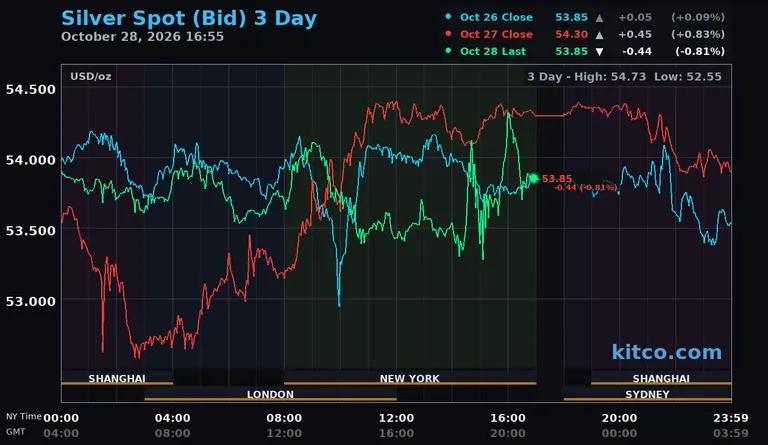
Spot silver bulls' next upside price objective is to drive prices back above the $54.460 to $55.130 resistance zone, with a sustained move targeting $55.770 and then the $56.000 to $57.000 area. The next downside price objective for the bears is a break below $53.243, with deeper downside targets at $52.410 and then $51.390. First resistance is seen at $54.460 and then at $55.130. Next support is seen at $53.243 and then at $52.410.
See live precious metals prices for gold, silver, platinum and palladium — in USD, CAD and 12 more currencies.

