

(Kitco NewsWire) – Spot gold and silver prices were sharply lower in early U.S. trading Thursday, as stronger-than-expected U.S. economic growth and another increase in inflation reinforced expectations for additional Federal Reserve tightening before year-end. The latest third-quarter gross domestic product and September personal consumption expenditures inflation reports highlighted the economy's resilience and persistent price pressures, limiting precious metals' ability to benefit from renewed diplomatic efforts involving the United States and Iran. Spot gold was trading near $4,026.20 an ounce, down $40.40, or 0.99%, while spot silver was trading near $52.590, down $1.256, or 2.33%.
The U.S. economy expanded at a stronger-than-expected pace in the third quarter, while the Federal Reserve's preferred inflation gauge accelerated in September. The advance estimate of gross domestic product showed the economy growing at an annualized 3.4% rate, above expectations for a 3.1% increase and accelerating from 2.2% in the second quarter. Consumer spending increased 3.8%, while fixed investment surged 19.4%, reflecting continued strength in household demand and substantial business investment, particularly in artificial intelligence-related infrastructure. The expansion highlights the resilience of economic activity despite elevated borrowing costs and growing pressure on interest rate-sensitive industries.
The September personal consumption expenditures price index increased 0.5% on the month, its largest monthly gain in six months, while the annual inflation rate accelerated to 3.6% from 3.4% in August. Core PCE inflation, which excludes volatile food and energy costs, rose 0.3% on the month, matching expectations, while the annual core rate increased to 3.1% from 3.0%. The reports indicate that underlying inflation remains above the Federal Reserve's 2% target despite restrictive monetary policy. The combination of stronger economic growth, resilient consumer spending and elevated inflation strengthens the argument for maintaining higher interest rates and reinforces concerns that the Fed may need to resume tightening in December.
Market positioning remains focused on the prospect of another Federal Reserve rate increase before year-end following Wednesday's decision to leave the benchmark interest rate unchanged at 3.75% to 4.00%. The Federal Open Market Committee voted 10-2 to maintain the current range, with Fed Governor Lisa Cook and Cleveland Fed President Beth Hammack favoring a 25-basis-point increase. Fed Chair Kevin Warsh acknowledged continued economic strength and elevated inflation while leaving the possibility of additional tightening open. Interest rate futures indicated an approximately 83% probability of a 25-basis-point increase at the Dec. 8-9 meeting. Thursday's GDP and PCE figures reinforce those expectations, with the benchmark 10-year Treasury yield trading near the 5.0% area after rising to approximately 5.044% Wednesday. Higher nominal and real yields continue to increase the opportunity cost of holding non-yielding gold, while the dollar's relative strength has added to selling pressure on precious metals.
The Strait of Hormuz and U.S.-Iran situation remains a significant source of uncertainty in global energy markets, although fresh diplomatic efforts have reduced immediate concerns about another military escalation. U.S. Vice President JD Vance has sought to revive negotiations by sending a letter to Iranian national security chief Mohsen Rezaei, with Washington seeking renewed discussions on Iran's nuclear program and broader security arrangements. Qatari mediators have also presented a new proposal aimed at ending the conflict, although a senior Iranian official dismissed the latest framework as unacceptable. Tehran continues to demand relief from the U.S. naval blockade, sanctions and restrictions on oil exports, while Washington insists that negotiations address Iran's nuclear activities. The differences leave the prospects for a near-term settlement uncertain, particularly as the possibility of renewed U.S. military action remains unresolved.
Continuing attacks by Iranian-aligned Houthi forces against Saudi Arabian targets and threats to commercial shipping through the Strait of Hormuz have complicated the diplomatic efforts. Saudi air defenses intercepted a missile aimed at the kingdom's Eastern Province, while earlier Houthi claims of an attack on the Ras Tanura refinery have not been accompanied by confirmation of a major operational disruption. Crude oil prices declined Thursday as hopes for renewed negotiations reduced some of the immediate geopolitical risk premium, with Brent crude retreating toward $114.00 a barrel and WTI falling near $101.00. However, the continuing threat to Gulf energy infrastructure and maritime traffic has prevented a more substantial retreat in oil prices, leaving the market exposed to further supply disruptions.
For gold, the decline in crude oil prices offers some relief from energy-driven inflation expectations, but Thursday's strong GDP and persistent core inflation figures have reinforced expectations for restrictive U.S. monetary policy. The unresolved Gulf confrontation continues to support defensive demand, although higher real yields and the possibility of additional Fed tightening remain significant headwinds. Silver has suffered heavier selling pressure as concerns about restrictive monetary policy and industrial demand compound the broader precious metals weakness. The divergence between continuing geopolitical risk and falling bullion prices underscores the dominant influence of interest rate expectations and investment positioning.
Global equity markets were weaker before the U.S. open as investors assessed the stronger U.S. economic data, persistent inflation and the implications for corporate borrowing costs. S&P 500 and Dow futures declined following the GDP and PCE releases, while Nasdaq futures remained volatile as investors digested quarterly results from major technology companies and continued concerns about artificial intelligence-related capital spending. European equity markets were mixed to weaker, with investors assessing regional economic data and Thursday's European Central Bank monetary policy decision. The ECB is scheduled to announce its decision at 9:15 a.m. EDT, followed by President Christine Lagarde's news conference at 9:45 a.m. EDT. The Bank of Japan also concludes its policy meeting Friday, adding another potential source of volatility in global currency and bond markets.
The key outside markets see Nymex WTI crude oil prices lower and trading near $101.27 a barrel, while Brent crude was near $114.05. The yield on the benchmark 10-year U.S. Treasury note is trading near the 5.0% area following Wednesday's increase. The U.S. dollar remains supported by expectations for additional Federal Reserve tightening, while the retreat in crude oil prices is providing limited relief for precious metals following the stronger GDP and inflation readings. (Kitco Global Index shows how much of today's gold move is the dollar versus the gold market itself.)
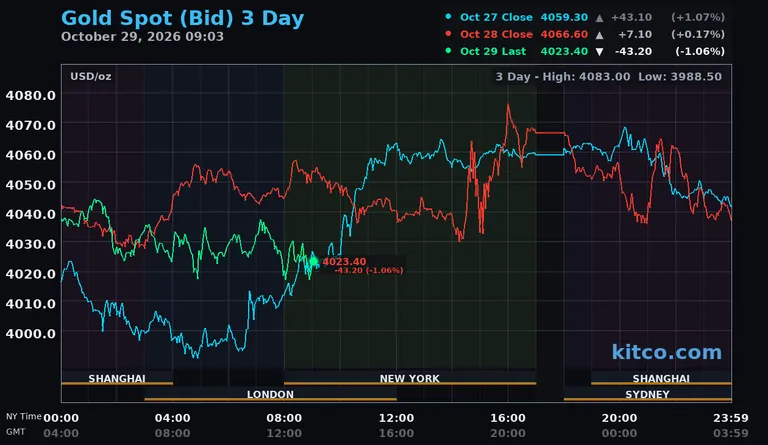
Technically, spot gold bulls' next upside price objective is to push prices back above the $4,084.00 to $4,146.00 resistance zone, with a sustained move through that area needed to reverse the near-term bearish technical trend. Bears' next near-term downside price objective is a break below $4,024.00, with a deeper downside target at $3,986.00. First resistance is seen at $4,084.00 and then at $4,146.00. First support is seen at $4,024.00 and then at $3,986.00.
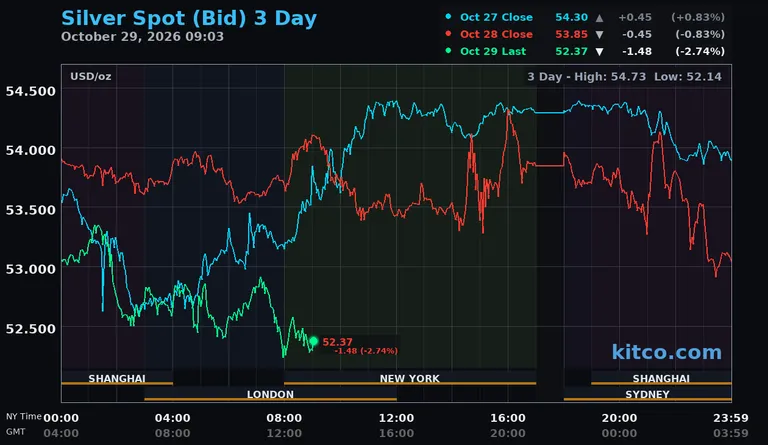
Spot silver bulls' next upside price objective is to drive prices back above the $54.680 to $56.420 resistance zone, with a sustained move through that area needed to improve the near-term technical outlook. The next downside price objective for the bears is a break below $52.690, with a deeper downside target at $51.300. First resistance is seen at $54.680 and then at $56.420. Next support is seen at $52.690 and then at $51.300.
See live precious metals prices for gold, silver, platinum and palladium — in USD, CAD and 12 more currencies.

