

(Kitco NewsWire) - Spot gold and silver prices were sharply lower in late U.S. trading Thursday, as stronger-than-expected economic growth and persistent inflation reinforced expectations for additional Federal Reserve tightening before year-end. Declining crude oil prices provided some relief from energy-driven inflation concerns, while renewed diplomatic efforts involving Washington and Tehran reduced immediate fears of another escalation in the Middle East. However, a technology-led selloff on Wall Street and lower Treasury yields failed to generate sustained safe-haven buying in precious metals. Spot gold was trading near $4,024.60 an ounce, down $42.00, or 1.03%, while spot silver was trading near $52.180, down $1.672, or 3.10%.
Thursday's U.S. economic reports confirmed continued resilience in the world's largest economy despite elevated borrowing costs. The advance estimate of third-quarter gross domestic product showed annualized growth of 3.4%, exceeding expectations near 3.2% and accelerating from 2.2% in the second quarter. Consumer spending increased at a 3.8% annualized pace, while business investment and government spending also contributed to the expansion. The figures reinforced expectations that domestic demand remains sufficiently strong to withstand restrictive monetary policy, even as elevated financing costs weigh on housing and other interest rate-sensitive sectors.
The Federal Reserve's preferred inflation measure also indicated persistent price pressures. September's personal consumption expenditures price index increased 0.5% on the month, compared with a 0.3% rise in August, while the annual inflation rate accelerated to 3.6% from 3.4%. Core PCE inflation, which excludes food and energy, increased 0.3% on the month and 3.1% annually, compared with 3.0% in August. Personal income increased 0.2%, while consumer spending rose 0.5%, leaving inflation-adjusted spending essentially unchanged. The personal saving rate declined to 3.8%, suggesting households are saving a smaller share of disposable income even as nominal consumption continues to expand. Weekly initial jobless claims fell to approximately 194,000, indicating that layoffs remain relatively limited despite signs of slowing activity in selected industries.
Market positioning remains focused on the likelihood of another Federal Reserve rate increase in December following Wednesday's decision to leave the benchmark federal funds target range unchanged at 3.75% to 4.00%. The Federal Open Market Committee voted 10-2 to maintain rates, with two policymakers favoring an immediate 25-basis-point increase. Thursday's combination of stronger economic growth and core inflation remaining above the Fed's 2% target reinforced expectations that monetary policy will stay restrictive. Although Treasury yields declined during the equity-market selloff, the prospect of further tightening continued to limit demand for non-yielding bullion. The benchmark 10-year yield remained near the 5.0% area, while the dollar retained support from the relatively firm outlook for U.S. interest rates. The decline in gold despite lower yields suggests that positioning and concerns about the longer-term monetary policy outlook continued to offset defensive demand.
The Strait of Hormuz and U.S.-Iran situation remained a significant source of uncertainty Thursday, although fresh diplomatic efforts helped reduce some immediate concerns about further military escalation and additional disruptions to Middle Eastern energy supplies. U.S. Vice President JD Vance has sought to revive negotiations through a letter to Mohsen Rezaei, the head of Iran's Supreme National Security Council, while Qatari mediators have presented a separate draft proposal aimed at ending the conflict. However, a senior Iranian official dismissed the latest proposal as unacceptable, underscoring the substantial differences that remain between Washington and Tehran over sanctions, security arrangements and the future of maritime access through the Strait of Hormuz.
The diplomatic efforts follow renewed threats to Gulf energy infrastructure and commercial shipping, including a claimed Houthi attack on Saudi Arabia's Ras Tanura refinery. No independently confirmed major operational disruption at the facility has emerged, but the continuing risk of attacks on oil installations and tanker traffic has sustained a substantial geopolitical premium in crude prices. Alternative export infrastructure has helped mitigate some shipping disruptions, although security concerns and elevated insurance costs continue to complicate the restoration of normal trade through the waterway. Brent crude futures settled lower at $114.88 a barrel, down 0.38%, while Nymex WTI futures declined 0.76% to settle at $102.00 a barrel after both benchmarks experienced considerably larger intraday losses.
For gold, the retreat in crude oil prices reduced some immediate concerns about energy-driven inflation, while the continuing risk of a breakdown in U.S.-Iran negotiations maintained an underlying source of defensive demand. However, Thursday's strong GDP report and persistent core inflation reinforced expectations for restrictive U.S. monetary policy, limiting the metal's ability to recover. Silver suffered heavier selling pressure as the broader precious metals decline coincided with concerns about industrial demand, financing costs and the implications of elevated energy prices for global manufacturing activity.
North American equity markets finished mostly lower Thursday, with heavy selling in major technology shares overshadowing gains across much of the broader market. The Dow Jones Industrial Average declined approximately 0.3% to close at 52,342.56, while the S&P 500 fell 0.3% to 7,720.39, ending a three-session advance. The Nasdaq Composite dropped 381.28 points, or 1.44%, to finish at 26,168.57, pressured by a sharp decline in Alphabet shares following disappointing quarterly results and renewed concerns about the profitability of large artificial intelligence investments. Alphabet's Class A shares fell approximately 13.3%, while the broader technology sector remained sensitive to rising capital expenditure commitments and financing requirements. The Russell 2000 outperformed, advancing approximately 1.0% to 2,859.22, indicating that selling remained concentrated in selected large-cap growth stocks rather than extending uniformly across the market. Canada's S&P/TSX Composite Index finished lower, with weakness in materials and energy-related shares offsetting support from portions of the financial sector.
European equity markets closed higher Thursday after the European Central Bank left interest rates unchanged, as expected, while indicating that additional tightening could be considered if inflation pressures persist. The pan-European Stoxx 600 gained approximately 0.8% to close at 649.43, while Germany's DAX advanced 1.4% to 26,052.75 and France's CAC 40 rose 1.1% to 7,970.00. The U.K.'s FTSE 100 gained approximately 0.3%, finishing near 10,722. European equities benefited from selected corporate earnings and improved sentiment toward industrial and financial shares, although elevated energy costs and concerns about restrictive monetary policy remained important influences. The ECB maintained its deposit rate at 2.50%, while continuing to assess the implications of high energy prices for inflation and economic growth. The contrast between stronger European equities and weakness in major U.S. technology stocks highlighted the influence of company-specific earnings and sector positioning on global risk sentiment.
The key outside markets see Nymex WTI crude oil futures lower and settling at $102.00 a barrel, while Brent crude futures finished at $114.88. The yield on the benchmark 10-year U.S. Treasury note declined as investors sought the relative safety of government bonds during the technology-sector selloff. The U.S. dollar remained supported by expectations for restrictive Federal Reserve monetary policy, limiting the relief for precious metals from lower crude prices and bond yields. (Kitco Global Index shows how much of today's gold move is the dollar versus the gold market itself.)
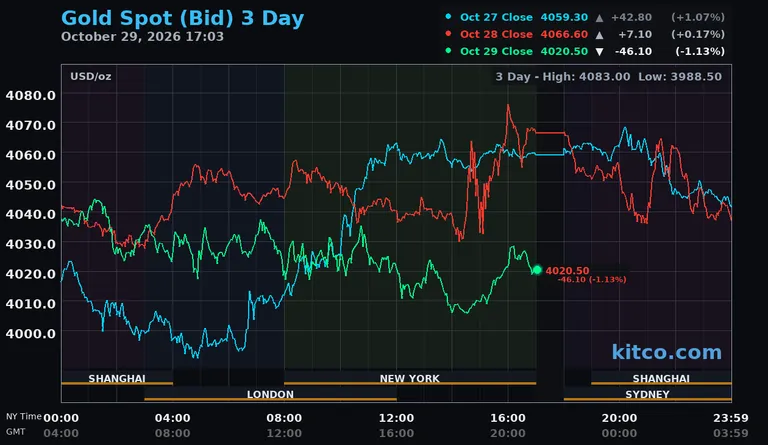
Technically, spot gold bulls' next upside price objective is to push prices back above the $4,084.00 to $4,146.00 resistance zone, with a sustained move above the upper boundary needed to reverse the prevailing bearish technical bias. Bears' next near-term downside price objective is a break below $4,024.00, with a deeper downside target at $3,986.00. First resistance is seen at $4,084.00 and then at $4,146.00. First support is seen at $4,024.00 and then at $3,986.00.
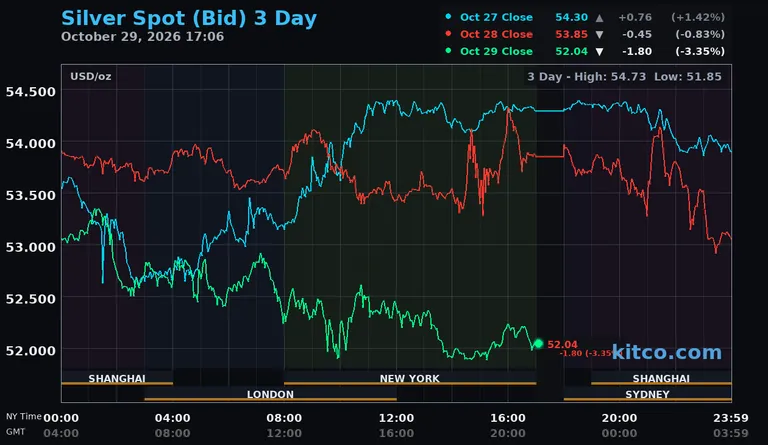
Spot silver bulls' next upside price objective is to drive prices back above the $54.680 to $56.420 resistance zone, with a sustained recovery through the upper boundary needed to improve the near-term technical picture. The next downside price objective for the bears is a break below $52.690, with a deeper downside target at $51.300. First resistance is seen at $54.680 and then at $56.420. Next support is seen at $52.690 and then at $51.300.
See live precious metals prices for gold, silver, platinum and palladium — in USD, CAD and 12 more currencies.

