

(Kitco NewsWire) – Spot gold prices were higher and spot silver prices were lower in early U.S. trading Tuesday, as investors positioned for the U.S. midterm elections amid renewed tensions involving Iran and the Strait of Hormuz. Crude oil prices rebounded after Monday's sharp decline following reports of U.S. military strikes on Iran's Qeshm Island, while persistent inflation concerns and expectations for additional Federal Reserve tightening continued to complicate the outlook for precious metals. At the time of writing, spot gold was trading near $3,965.80 an ounce, up $20.10, or 0.51%, while spot silver was trading near $50.290, down $0.241, or 0.48%, on the session.
The latest U.S. economic reports continue to highlight resilient manufacturing activity alongside persistent inflation pressure. Monday's October Institute for Supply Management manufacturing purchasing managers' index increased to 55.5 from 54.5 in September, exceeding expectations near 54.7 and marking the sector's 10th consecutive month of expansion. The production index climbed to 59.0 from 56.7, its highest reading since November 2021, while new orders edged up to 55.5 from 55.3. The employment index slipped to 52.4 from 52.7, suggesting a modest slowing in factory hiring. The prices-paid index declined to 75.2 from 77.9, indicating that manufacturing input costs continued to rise, although at a slower pace. The figures reinforced expectations that U.S. economic activity remains resilient enough to support restrictive monetary policy, even as lower crude oil prices have provided some relief from inflation concerns.
Market positioning is increasingly influenced by Tuesday's U.S. midterm elections, with investors assessing the implications of a possible change in congressional control for fiscal policy, government borrowing, regulation and the outlook for Federal Reserve interest rates. President Donald Trump's Republican Party currently controls both chambers of Congress, but pre-election polling favors Democrats to regain the House of Representatives, while control of the Senate remains uncertain. A divided Congress could limit the administration's ability to enact additional spending or tax legislation, potentially reducing upward pressure on long-term Treasury yields and the dollar. That outcome could provide some support for gold, although fiscal deficits would remain substantial. Conversely, continued Republican control of Congress could preserve greater flexibility for fiscal expansion, potentially increasing Treasury issuance expectations and long-term yields. (Gold prices rose an average of 14% in the 12 months following the last 13 midterm elections, according to the new midterm event study from Kitco Research.)
The election comes at a particularly sensitive time for financial markets following October's sharp precious metals correction and renewed volatility in artificial intelligence-related equities. Concerns about technology-sector financing requirements and elevated valuations have encouraged defensive positioning, while expectations for another Federal Reserve rate increase in December continue to limit gold's recovery. Last week's stronger-than-expected third-quarter gross domestic product report showed annualized growth of 3.4%, while September core personal consumption expenditures inflation reached 3.1% annually, reinforcing expectations that monetary policy will remain restrictive. The benchmark 10-year Treasury yield was trading near the 4.9% area Tuesday, while the dollar remained relatively firm. A divided-government outcome could restrain longer-term yields if investors anticipate slower fiscal expansion, but the more immediate direction of gold will also depend on whether incoming economic data validate the market's expectations for additional tightening.
Tuesday's economic calendar includes September job openings and factory orders, both scheduled for release at 10 a.m. EST. Economists expect approximately 7.1 million job openings, compared with 7.079 million previously, while factory orders are forecast to increase around 1.2%. Wednesday brings the ADP private-sector employment report at 8:15 a.m. EST, international trade figures at 8:30 a.m. EST and the October ISM services index at 10 a.m. EST. Thursday's schedule includes weekly initial jobless claims and third-quarter productivity figures, while Friday's October employment report at 8:30 a.m. EST will be a major test of expectations for the Fed's Dec. 8-9 meeting. The election results could influence longer-term fiscal and Treasury-market expectations, while softer labor-market readings and easing inflation pressure could reduce December rate hike bets and support gold through lower yields and a weaker dollar. Stronger employment and persistent cost pressure would reinforce the case for additional tightening.
The Strait of Hormuz and U.S.-Iran situation deteriorated overnight following U.S. military strikes on Iran's Qeshm Island, reversing some of the optimism generated by recent diplomatic efforts. U.S. officials characterized the strikes as defensive measures aimed at military capabilities that threatened American assets and commercial shipping in the strategic waterway. Iran's Revolutionary Guard also claimed to have downed a U.S. MQ-9 drone over the eastern Strait of Hormuz. The incidents followed several days of negotiations involving Iranian officials and Qatari mediators, during which proposals aimed at reopening the shipping corridor and ending the broader conflict were circulated. However, a senior Iranian official said Tuesday that Washington and Tehran remain far from an agreement, with substantial differences over sanctions, the U.S. naval blockade of Iranian ports and Iran's nuclear activities.
The latest developments have renewed concerns about possible escalation following the U.S. midterm elections, although diplomatic contacts remain active. Qatar has continued working to narrow differences between Washington and Tehran, with both sides reviewing proposals intended to establish a framework for reopening the Strait of Hormuz and preventing renewed large-scale military action. Tehran maintains that its conditions must be met before normal maritime access can be restored, while Washington has yet to accept those terms. The continuing military threats, commercial shipping disruptions and uncertainty surrounding negotiations leave Gulf energy supplies exposed to further interruptions. The absence of a confirmed agreement means the geopolitical risk premium in crude oil prices remains sensitive to military developments and the progress of mediation.
Crude oil prices rebounded Tuesday following Monday's decline of more than 7%, with Brent futures rising toward $106.13 a barrel and WTI advancing near $97.91 in European morning trading. The recovery reflected renewed concern about Gulf supply security after the Qeshm Island strikes and warnings that a negotiated settlement remains distant. For gold, heightened geopolitical uncertainty supports defensive demand, but higher crude prices also threaten to reinforce inflation and expectations for further Federal Reserve tightening. That competing influence has limited bullion's ability to sustain rallies following October's sharp losses. Silver remains more vulnerable to concerns about industrial demand and tighter financial conditions, with the latest selling pressure reflecting its greater sensitivity to economic growth and broader investment risk appetite.
Global equity markets were mixed to weaker before the U.S. open as investors assessed the midterm elections, renewed Middle East tensions and the outlook for technology-sector earnings. U.S. stock index futures pointed to a softer opening after Monday's mixed session, when the Dow Jones Industrial Average gained 0.41%, while the S&P 500 declined 0.51% and the Nasdaq Composite lost 1.07%. Asian markets were generally weaker, with South Korean technology shares under pressure, while Japanese markets were closed for a public holiday. European equities were mixed in early dealings as investors weighed higher crude prices against the possibility of reduced U.S. fiscal stimulus following the elections. Uncertainty surrounding artificial intelligence investment, government borrowing requirements and the direction of global interest rates continued to limit risk appetite.
The key outside markets see Nymex WTI crude oil prices higher and trading near $97.91 a barrel, while Brent crude was near $106.13 in European morning dealings. The yield on the benchmark 10-year U.S. Treasury note was trading near the 4.9% area. The U.S. dollar remained comparatively firm, with election-related uncertainty and expectations for restrictive Federal Reserve monetary policy continuing to influence currency and bond markets. (Kitco Global Index shows how much of today's gold move is the dollar versus the gold market itself.)
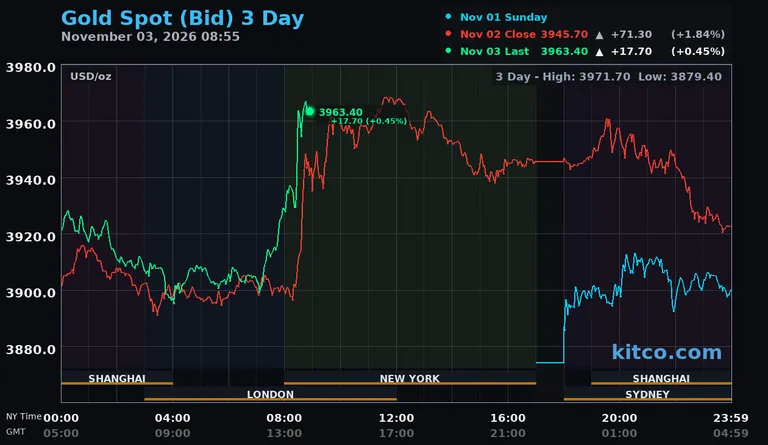
Technically, spot gold bulls' next upside price objective is to push prices back above the $3,975.00 to $4,084.00 resistance zone, with a sustained move above the upper boundary needed to improve the near-term technical outlook. Bears' next near-term downside price objective is a break below $3,871.00, with a deeper downside target at $3,797.00. First resistance is seen at $3,975.00 and then at $4,084.00. First support is seen at $3,871.00 and then at $3,797.00.
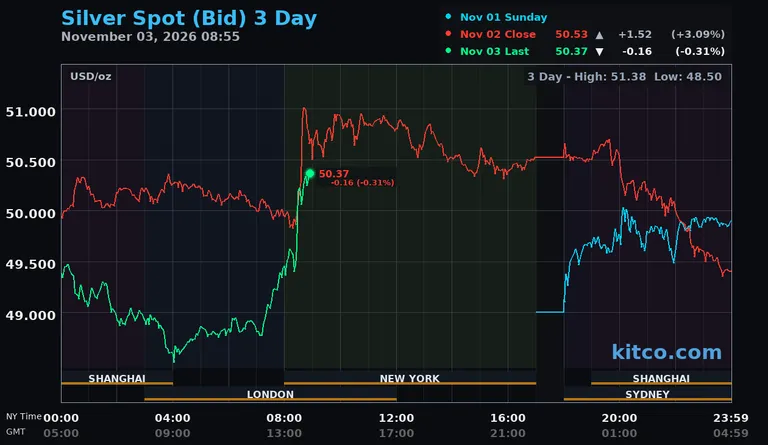
Spot silver bulls' next upside price objective is to drive prices back above the $51.270 to $53.280 resistance zone, with a sustained move through the upper boundary needed to reverse the prevailing bearish technical structure. The next downside price objective for the bears is a break below $48.850, with a deeper downside target at $47.060. First resistance is seen at $51.270 and then at $53.280. Next support is seen at $48.850 and then at $47.060.
See live precious metals prices for gold, silver, platinum and palladium — in USD, CAD and 12 more currencies.

