
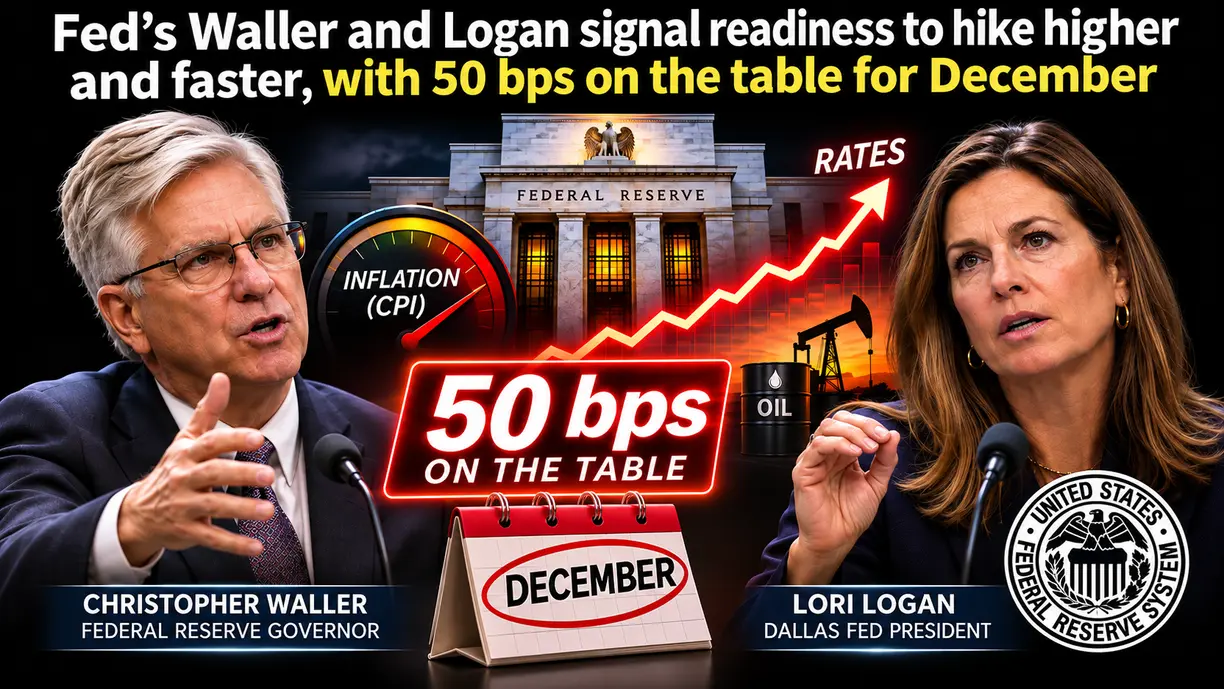
(Kitco News) – The latest remarks from governors of the Federal Reserve demonstrate a new degree of seriousness and concern about inflation, and for the first time under the Warsh regime, they included explicit forward guidance and concrete rate hike projections.
On Monday, Fed Governor Christopher Waller told the Bank of England Watchers Conference in London that he believed elevated inflation had put the central bank’s credibility at stake – and a 50-basis-point hike may be necessary to safeguard it.
“At our most recent meeting, I supported the FOMC majority in holding monetary policy at its current setting,” he said on Monday. “[M]y rationale was that the Committee's communication about the likely tightening of policy had already led financial markets to price in some tightening. When this communication is clear and credible, what really matters is that those hikes are eventually carried out—it is not necessary, for example, to raise rates at consecutive meetings.”
“If, however, the hikes are not carried out, markets will reduce expectations of rate hikes and rates will immediately fall, which would loosen monetary policy in an undesirable way,” he warned. “So, while the precise timing of the hikes doesn't matter, ensuring that the promised hikes are implemented in a reasonable period of time does.”
After reviewing the health of the overall economy and the labor market, Waller shared his concerns about inflation, sounding the alarm on high energy prices and AI capex.
“Federal Reserve staff have been thinking hard about the effects on inflation of the AI buildout and elevated energy prices, and their findings do not encourage me to think that these factors will be fading anytime soon,” he said. “In one exercise, researchers tried to capture imminent price pressures with a textual analysis of the well-known surveys of purchasing managers conducted by the Institute for Supply Management (ISM)… They found these indexes provide information about future changes in producer prices and, as a result, should have some signal about future PCE inflation. For example, the index for high-tech products rose in December 2025 and jumped further in January 2026, ahead of an escalation in those goods prices that eventually showed up in the February PPI and inflation data. The most recent ISM data, for October, point to the possibility of more price increases ahead.”
Waller also highlighted some of the Fed’s own research which seemed to indicate that energy prices are passing through to goods and services in a more sustained manner than in the past.
“The researchers find a potential shift in the inflation process after the pandemic that suggests core inflation may be more responsive to energy shocks,” he said. “Central bankers have tended to look through energy price shocks and expect that their effects on inflation will soon fade, but this new work cautions against taking too much comfort in this view. Their analysis suggests that, especially if oil prices were to remain elevated, these pressures could be larger than previously thought and persist well into 2027.”
Waller said that “economic activity is strong, the labor market is stable, but inflation is too high, well above the FOMC's 2 percent goal.”
“This means that even if, as I expect, the monthly rate of inflation improves in October, I am leaning toward supporting an increase in our policy rate of 25 basis points at the FOMC's December meeting,” he said, but warned that if October’s CPI numbers “are similar to the past two monthly readings—with core CPI inflation around 0.3 percent or even higher—then a stronger policy move may be needed.”
“In that case, I believe a 50 basis point hike in the policy rate should be considered at the December meeting,” Waller concluded. “Hiking only 25 basis points would put our credibility at risk, a risk I am not eager to take.”
CPI, both headline and core, did come in above the consensus forecasts of economists, which suggests that Waller is ready to vote in favor of a 50-basis-point rate hike in December, and to argue for others to join him.
Then on Tuesday, Dallas Fed president Lorie Logan offered her own sobering take on inflation and the Fed’s responsibility to combat it.
“When inflation trends too high while the labor market remains near maximum employment and even tightens, the FOMC is achieving only one of its two goals,” Logan told the 11th joint energy conference hosted by the Federal Reserve banks of Dallas and Kansas City. “Tighter policy will be necessary to appropriately balance the outlook and risks for inflation and employment. And it is important to achieve that balance promptly. The longer above-target inflation persists, the greater the risk that it becomes baked into behavior.”
“In my view, accommodative monetary policy is adding to inflationary pressures,” she added.
Logan noted that the FOMC decided to hold rates unchanged at the October meeting following the 25-basis-point hike in September.
“Financial markets had been volatile in the weeks before the meeting in response to news on the technology investment outlook and geopolitical developments,” she said. “In such an environment, adjusting policy more gradually can help households, businesses and market participants adapt to higher rates and reduce the risk that economic activity deteriorates more sharply than necessary. Moreover, as long as market participants understand the FOMC’s policy plans, the precise timing of each rate increase has little effect on the longer-term rates most borrowers pay.”
Logan said that skipping one meeting does not change the monetary policy destination – and she believes that multiple additional hikes will be needed to get there.
“Indeed, by making the destination clear, the FOMC can better help the economy adapt and obtain the promised benefits of a skip,” she said. “It remains clear to me, given the current outlook, that the FOMC needs to implement at least two more 25-basis-point rate increases.”
“It may be possible to move more rapidly this winter than the FOMC has moved so far this fall,” she added.
See live precious metals prices for gold, silver, platinum and palladium — in USD, CAD and 12 more currencies.
