
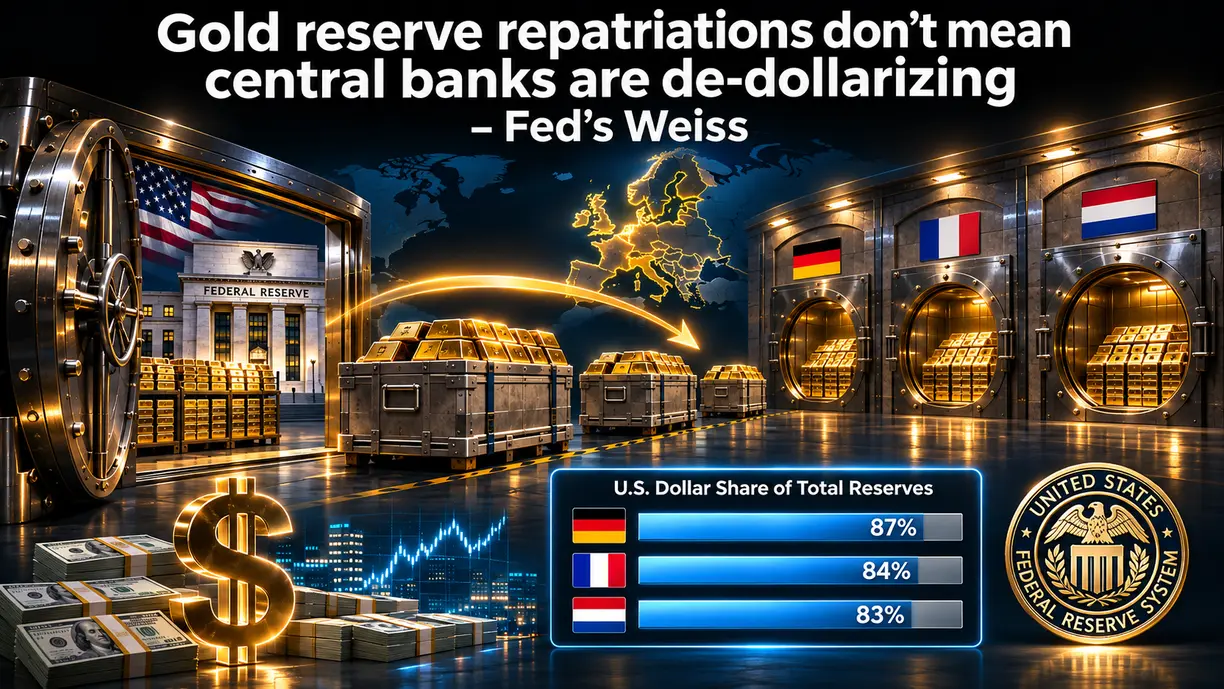
(Kitco News) – The highly publicized central bank gold reserve relocations and repatriations by the Netherlands, France, and Germany in recent years have had little impact on their U.S. dollar reserve allocations, according to Colin Weiss, Principal Economist for Global Financial Flows at the Federal Reserve.
“Generally, the choice of where to custody gold reserves may in part reflect the perceived risk of sanctions or expropriation in the jurisdiction of custody alongside other considerations like the proximity to international gold markets,” Weiss wrote in a Federal Reserve research note on Monday. “The U.S. dollar share of foreign exchange (FX) reserves may also depend on sanctions risk in addition to other factors like the size and strength of the U.S. economy and the unmatched depth and liquidity of U.S. financial markets.”
Weiss noted that while some countries have accumulated gold reserves stored outside the U.S. even as they have reduced the share of their FX reserves held in U.S. dollar assets due to sanctions risk, the central banks of the Netherlands, France, and Germany have not followed this pattern. “Instead, they continue to hold most of their FX reserves in U.S. dollar assets without substantial declines in the U.S. dollar share following the shift of their gold reserves out of the U.S.,” he said. “For these euro area central banks, the economic benefits of allocating reserves to U.S. dollar assets appear to outweigh any potential costs.”
Weiss explained why the storage location of a country's gold reserves could have implications for its U.S. dollar reserves.
“One of gold's potential appeals as a reserve asset is that it can be used to evade financial sanctions and asset seizures imposed by foreign governments, in contrast to foreign currency assets,” he wrote. “For these facts to be true, however, the gold cannot be custodied in the country of the sanctioning government. In practice, this has meant that central banks concerned about sanctions custody their gold reserves in domestic vaults.”
Weiss offers two well-known examples of this practice. “First, Russia holds its gold reserves domestically, having stockpiled gold and reduced its dollar holdings during the 2010s amid concerns about U.S. financial sanctions,” he said. “Second, Turkey repatriated gold held in the U.S. and U.K. in 2018 and also dramatically cut the dollar share of its reserves, actions taken during a period of geopolitical tensions with the U.S. that included President Erdoğan's criticism of the dollar's international role.”
But the three euro-area nations did not follow suit. “Germany, the Netherlands and France, unlike Russia and Turkey, maintained U.S. dollar reserve allocations even after relocating gold reserves out of U.S.,” Weiss noted. “Germany shifted about one-fifth of its U.S.-held gold to domestic vaults between 2013 and 2017. (Bundesbank, 2017). Its dollar share of foreign exchange reserves remained around 90 percent during this period and currently exceeds 80 percent—well above the U.S. dollar's overall share in global FX reserves based on the IMF's COFER data.”
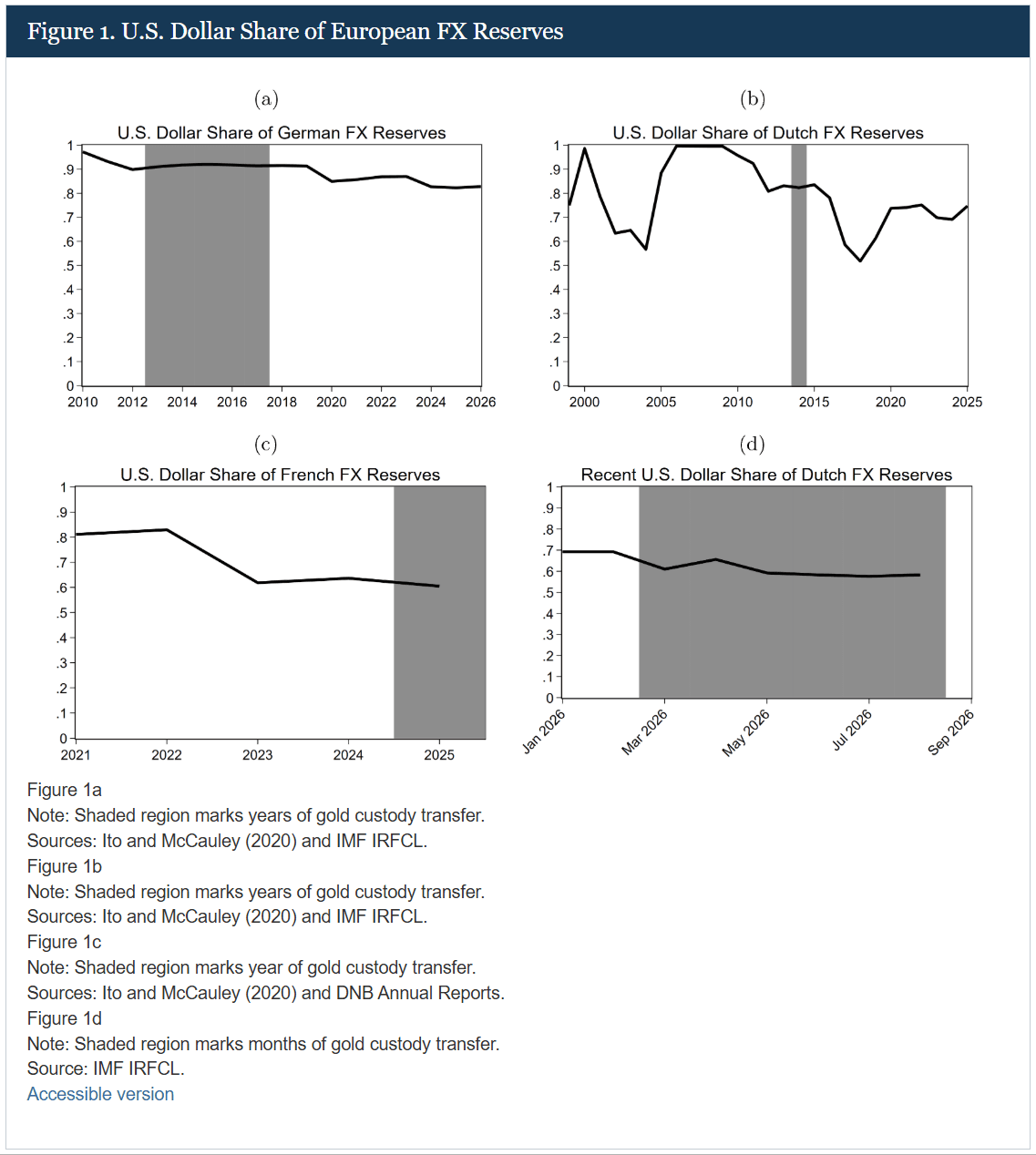
“Similarly, the Netherlands repatriated about two-fifths of its U.S.-custodied gold reserves in 2014, with little change to the 83 percent U.S. dollar share of its FX reserves,” he wrote. “While the dollar share did dip to nearly 50 percent in 2018, this large decline proved short-lived.”
Then in the 2020s, two more euro-area central banks repatriated their overseas gold reserves. “France repatriated all its U.S.-held gold reserves in 2025 and early 2026 (Banque de France, 2026), yet its U.S. dollar share of FX reserves remained steady at 60 percent (Figure 1(c)), even as the overall U.S. dollar share of global FX reserves in the IMF COFER data declined,” Weiss pointed out. “The Netherlands moved two-fifths of its U.S.-stored gold to London in 2026 (De Nederlansche Bank, 2026). While the U.S. dollar share of its FX reserves did undergo a concurrent 10-percentage-point decline (Figure 1(d)), this share remains above 2018 lows and still dominates Dutch FX reserves.”
“In all cases, these central banks continue holding most reserves in U.S. dollar assets, indicating no substantial diversification away from the U.S. dollar,” he concluded.
On September 3, Weiss published a research note showing that even though central banks have been ramping up their bullion purchases, gold’s price appreciation has been driven largely by private demand, while most official gold reserves are still held by countries that haven’t purchased any in over 50 years.
“In 2025, world international reserves held in gold surpassed foreign official holdings of U.S. Treasury securities, a fact drawing attention from media and policymakers,” Weiss wrote at the time. “Should this be interpreted as gold overtaking U.S. Treasury securities in its appeal as a reserve asset?”
Weiss said this is not the case, offering several reasons why “a comparison of world gold reserves and aggregate foreign official holdings of U.S. Treasury securities is problematic.”
“First, the rise in the market value of gold reserves since 2024 was primarily driven by a surge in gold prices from a jump in private sector demand,” he argues. “Second, the rise in the share of gold in global reserves is mostly accounted for by a handful of countries with large legacy holdings from the Bretton Woods era that have not accumulated gold in any meaningful amount since the 1970s—including the U.S., which cannot hold Treasury securities as international reserves.”
Weiss wrote that the dramatic increase in the market value of countries’ gold reserves since 2024 was fueled primarily by a sharp rise in private sector demand, which had the effect of boosting gold prices.
“This surge in gold prices does not reflect a concurrent spike in central bank purchases,” he said. “While central bank purchases of gold likely increased substantially in 2022, these banks have only maintained that elevated pace since then. Rather, demand from private sector investors jumped in late 2024, manifesting in inflows to physical gold-backed exchange traded funds.”
“Thus, while the spectacular rise in gold prices witnessed in 2025 likely required strong demand from both private and official investors, the demand from official investors in isolation would not have been sufficient to cause a surge in prices.”
Weiss characterized the overwhelming majority of the world’s central bank gold reserves not as a deliberate and strategic decision to diversify away from the U.S. dollar, but as an accidental relic of the Bretton Woods era.
“Despite accumulation by many emerging market central banks beginning in 2008, most world gold reserves were still acquired prior to 1971, which was the de facto end of the Bretton Woods system,” he notes. “By contrast, most foreign official holdings of Treasuries were accumulated after 2000. Moreover, the set of countries holding large gold reserves is often distinct from the set of countries holding large foreign exchange reserves.”
Weiss pointed out that the countries in 2026 who are “actively choosing between holding reserves in gold or U.S. Treasury securities” still account for a small share of world gold reserves.
“The five largest holders of gold reserves—the U.S., Germany, Italy, France, and the IMF—account for about 52 percent of current world gold reserves but have not accumulated gold in any meaningful amount since the 1970s,” he writes. “Moreover, the U.S., Germany, France, and Italy have not accumulated substantial foreign exchange reserves either, so gold now, at its current market price, accounts for more than 80 percent of international reserves in each country.”
“[D]espite several major holders of foreign exchange reserves selling hundreds of billions of dollars of reserves to support their currencies after 2021, foreign official investors have purchased nearly $200 billion of U.S. Treasury securities on net from 2022 through April 2026,” he concluded. “Treasury securities thus remain an important part of reserve portfolios.”
See live precious metals prices for gold, silver, platinum and palladium — in USD, CAD and 12 more currencies.
