
(Kitco News) – Asia’s growing importance within the gold ecosystem is drawing increased interest from global financial institutions, but new research shows that a significant number of central banks are now assessing the region for safe storage of their gold reserves.
These were the findings of a new white paper from DBS, a Singapore-based financial services group with a presence in 19 Asian markets. Gold in an Age of Transformation examines the precious metal’s “evolving role in the global financial system, the rise of Asian gold hubs and the development of tokenised gold.” The research incorporates findings from an independent survey of central banks, asset managers and banks commissioned by DBS and conducted by Kantar in September 2026.
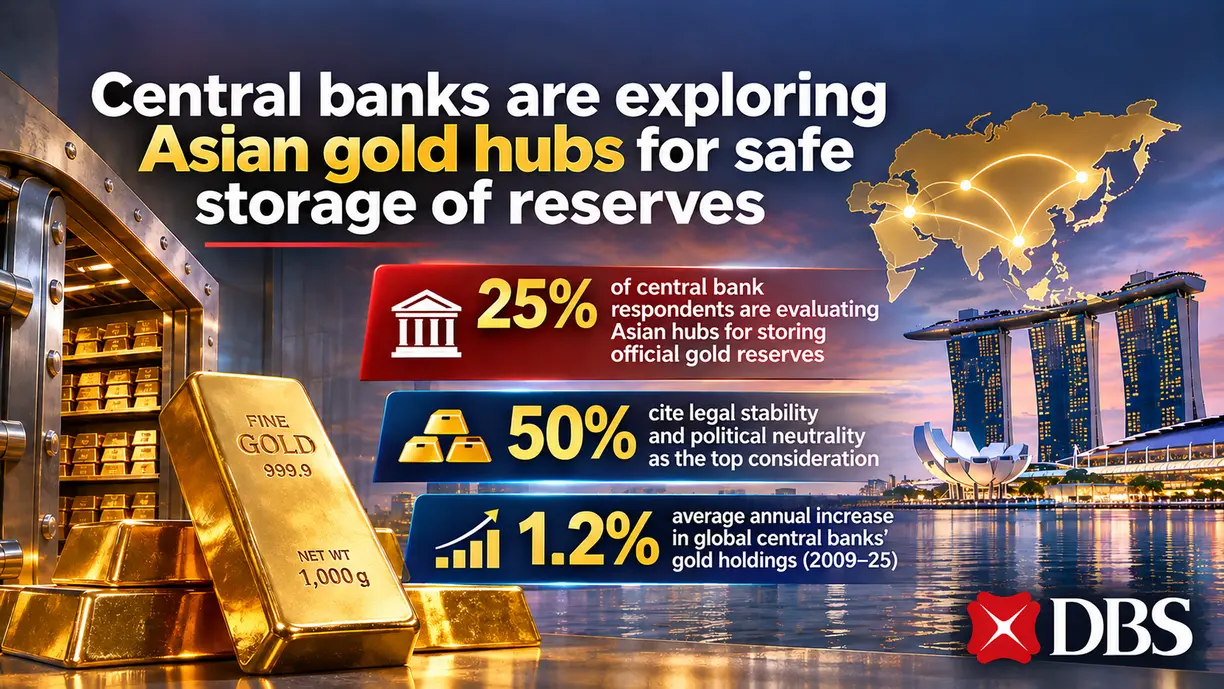
“About half of surveyed asset managers and banks said state-backed gold infrastructure had increased their institutions’ interest in Asian hubs, while 25% of central bank respondents were evaluating the region for storing official gold reserves,” DBS announced when the research was published on Nov. 10.
“One in four central bank respondents were actively evaluating Asian hubs as potential storage locations for official gold reserves, underscoring the importance of market liquidity, regulatory clarity and trusted infrastructure in translating interest into adoption,” they said. “Approximately 50% identified legal stability and political neutrality as the most important consideration when selecting a new gold storage location.”
“Asia has long been the leading global demand source of physical gold, yet much of the gold trading infrastructure is concentrated in Western financial centres,” said Taimur Baig, Chief Economist at DBS Bank. “As Asia’s role in the gold market grows and new investment channels emerge, the development of trusted market infrastructure will be critical.”
The research noted that central bank allocations “have emerged as a dominant structural anchor of the global gold market, driven by official sector efforts to optimize foreign exchange reserve composition in an increasingly fragmented geopolitical environment.”
“While central bank gold holdings historically stemmed from the Gold Standard era, the rationale for holding gold today is increasingly forward-looking,” the paper stated. “It is now increasingly viewed as a strategic reserve asset rather than a legacy holding.”
The research cited World Gold Council data showing global central banks’ gold holdings steadily growing by an average of 1.2% over 2009-25 against a backdrop of rising geopolitical tensions, increased sanctions risks and concerns over reserve concentration. “Central bank demand has therefore become an increasingly durable source of structural support for the gold market,” they said.
Meanwhile, financial institutions were focused on the possibilities that various gold-based digital and other investment products could unlock in the region. “Alongside physical gold formats, respondents ranked exchange-traded funds (27%), derivatives (27%) and tokenised gold (18%) as the investment channels with the strongest expected growth over the next 12 months,” the report said.
Financial institutions ranked market liquidity, regulatory clarity, clearing and custody infrastructure, and cost efficiency ahead of time zone alignment and geographical proximity in their priorities.
Asia accounted for more than half of physical bar and coin investment and jewelry demand in 2025, even as global gold demand surpassed 5,000 tonnes to reach a record $555 billion in value last year. “Consequently, stronger regional infrastructure could deepen liquidity during Asian trading hours, facilitate local clearing and settlement, and support greater trading in gold bar formats,” the DBS report said.
See live precious metals prices for gold, silver, platinum and palladium — in USD, CAD and 12 more currencies.
