

(Kitco NewsWire) - Spot gold prices were modestly higher and spot silver prices were sharply lower in late U.S. trading Friday, as persistent inflation concerns, elevated Treasury yields and expectations for additional Federal Reserve tightening continued to weigh on precious metals. Gold stabilized after Thursday's steep losses, supported by bargain hunting, while silver remained under pressure amid concerns about industrial demand and restrictive financial conditions. Spot gold was trading near $3,883.40 an ounce, up $7.00, or 0.18%, while spot silver was trading near $48.630 an ounce, down $1.320, or 2.63%, on the session.
The U.S. Labor Department reported Friday that the producer price index increased 0.3% in October, below expectations for a 0.4% gain, while annual producer inflation accelerated to 6.5%, its highest level since November 2022. Goods prices increased 0.5% and services prices rose 0.2%, while the index excluding food, energy and trade services advanced 0.5%, indicating continued underlying cost pressure. The report followed Tuesday's stronger-than-expected consumer inflation figures and last week's October employment report, which showed 165,000 additional jobs and unemployment declining to 4.1%. The combination of resilient employment and persistent inflation continues to support expectations for restrictive monetary policy despite evidence of moderation in some monthly price measures.
Market positioning remains focused on the Federal Reserve's Dec. 8-9 meeting, with the latest independently verified prerelease futures assessment indicating an 89% probability of a 25-basis-point increase and an 11% probability of a 50-basis-point move. The benchmark 10-year Treasury yield rose toward 5.15% Friday, increasing the opportunity cost of holding non-yielding bullion, while the dollar remained comparatively firm. The softer headline PPI reading provided some relief, but persistent underlying producer inflation limited expectations for a substantial change in Fed policy. Next week's principal economic events include Tuesday's October retail sales report and Wednesday's release of the Fed's October meeting minutes. Stronger consumption or hawkish policy commentary could reinforce tightening expectations, while weaker demand could provide some support for gold through lower yields.
The Strait of Hormuz and U.S.-Iran situation remained a significant source of uncertainty Friday as Washington continued its naval blockade of Iran while signaling that renewed large-scale military action was not its immediate priority. President Donald Trump indicated Thursday that a diplomatic agreement with Tehran was no longer necessary, reducing expectations for an imminent negotiated settlement. Meanwhile, attacks attributed to Iranian-aligned Houthi forces against Saudi energy infrastructure and continuing threats to commercial tankers underscored the fragility of regional petroleum supplies. The absence of a settlement leaves shipping restrictions and security risks unresolved. For gold, continued geopolitical uncertainty supports defensive demand, but the inflationary implications of higher energy prices also reinforce expectations for restrictive Fed policy.
Crude oil futures finished mixed Friday as supply concerns surrounding the Persian Gulf competed with expectations for improving global petroleum availability. Brent crude settled nearly unchanged at $95.84 a barrel, while Nymex WTI declined approximately 0.2% to $88.56. Both benchmarks recorded their second consecutive weekly loss. The International Energy Agency's expectation of a fourth-quarter global supply surplus and an unexpected increase in U.S. crude inventories helped offset some of the geopolitical risk premium associated with the Strait of Hormuz. Lower oil prices could eventually ease inflation pressure, although Friday's producer price report showed that underlying cost increases remain persistent.
North American equity markets finished mixed Friday as weakness in semiconductor and artificial intelligence-related shares weighed on major benchmarks despite the softer-than-expected headline PPI reading. The Dow Jones Industrial Average gained approximately 0.1% to close at 52,347.55, while the S&P 500 declined 0.4% to 7,561.67. The Nasdaq Composite lost 0.9% to finish at 25,136.27, and the Russell 2000 declined 0.3% to 2,790.49. Nvidia remained under pressure following the resignation of chief executive Jensen Huang, while concerns about technology valuations and financing costs continued to restrain investor sentiment. Despite Friday's losses, all four benchmarks finished the week higher.
Canada's S&P/TSX Composite Index finished modestly lower Friday, declining 31.29 points, or 0.09%, to close at 36,105.90. Weakness in technology and base metals shares was partly offset by defensive sectors, including utilities and telecommunications. The limited decline contrasted with heavier selling in U.S. technology shares, reflecting the Canadian market's greater weighting toward financial institutions and traditional resource industries. The benchmark nevertheless remained sensitive to fluctuations in precious metals prices, crude oil and expectations for U.S. monetary policy.
European equity markets finished mixed to lower Friday, retreating from record levels reached Thursday as uncertainty surrounding artificial intelligence investment and elevated borrowing costs weighed on sentiment. Germany's DAX and France's CAC 40 came under pressure, while the U.K.'s FTSE 100 showed comparatively limited movement. The pan-European Stoxx 600 remained on course for a positive weekly performance after four consecutive sessions of gains. Investors balanced the prospect of continued restrictive U.S. monetary policy against relatively resilient European corporate earnings and the recent decline in global energy prices. Exact final closing-auction values for the major European benchmarks could not be independently reconciled.
The key outside markets see Nymex WTI crude oil futures settling at $88.56 a barrel and Brent crude at $95.84. The benchmark 10-year U.S. Treasury yield climbed toward 5.15%, while the U.S. dollar remained firm. (Kitco Global Index shows how much of today's gold move is the dollar versus the gold market itself.)
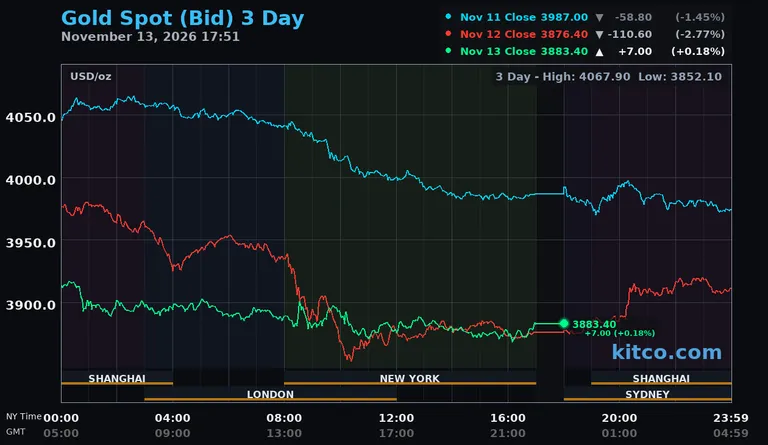
Technically, spot gold bulls' next upside price objective is to push prices back above the $3,903.00 to $3,934.00 resistance zone, with a sustained recovery targeting the published $3,970.14 resistance reference. Bears' next near-term downside price objective is a break below $3,852.00, with deeper downside targets at $3,823.00 and then $3,821.99. First resistance is seen at $3,903.00 and then at $3,911.36. First support is seen at $3,852.00 and then at $3,823.00.
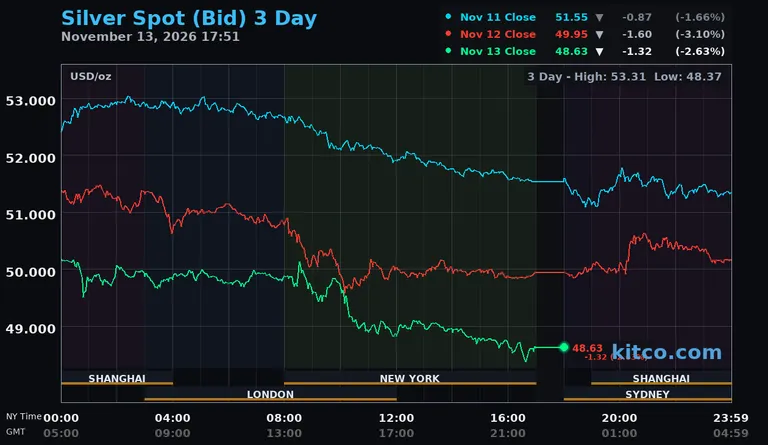
Spot silver bulls' next upside price objective is to drive prices back above the $49.670 to $50.720 resistance zone, with a sustained recovery targeting $51.480 and then $51.950. The next downside price objective for the bears is a break below $49.230, with a deeper downside target at $48.650. First resistance is seen at $49.670 and then at $50.592. Next support is seen at $49.230 and then at $48.650.
See live precious metals prices for gold, silver, platinum and palladium — in USD, CAD and 12 more currencies.

