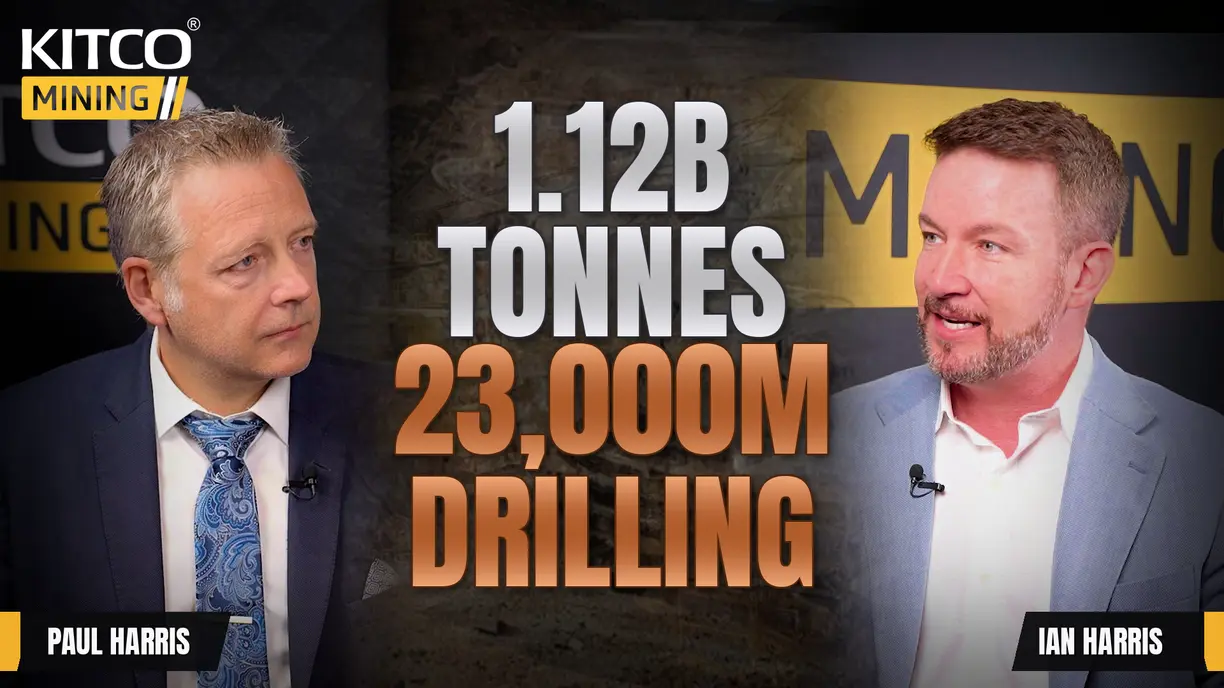
(Kitco News) Copper Giant Resources is weighing a phased build at its Mocoa copper-molybdenum project in Colombia. Its first preliminary economic assessment, due in the fourth quarter of 2026, will test whether the project can start large and expand without one massive upfront check.
Copper Giant is drilling to raise confidence in the resource ahead of a prefeasibility study. “We want to move as quickly as possible,” President and CEO Ian Harris told Kitco Mining on Sept. 24 at the 2026 Precious Metals Summit in Beaver Creek, aiming to convert more of the inferred resource into the higher-confidence measured and indicated categories. With four rigs now turning, he expected to finish 2026 a little past 23,000 meters.
The resource has since been updated. On Oct. 14, Copper Giant reported Mocoa’s first indicated resource of 290 million tonnes at 0.54% copper equivalent, containing 2.13 billion pounds of copper, alongside 1.60 billion tonnes of inferred resources at 0.40% copper equivalent. Contained copper is up about 50% from the November 2025 estimate. The tonnage gain reflects a larger conceptual pit, a lower reporting cut-off within it, and new material reported below the pit. At the 2025 cut-off, 260 million tonnes at 0.58% copper equivalent are now indicated, while the remaining inferred grade is 0.45% copper equivalent, compared with 0.51% in 2025. The 2026 figures are reported on a diluted basis, unlike the 2025 estimate. Roughly 10,000 meters drilled after the data cut-off are not yet included.
The PEA is built on that estimate, and Harris said Mocoa starts with advantages many large copper projects lack. “The power lines are there, the road is there, the ports are there,” he said. “Nobody lives in the project area, but the town of Mocoa is 10 kilometers away, and we’re at about 1,300 meters, not some high elevation type situation.”
That lets the company think about growth in stages, adding identical processing lines rather than building everything at once. “30,000 tons per day is not a small project, but it’s still easier to go 30, 60, 120, and 180,000 tons per day than these really big projects,” Harris said. The alternative, he said, is a developer facing the prospect of “day one, I got to cut a $7 billion check.”
Phasing has a cost. “The disadvantage of it is obviously because they’re discounted cash flows, your NPV number normally is a little bit lower,” Harris said. “But I think the attraction is the market can say, ‘Wow, these guys could do it themselves if they had to.”
Harris expects the base case to be an open pit. He said about 20% of the material is higher grade, at roughly 0.94% copper equivalent, and that the deposit continues at depth. The Oct. 14 estimate includes Mocoa’s first resource below the pit, 120 million tonnes of inferred material in potentially mineable underground shapes. Where to put the waste is one of the first design questions. “If you’re going to be mining a billion tons, you got to find a place to actually put all that material,” he said.
Molybdenum adds a second product. Harris said about 90% of the world’s molybdenum comes from copper-molybdenum porphyries, but recovery can be difficult because the particles are usually fine. At Mocoa, he said, “our initial metallurgy is looking good because it’s free grain,” and the flow sheet would produce a separate molybdenum concentrate. “So it would definitely be its own product.”
Timing in Colombia also matters to Harris. The company advanced its baseline studies and metallurgical testwork so it could move toward an environmental license, which can follow a prefeasibility study, early in the term of the new president, who took office in August. “Presidents don’t want to help support a mining project in their last year. They’re going to support it in the beginning of their term,” Harris said. He said licensing normally takes about a year if a project avoids roadblocks. “You can get a license approved in a year in Colombia. It’s been done.”
He also sees untapped potential across the country, calling Colombia “one of the last places on the planet” where large, near-surface copper deposits may still be found. Copper Giant holds more than 128,000 hectares across the Jurassic porphyry belt.
In August, Copper Giant announced a C$31 million placement led by Denarius Metals, which is set to hold about 15.6% of the company. Alongside it, commodity trader Trafigura agreed to buy 20% of Mocoa’s future copper and molybdenum concentrate for 10 years from the start of commercial production. “I think the clear demonstration was Trafigura coming into our project before we even put out a PEA,” Harris said.
Past a billion tonnes, more drilling mostly adds mine life, so the value now comes from reducing risk, according to Harris. “You can’t design a project bigger than that. You’re just going to start adding years,” he said, adding, “so our big catalyst is that first PEA.”
Watch the full video on the Kitco Mining YouTube channel.
This article/video was produced with support from a Kitco sponsor. The views expressed in this content do not necessarily reflect the views of Kitco Metals Inc. Kitco does not endorse or recommend any company, security, investment product, or investment strategy. This content is for informational purposes only and should not be considered investment advice.
Learn more about Copper Giant here

Kitco Spotlight Editorial
Kitco Spotlight Editorial is sponsored content, articles and announcements paid for by our advertisers that support our journalism. Our sponsored messages are targeted and hand-curated, highlighting the best of what's happening in the mining sector.
