
(Kitco News) - The ongoing adjustment in market expectations of the timing of Fed rate cuts could push back any further rally in gold prices, while a potential recession will drive silver prices to their cyclical bottom, according to the latest precious metals report from analysts at Heraeus.
“Traders are no longer expecting the first cut to baseline US interest rates to come in March, and see just a 2.5% chance of rate cuts beginning at this week’s meeting of the Fed,” the analysts wrote. “Just a few weeks ago, markets saw a 90% chance of cuts beginning in March but this is now below 50%.”
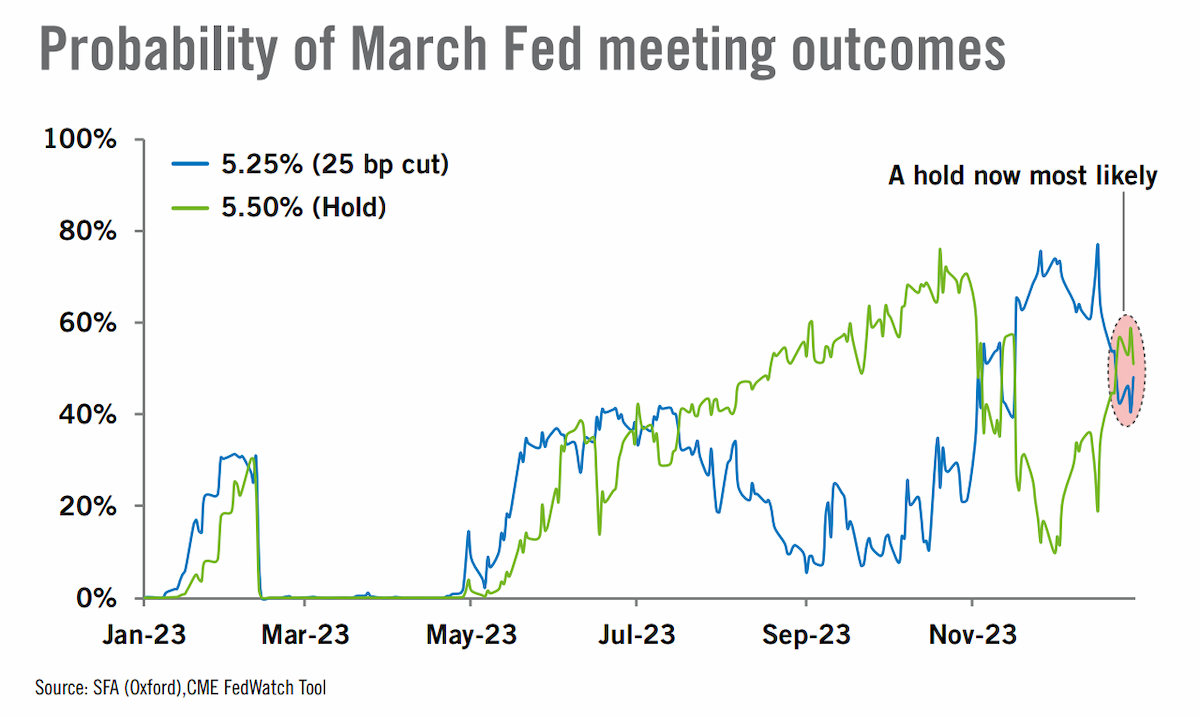
The analysts said that the pushing back of rate cut expectations suggests “the consensus is that the US economy is stronger than thought at the start of the year,” but they warn that investors need to be cautious.
“Sections of the US yield curve are now close to uninversion (typically a signal of recession within months) and the Sahm Rule recession indicator (based on unemployment rates) is now at a level consistent with recession onset going back to the mid-1970s,” they said. “When the Fed does decide to cut interest rates, the dollar will likely weaken, which is usually positive for the gold price. Gold has been consolidating above $2,000/oz, which, when interest rates are cut, could form a solid base from which the price could move higher.”
Spot gold has had a volatile start to the week, spiking around $10 to $2,037.31 per ounce just before 9 am EST before falling sharply to $2,022.26 less than an hour later. It last traded at $2,023.04, up 0.22% on the 24-hour chart.
Turning to silver, Heraeus noted that mega-miners KGHM and Fresnillo met their production targets last year, and the trend is expected to continue in 2024.
“Fresnillo achieved 56.3 moz of attributable silver production, a 4.7% increase versus 2022. The increase was largely due to the completion of the ramp-up at Juanicipio mine which is the largest silver project to come online since 2016,” they said. “KGHM exceeded guidance by 7.9%, having produced 45.9 moz of silver, a company record.”
They pointed to the unexpected shutdown of Newmont’s Peñasquito mine as the main driver of last year’s fall in the overall silver supply. “Primary supply in 2024 is likely to recover, with a number of notable projects expected to come on stream, including Bosnia’s Vareš mine that entered production last week and which could produce around 2.5 moz of silver this year,” they said.
Heraeus sees silver prices continuing to play catch-up with gold. “The level of silver’s underperformance relative to gold is similar to that during the first Covid lockdowns and the invasion of Ukraine, though this time the rise in the [gold:silver ratio] was driven by a falling silver price rather than a rising gold price,” the analysts wrote, adding that the strength of silver’s position as both an industrial commodity and as a safe haven is likely to fluctuate this year.
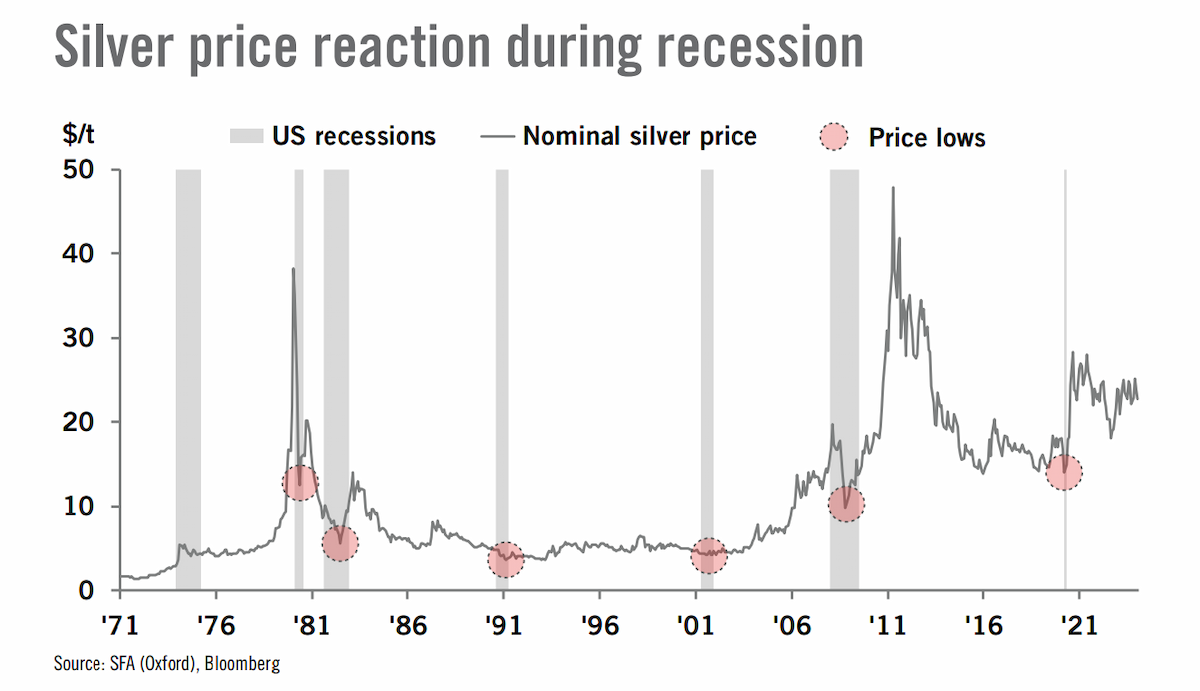
“The silver price tends to reach its lowest point in the midst of a recession,” they said. “Silver did rebound later in the week as some traders stepped in to buy the dip. ETF inflows reversed trends, with 15.9 moz of inflows on Wednesday alone, offsetting all outflows since November 2023.”
Silver followed gold lower on Monday morning, with the spot price sliding from $23.046 per ounce just after 9 am EST to session lows of $22.771 around 40 minutes later. Spot silver last traded at $22.832, up 0.14% at the time of writing.
