
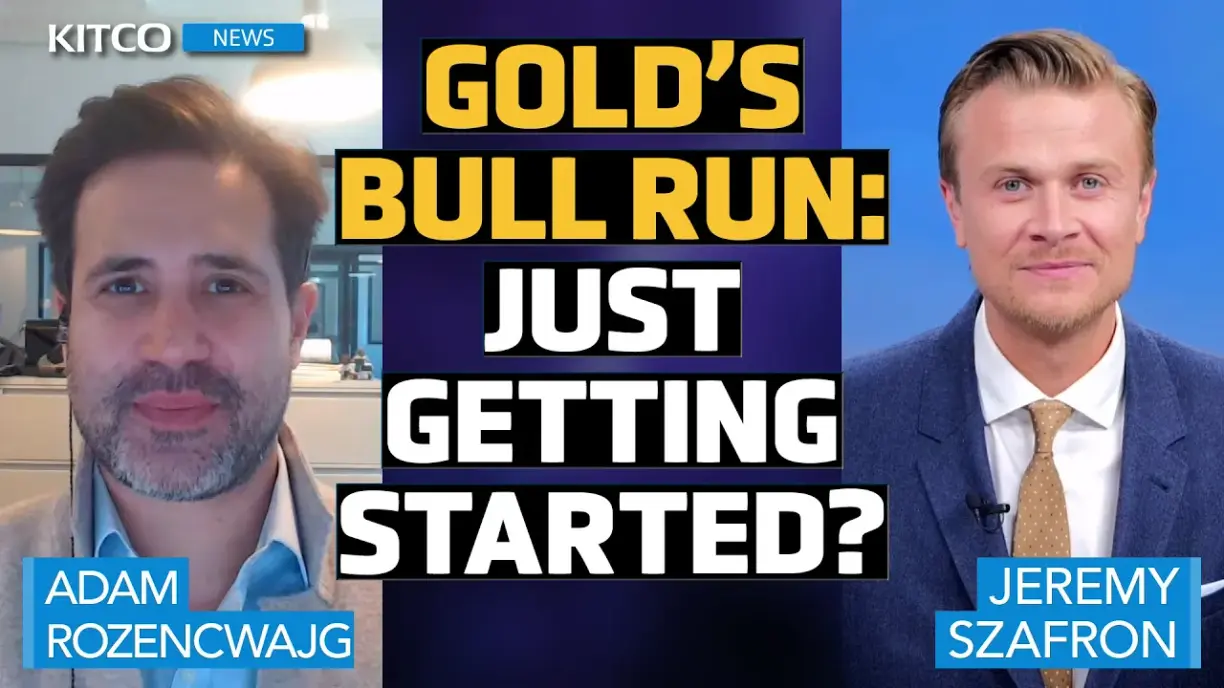
(Kitco News) - Gold prices could reach $5,000 to $7,000 per ounce, marking the beginning of a prolonged and substantial bull market. According to Adam Rozencwajg, managing partner at Goehring & Rozencwajg, this dramatic forecast hinges on unprecedented central bank accumulation and significant shifts in global monetary systems.
Rozencwajg believes we are only in the early stages of this rally. "I think we are in the early innings here of a very prolonged and substantial gold bull market. Ultimately, I think that prices could get really out of control. How high could they ultimately get? You could make a case for five, six, $7,000 gold," he explained. He suggests that this could happen within the next decade if current trends continue. This bullish sentiment is underpinned by unprecedented central bank buying. "We've seen central banks buy well over 1,000 tons of gold. That's the fastest pace of accumulation we have seen since we've gone off the gold standard in 1971," Rozencwajg added in a recent interview with Jeremy Szafron, Anchor at Kitco News.
Central Bank Buying and De-Dollarization
Recent data from the World Gold Council shows that central banks purchased a record 1,136 tons of gold in 2023, surpassing the previous high of 668 tons in 1971. This surge is part of a broader trend of central banks diversifying away from the US dollar. Rozencwajg noted, "There's a big push by several countries, notably the BRICS, to begin to move away from the US dollar and use a different currency. So right now, the currency where most of these trades are happening is the renminbi."
The BRICS nations—Brazil, Russia, India, China, and South Africa—recently expanded their bloc to include six more countries, making it BRICS Plus. This official expansion includes Argentina, Egypt, Ethiopia, Iran, Saudi Arabia, and the United Arab Emirates. These countries have been actively seeking alternatives to the US dollar for international trade. For instance, China's Belt and Road Initiative often involves transactions in renminbi, reducing reliance on the dollar. This shift could bolster the demand for gold as these nations look for stable reserves.
The Role of Silver and Uranium in the Bull Market
While Rozencwajg remains optimistic about gold, he also touched on the potential for silver and uranium. Despite rumors of potential short squeezes in the silver market, Rozencwajg remains skeptical. "Potential short squeezes in the silver market have been a thing of rumor for many, many years. There's been a lot of different views on that, trading desks like at JP Morgan and what have you. I have never subscribed to those views. We're gold bulls today and positive on silver, although I would prefer gold if I had given the choice."
Historical data shows that silver prices have experienced significant volatility, with notable spikes driven by market speculation. For instance, the Hunt Brothers' attempt to corner the silver market in the late 1970s pushed prices from $6 per ounce to nearly $50 before crashing back down. More recently, the Reddit-fueled silver squeeze in early 2021 briefly pushed prices above $30.
On the other hand, uranium presents a compelling case for future investment. Rozencwajg highlighted a structural and primary uranium shortfall for the first time since the Manhattan Project. "For the first time since the Manhattan Project, for the first time since the atom was split, we now have a structural and primary uranium shortfall. It will only be closed by bringing on new mine supply because a nuclear reactor can withstand two, three, $400 uranium prices and not impair the economics," he said.
The Future of Precious Metals
The potential for gold to reach unprecedented highs is also supported by historical trends. Rozencwajg pointed out, "There have been several times over the last 120 years where every dollar of US currency has been backed by $1.40 worth of gold. If you did that math today based on how much money is outstanding, the numbers are huge."
Historical instances such as the gold standard abandonment in 1971 and the subsequent inflationary period saw gold prices soar from $35 per ounce to over $800 by 1980. Similar dynamics could unfold in the current economic environment, driven by factors like inflation, geopolitical instability, and de-dollarization efforts.
He also discussed the possibility of a new monetary regime centered around gold. "When you get these periods where commodity prices or real assets in general become super dislocated, what you often get, believe it or not, is a change in the global monetary system," Rozencwajg explained.
As central banks continue to accumulate gold and the push for de-dollarization gains momentum, the gold market is likely to see significant volatility and growth. Rozencwajg concluded, "Until there's evidence to the contrary, I think we continue down that path."
For a deeper dive into Adam Rozencwajg's insights on the future of gold, silver, and uranium markets, be sure to watch the full Kitco News interview above.