
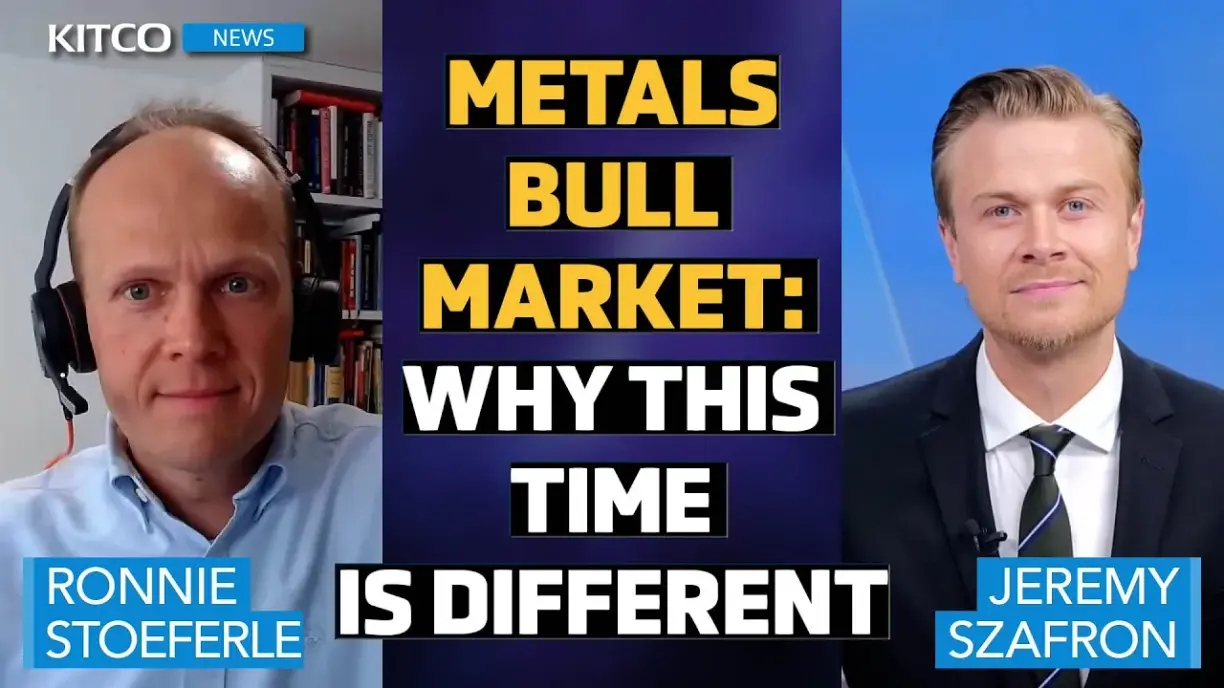
(Kitco News) - The precious metals market is heating up, with gold up over 14% on the year, and silver prices up over 26%. As of June 5, 2024, gold trades at $2,346 per ounce, while silver is priced at $29.63 per ounce. This surge is driven by increasing demand from emerging markets and strategic moves by central banks, signaling a new phase in the gold bull market.
Ronnie Stoeferle, Managing Partner at Incrementum AG, believes we're witnessing classic early bull market behavior.
"We're now in a new stage of this gold bull market,” he said in a recent interview with Kitco News AnchorJeremy Szafron. “What we're seeing in markets is classic early bull market action. Miners are leading the price of gold. Silver is outperforming gold.”
The gold-silver ratio, which measures the amount of silver needed to buy one ounce of gold, has declined to around 79, showing silver's strong performance relative to gold.
Gold Mining Stocks on the Rise
Gold mining stocks, particularly those tracked by the VanEck Vectors Gold Miners ETF (GDX), are seeing notable gains. Over the past three months, GDX has increased by about 13%, reflecting growing investor confidence. "Miners are leading the price of gold. They're outperforming gold," Stoeferle emphasized. This growth in GDX underscores the health of the mining sector with rising gold prices, even as operating costs are still inflated.
The GDX's performance is significant because it represents a broad range of gold mining companies, which often act as a leveraged play on the price of gold. When gold prices rise, mining stocks tend to rise even more as their profit margins increase. This is due to the relatively fixed costs of mining operations, meaning that higher gold prices directly translate into higher profits.
Emerging Markets Fueling Demand
One of the main drivers of this bull market is the soaring demand from emerging markets. "The emerging markets are buying gold like crazy,” Stoeferle noted. “China and India alone are responsible for more than 50% of all gold demand. If you include the Arabic countries, Turkey, Russia, you end up with two-thirds up to almost 70% of all gold demand.” This shift shows that traditional Western markets are no longer the primary drivers of gold demand.
Turkey’s interest in joining BRICS+ (Brazil, Russia, India, China, South Africa, and additional partner countries) further highlights this shift. As Turkey aligns more with BRICS+, it aims to strengthen its economic ties and increase its gold reserves, reducing reliance on the U.S. dollar.
Central banks' significant gold purchases, especially since the Ukraine invasion, have also played a critical role. "Central banks have put in a floor under the gold price since the invasion of Ukraine... Central bank demand has tripled," Stoeferle added. This has provided strong support for gold prices, ensuring stability despite economic uncertainties.
Stoeferle is optimistic about the future of gold, projecting a long-term price target of $4,800 by 2030.
"We put out that model in the In Gold We Trust report 2020 and said $4,800 U.S. dollars, that's our long-term price target for the end of this decade,” he said. “$4,800 bucks sounds spectacular, but it's like 10-12% CAGR for the next couple of years until 2030. That sounds pretty realistic.”
For more of Ronnie Stoeferle's precious metals analysis, watch the full interview on Kitco News above.