

(Kitco News) – The launch of spot Bitcoin (BTC) exchange-traded funds (ETFs) has catapulted the digital asset class into the investing limelight as data shows that institutional investors have jumped into the market with both feet now that there is an easy, regulatory-complaint way to allocate to BTC.
According to investment firm River, 52% of the top U.S. hedge funds have disclosed exposure to newly launched Bitcoin ETFs, helping King Crypto to outperform the major stocks and indices.
“Of the largest 25 hedge funds in the US, over half now have exposure to Bitcoin, with a staggering $2 billion held by Millennium Management,” analysts at River said. “Additionally, 11 of the largest 25 Registered Investment Advisors (RIAs) now have an allocation, as well as hundreds of smaller ones.”
The ETFs have also changed the trading landscape of the crypto market in the U.S., according to Kaiko Research, which released a research report showing that “trade volumes rose on crypto exchanges included in Bitcoin benchmark reference rates. In particular, volumes increased around the US market close following the approval of spot BTC ETFs in the US.”
“The increased activity between 3 pm and 4 pm New York time (US market close) is linked to the ETFs’ net asset value (NAV),” analysts at Kaido said. “Issuers calculate this based on benchmarks fixing prices, which are calculated over this hour period.”
Bitcoin benchmarks provide an index price, denominated in U.S. dollars, for one BTC once a day. The benchmark price is calculated based on aggregated trade data from select exchanges.
“ETF trading can contribute to increased spot Bitcoin liquidity throughout the ETF trading day as liquidity providers and market makers for the ETF trade and hedge in the spot market,” Kaiko said. “The ETF benchmark fixing window can have an even more significant impact on spot trading volume. To reflect the benchmark price as closely as possible, the buying and selling of Bitcoin for creations and redemptions must occur during the fixing window. Therefore, we expect increased spot volume during this time.”
“Bitcoin reference rates calculate the index price based on trade data received between 3 pm and 4 pm New York time,” they noted. “Each ETF then calculates its net asset value (NAV) using its benchmark index price following market close at 4 pm.”
Kaiko’s research found that ever since the approval of spot BTC ETFs, Bitcoin trade volumes have “significantly increased.”
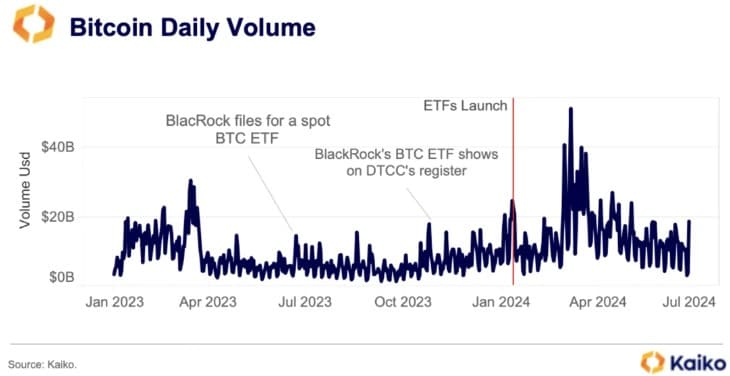
“Volumes rebounded in October from multi-year lows hit during the summer, when signs of an imminent ETF approval became evident,” they said. “The overall market euphoria was supported by a constructive macro environment for risk assets, with market pricing in six U.S. rate cuts in December 2024.”
The data shows that since the ETFs launched, there has been an increase in trading activity concentrated around U.S. market hours, Kaiko noted.
“In particular, volumes during the benchmark fixing window, between 3 pm and 4 pm New York time, have improved,” they said. “This changing dynamic helps to improve liquidity and price discovery in BTC markets but could also lead to increased intra-day volatility.”
Further evidence that the ETFs have had an impact on buying and selling behavior was found by comparing trading activity when Bitcoin hit a new all-time high in 2021 to the activity seen when it hit its record high in 2024.
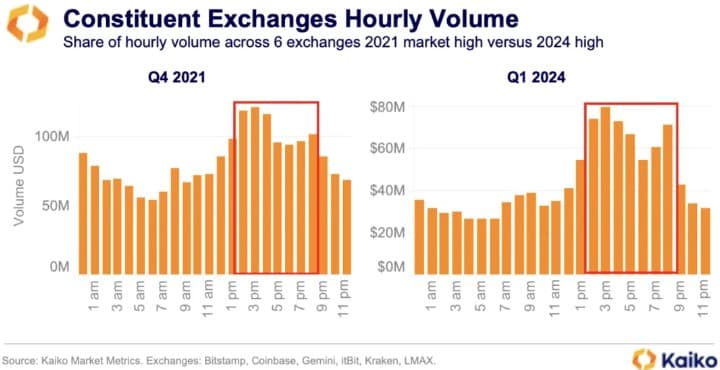
“When BTC set its previous record high in November 2021 less trading took place at US market close – between 3 pm and 4 pm New York time (8pm-9pm UTC during Eastern Standard Time),” Kaiko said. “That has begun to change since the launch of spot BTC ETFs in January, as trading becomes more concentrated on US trading, especially at the end of the day. Using weekly data – which shows the average of the 5 days’ volumes during that hour – volumes have notably increased since October.”
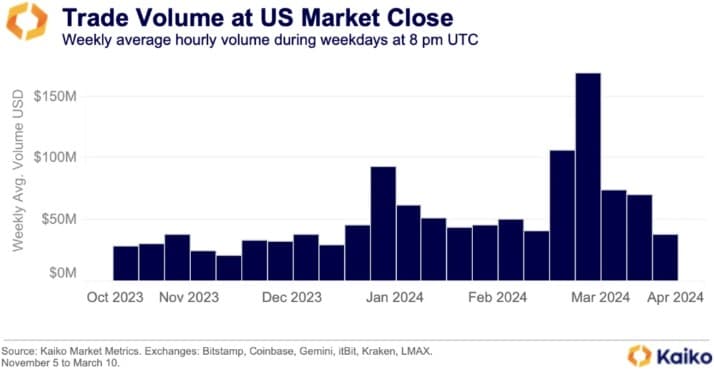
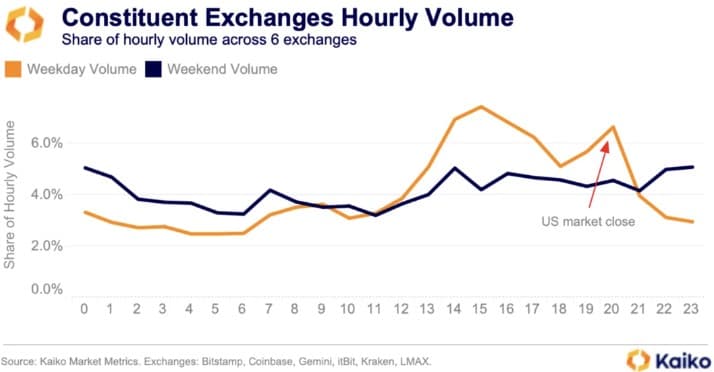
Data collected by Kaiko shows that cumulatively, more than $17.6 billion in Bitcoin trade volume was recorded on weekdays “between 8 pm and 9 pm UTC in the first quarter, making it the second most popular hour for trading, behind 3 pm UTC. As a result, the benchmark fixing window between 3 pm and 4 pm New York time accounted for over 6.7% of all volume, up from 4.5% in the fourth quarter of 2023.”
This has also led to the “death of the weekend warrior,” the analysts noted, as “the share of BTC trade volumes during weekends has consistently declined since 2021.”
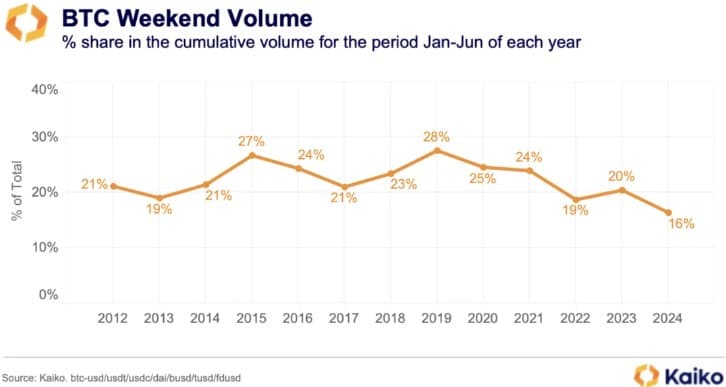
“This downward trend has been exacerbated since the introduction of spot ETFs,” Kaiko said. “Currently, the BTC weekend trading volume stands at an all-time low of 16% in 2024, marking a 12 percentage point decrease from its peak of 28% in 2019. The advent of spot BTC ETFs has contributed to the accelerated widening of the gap between weekday and weekend trading volumes.”
Whereas cryptos have historically traded at all hours of the day and saw heavier volumes on the weekend when other financial markets are closed, the launch of the ETFs has boosted the influence of the U.S. market on crypto trading, highlighting the newfound impact institutional investors have on the crypto market.
“During weekdays, the US market close accounts for over 6.6% of all trading volume on benchmark exchanges,” Kaiko said. “In contrast, this figure drops to just over 4% during weekends, with no discernible pattern or clustering of trading activity.”
While other jurisdictions such as Hong Kong have also listed spot Bitcoin ETFs, Kaiko found that “The impact of ETFs on spot BTC markets has been more pronounced on US-regulated exchanges.”
“If we take the world’s largest exchange, Binance, which is not regulated in the US, we can see that the average hourly trade volume during the first quarter peaks around the open US market open,” they said. “Volumes then consistently fall throughout the rest of the day. No ETF benchmarks include Binance, as most of its BTC trading volume is against stablecoins, and ETF benchmarks can only consider BTCUSD prices.”
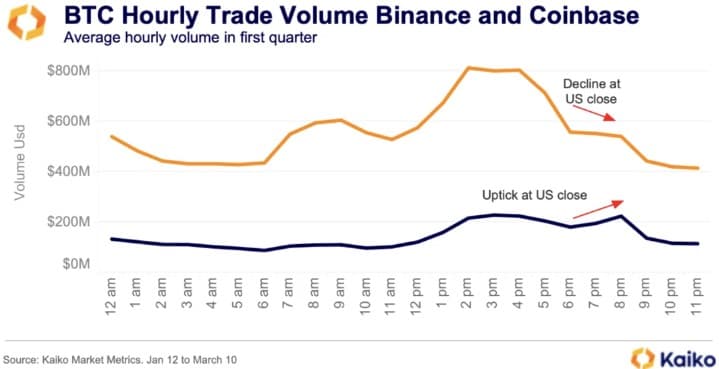
“The situation differs significantly when comparing it to the largest exchange across all Bitcoin reference rates, Coinbase, which is a US-regulated exchange,” they noted. “On Coinbase, volumes were heavily focused on the US market open and increased to an average of $220 million at the close, during the benchmark fixing window.”
The US-listed spot BTC ETFs have also helped to enhance liquidity conditions, Kaiko added, which reflects the market’s growing ability to handle large orders as Bitcoin trading evolves. “Although potential risks, such as outflows affecting liquidity during market stress, were identified, the case for ETFs boosting spot market liquidity remained strong,” the analysts said.
“Part of the argument for improving liquidity was based on ETF issuers’ so-called ‘authorised participants,” they noted. “These firms create or redeem shares in the ETF daily based on demand. Authorized participants for US-based ETFs include firms like JP Morgan, DRW, and Jane Street. These firms have contributed to improved liquidity as price discrepancies between ETF shares and the underlying BTC have been efficiently arbitraged out of existence.”
And similar to the increase in trade volume, Kaiko found that the ETF launches coincided with “a shift in the share of BTC market depth towards U.S. markets. The share of liquidity on US exchanges has increased to 45% since the start of the ETF-led rally in October, up from 35% a year ago,” they said.
“The overall impact of ETFs on the Bitcoin spot market has been positive. Both trade volumes and market depth have increased this year,” Kaiko said. “The positive liquidity development has been primarily concentrated on US markets, particularly on weekdays and around US market close. This concentration could result in increased volatility outside US opening hours, potentially penalizing retail traders. Additionally, the impact on trading costs, as measured by the bid-ask spread, has been mixed.”
“US exchanges, which are included in Bitcoin benchmarks, benefited from improved volumes and more consistent liquidity during US market open and close,” the report concluded.
