

(Kitco News) – The outlook for Bitcoin (BTC) and the broader cryptocurrency market continues to improve by the day following the launch of multiple spot BTC exchange-traded funds earlier in 2024, according to a new report from the Bank of New York Mellon (BNY Mellon).
The Wall Street firm recently released the results of its 2024 BNY Mellon Wealth Management Survey, which, among other findings, indicates that family offices have increasingly added cryptocurrencies to their portfolios in recent months.
Their entrance into the world of cryptocurrencies comes as family offices have been intensely investigating new investment opportunities amid the uptick in global economic uncertainty. The survey found that approximately 39% of the family offices polled are either actively investing in or considering cryptocurrencies. The asset class currently constitutes 5% of family office portfolios.
“In keeping with their entrepreneurial nature, family offices demonstrate that they are ready and willing to move forward into new and emerging opportunities,” the report said. “Cryptocurrencies make up 5% of portfolios, an allocation that would have been unthinkable a decade ago.”
BNY Mellon suggested that this increase highlights a growing interest in crypto, though some family offices remain hesitant about the asset class overall. 38% of those surveyed expressed disinterest in cryptocurrencies, citing concerns about the high volatility of digital assets and regulatory uncertainty, as well as apprehension about hacking and cybercrime.
Spot ETFs are the favored route among those actively researching and investing in crypto, though some said they preferred to trade the assets directly on exchanges.
The report also found that family offices are increasingly becoming their own private equity funds and directly investing in companies. “Direct investment presents exciting opportunities for family offices to leverage their unique competencies,” the report said.
Private companies have welcomed the move as banks have been tightening their lending while private equity firms have been doing fewer deals. Family offices offer another route of funding and have the advantage of offering more patient capital since they're typically investing for decades or even generations.
Last year, a majority (62%) of family offices made at least six direct investments where they bought stakes in private companies or provided lending, the survey found. 71% of respondents said they plan to make the same number of direct investments or more in 2024.
"Successful private market deals capture the illiquidity premium, meaning that they can potentially achieve significantly higher returns than are available through public markets or even pooled private market investments," the report said.
And it's not just family offices that are delving into the world of cryptocurrencies to capture the alpha available as hedge funds have increasingly engaged with the asset class following the launch of U.S. spot BTC ETFs.
According to asset manager River, thirteen of the “largest 25 US Hedge Funds collectively have over $2.6 billion #BitcoinETF exposure,” while “11 of the largest 25 Registered Investment Advisors (RIAs) also have exposure, all while #Bitcoin is just a $1 trillion asset class.”
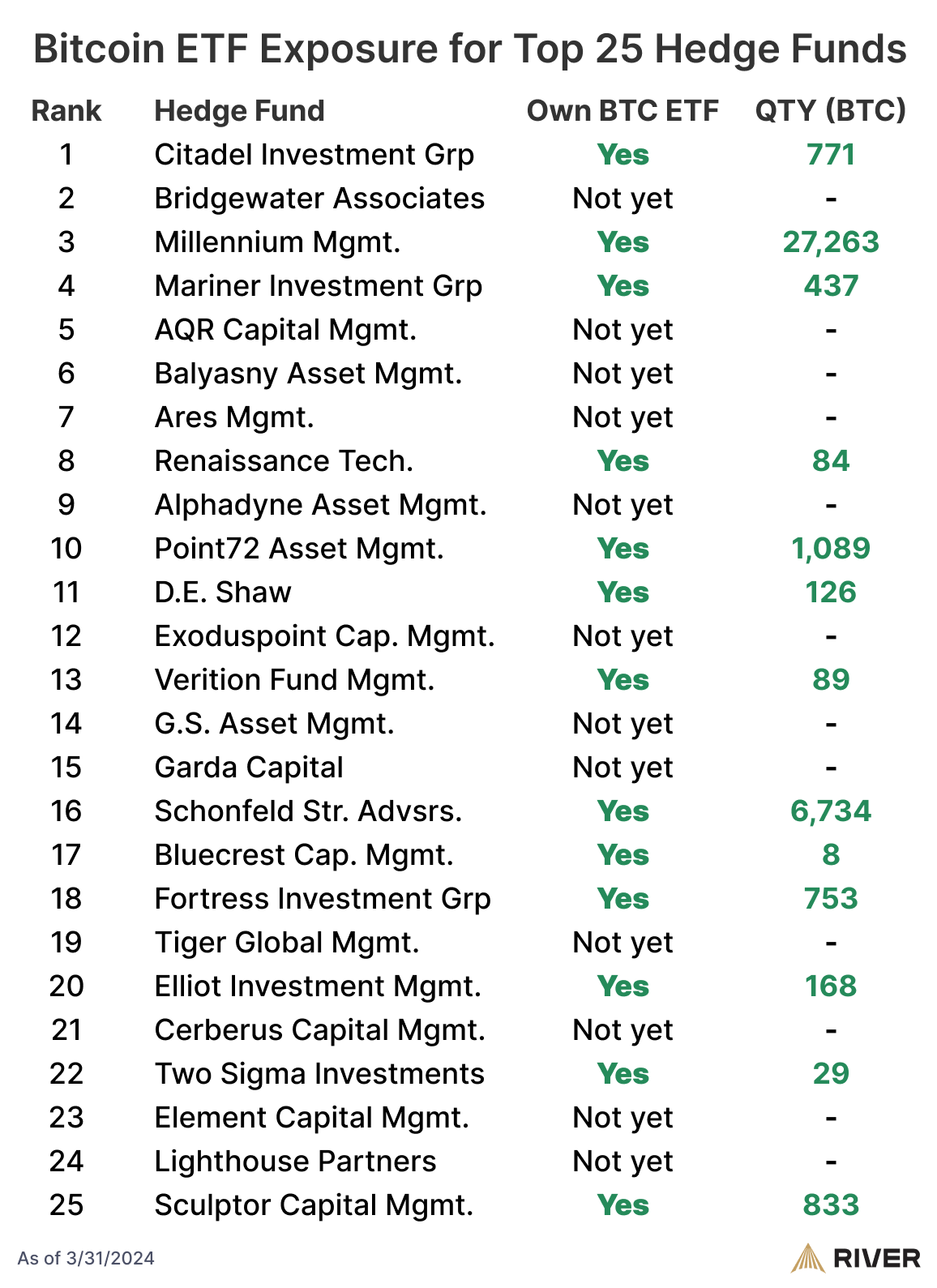
“Beyond the top 25, the numbers are even bigger,” they said. “RIAs have made relatively small allocations. But there are 405 advisors with $1B+ in assets that have collectively allocated $2.5B to Bitcoin ETFs.”
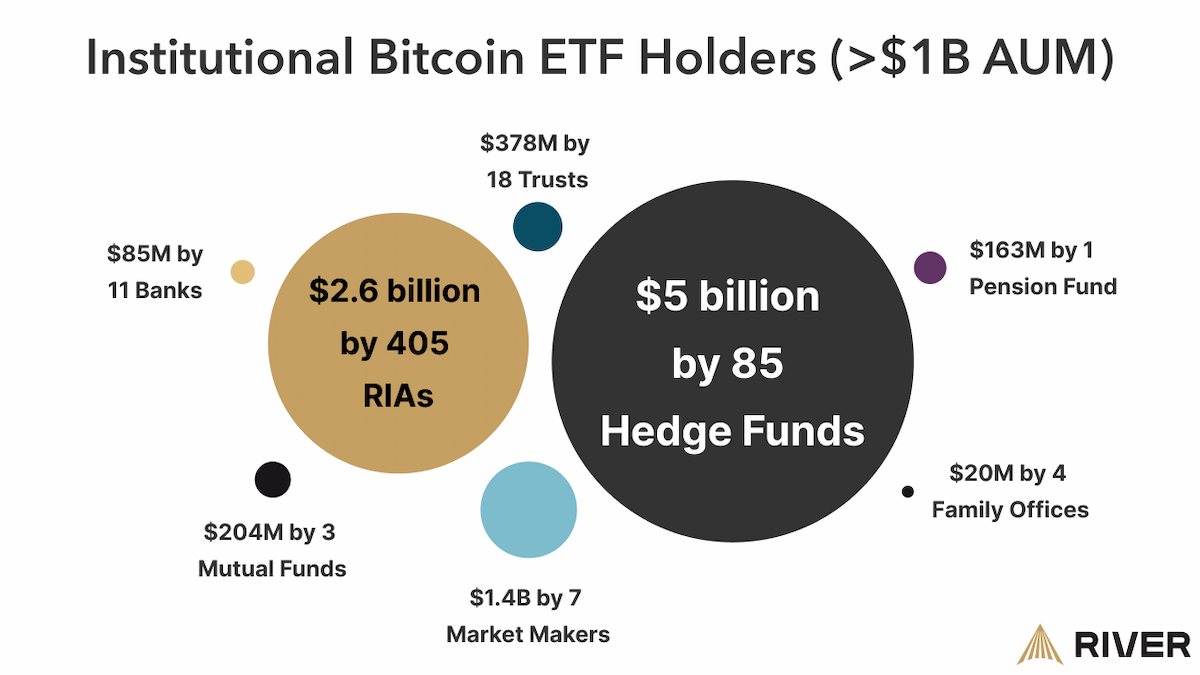
“As of Wednesday, we now know of 534 unique institutions with over $1 billion in assets that chose to begin allocating to Bitcoin in Q1 of this year,” wrote River analyst Sam Baker. “Ranging from hedge funds to pensions and insurance companies, the breadth of adoption is remarkable.”
For those wondering why Bitcoin’s price has been stagnant amid the uptick in interest, Baker noted that “While the ETFs have broad-based ownership, the average allocations of the institutions that own them are quite modest.”
“Of the major ($1b+) hedge funds, RIA’s, and pensions that have made an allocation, the weighted average allocation is less than 0.20% of AUM,” he said. “Even Millennium’s $2 billion allocation represented less than 1% of their reported 13F holdings.”
“The first quarter of 2024, therefore, will be remembered as the time when institutions ‘got off of zero,’” he said. “As for when they will get past dipping their toes in the water? Only time will tell.”
