
(Kitco News) – Bitcoin (BTC) and the broader crypto market traded in a holding pattern on Tuesday morning as investors tuned into remarks from Fed Chair Jerome Powell to get the central bank’s read on inflation and the economy, and to look for any clues as to when the first interest rate cut could be expected.
It was a similar story for stocks, which opened lower but have climbed back to neutral at the time of writing after Powell said he is encouraged by cooler inflation, with the last two inflation readings in April and May suggesting “that we are getting back on a disinflationary path,” before reiterating that the Fed will need to see more evidence of progress before cutting interest rates.
"We've made a lot of progress," Powell said. "We just want to understand that the levels that we're seeing are a true reading on what is actually happening with underlying inflation."
The bounceback in stocks came despite the latest data from the Bureau of Labor Statistics showing there were 8.14 million jobs open at the end of May, an increase from the 7.92 million job openings in April.
Wall Street has been looking for further signs of a cooling labor market to support the idea of interest rate cuts. Market watchers are now looking ahead to the Friday release of the June jobs report, hoping that it will provide more evidence that the labor market is cooling, supporting the argument that a rate cut is needed.
“Because of the fact that US employment data generally comprise of lagging indicators with a few exceptions like initial unemployment claims, we expect that US employment data are likely going to deteriorate as well over the coming months, following the patterns observed in housing and other leading indicators,” said André Dragosch, Head of Research at ETC Group. “What is more is that there is increasing evidence that the most recent employment data should be taken with a large grain of salt.”
“Although the latest headline non-farm payrolls number beat consensus expectations in May, the ‘small print’ of the employment report has revealed that US labour market conditions are rather weakening significantly,” he said.
Highlighting some of the recent “negative growth surprises” seen in the labor market, Dragosch said they have “led to a further repricing of benign global growth expectations as market participants are increasingly factoring in a potential US recession.”
“Meanwhile, major US large-cap equity indices rallied to new all-time highs in June,” he added. “However, this happened on weakening market breadth as the bottom 490 stocks generally underperformed the top 10 mega caps in the S&P 500. So, deteriorating market breadth in traditional equities is also signalling increasing recession and correction risk.”
“The risk for Bitcoin and other cryptoassets is that, firstly, major US large cap equity indices like the S&P 500 still exhibit a relatively high correlation to major cryptoassets,” Dragosch said. “Secondly, global growth expectations are still the dominant macro factor for the performance of Bitcoin.”
He noted that both the S&P 500 and Bitcoin are “currently dominated by global growth expectations in terms of macro factors which explains the high correlation between both markets as well.”
“Hence, a further deterioration in global growth expectations could very well be a headwind for Bitcoin and cryptoassets over the coming months barring any changes in macro factor dominance,” he said. “The good news is that Cryptoasset Sentiment has already declined significantly which means that investor positioning has become lopsided and sentiment very bearish. This implies that further downside risks for Bitcoin and cryptoassets appear to be relatively limited in the short term.”
Dragosch cited U.S. Treasury liquidity as a “potential systemic risk that could support Bitcoin and cryptoassets,” noting that the available liquidity is “currently worse than during the Covid-crisis in 2020. This could imply increasing Treasury volatility which could warrant a bond market intervention (read: ‘QE’) by the Fed in itself. This could also warrant interest rate cuts as happened in 2019.”
“If there was an escalation in the Treasury market it would most likely entail a renewed easing cycle by the Fed and a weak Dollar which would be bullish for Bitcoin and Cryptoassets,” he said. “Major central banks have already lowered interest rates this year such as the Bank of Canada, ECB or the SNB (twice). So, it appears as if the liquidity tide is already turning.”
“We think that a potential US recession as well as the rising risk of a Treasury market dysfunction are among the main catalysts to watch for a final Fed pivot this year,” Dragosch said.
“Bottom Line: US recession risks have recently increased with disappointing macro data from the US which have put pressure on Bitcoin and cryptoassets,” he said. “Bitcoin’s performance continues to be dominated by changes in global growth expectations. Systemic risks to watch include a revival of US regional bank stress, French sovereign risks, and US Treasury illiquidity.”
“Barring any renewed increase in global risk appetite, our base case still remains a short-term consolidation until the positive effect from the Halving starts to kick in around August 2024,” Dragosch concluded. “That being said, valuations have become more attractive due to the recent correction and are now close to ‘fair value.’”
After holding steady in early trading, Bitcoin’s price trended lower following the jobs data release and comments from Powell as investors remain unsure about the fate of interest rates.
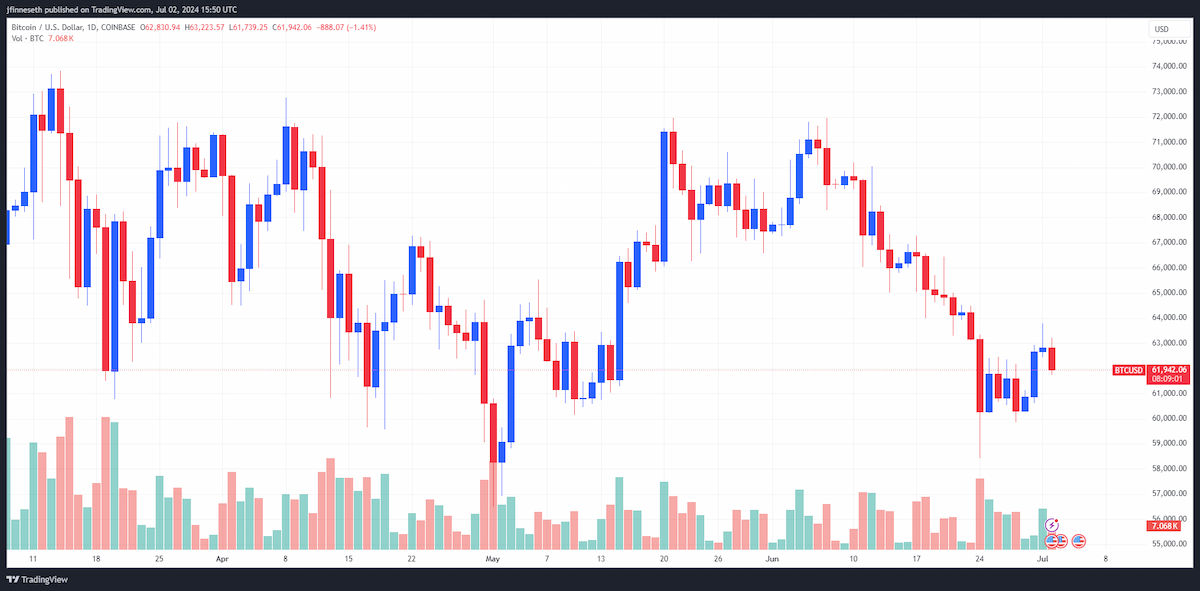
BTC/USD Chart by TradingView
At the time of writing, Bitcoin trades at $61,973, a decrease of 1.55% on the 24-hour chart.
