
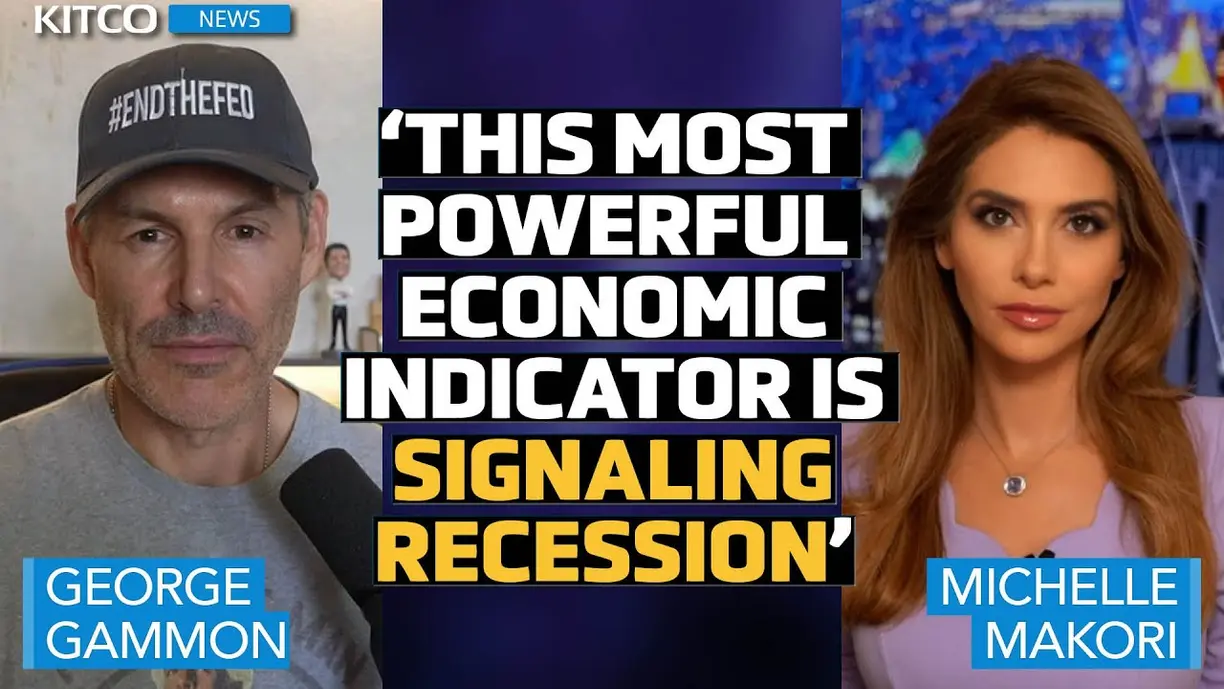
(Kitco News) - A hard landing and a severe recession in the U.S. is still coming, said George Gammon, an investor, macroeconomics expert, and host of The Rebel Capitalist Show, pointing to the world's most powerful economic indicator signaling a turning point.
The latest macro data shows somewhat robust economic growth and slowing inflation, boosting the case for the Federal Reserve rate cut in September. However, Gammon told Michelle Makori, Lead Anchor and Editor-in-Chief at Kitco News, that the world's "most powerful economic indicator" -the yield curve - is signaling a recession for the U.S.
The U.S. GDP grew at a 2.8% annualized pace in the second quarter, while the Fed's preferred inflation measure – the personal consumption expenditures price index – increased by 2.5% from a year ago, in line with market projections and slightly lower than the May advance of 2.6%.
Despite these numbers, Gammon said investors must pay more attention to the yield curve. More specifically, the 2-year and the 30-year Treasury yield curve which has started to show signs of un-inversion after more than two years of being inverted. This un-inversion is when economic trouble actually begins, according to Gammon..
An inverted yield curve forms when short-term debt instruments have higher yields than longer-term debt instruments. The 10-2 Year Treasury Yield Spread has been inverted since mid-2022. Going back to the 1980s, each recession has been preceded by an inverted yield curve.
Gammon pointed out that banks know economic storm clouds are coming. "Look at what the banks are doing. They have the most intel. They're the ones dealing with the entrepreneurs, multinational corporations, commercial real estate, consumers, and most importantly, other banks," he said. "If we have this booming economy, why aren't the banks lending? Do they not want profit? … The reason they're not lending is that the risk-reward doesn't make sense because when they look out at the real economy, they see storm clouds."
In order to grasp the extent of the incoming threat, Gammon explained that the majority of new dollars are created by banks lending them into existence. "It's not the Federal Reserve or the Treasury or the government or anything like this. It's the banking system lending them into existence. Since 2022, the M1 and M2 money supplies in the United States have been down. The last time that happened with M2 money supply, we were in the great depression of the 1930s."
The banks don't view the current state of the U.S. economy as healthy. Instead, they see immense problems on the horizon. "There is massive counterparty risk. Let's not forget that we're just in the middle innings of a banking crisis," Gammon said. "The mainstream media thinks we dodged a bullet and have averted the crisis. But we didn't. Every single month, we hear in the news that another bank goes bust. And not just in the United States."
Gammon warned that if the banking system fails, the economy will crash.
For Gammon's breakdown of what the banks are doing instead of lending out money, watch the video above. He also addresses the heightened contagion risk in the banking sector.
Potential Hard Landing Scenarios
Gammon's base case scenario going into 2025 is a severe recession. "It might not be to the degree we saw in 2008-2009, but at the very least something we saw during a dot-com bubble or maybe in the early 1980s," he told Kitco News.
According to him, a soft landing is impossible because of the interconnectivity within the banking system. Gammon compared the U.S. banking sector to the Tour de France, where banks, like cyclists, are just millimeters apart.
"If one guy goes down at the front of the race … it's like a domino effect. It wipes out all these other riders, and 90 percent of them fail. And the banking system is set up the exact same way right now," he noted.
Recession is coming whether or not the Federal Reserve cuts rates, Gammon added. For his explanation of why rate cuts no longer matter, watch the video above.
For portfolio implications and for Gammon's essential assets to hold, including their price outlooks, watch the video above.
