
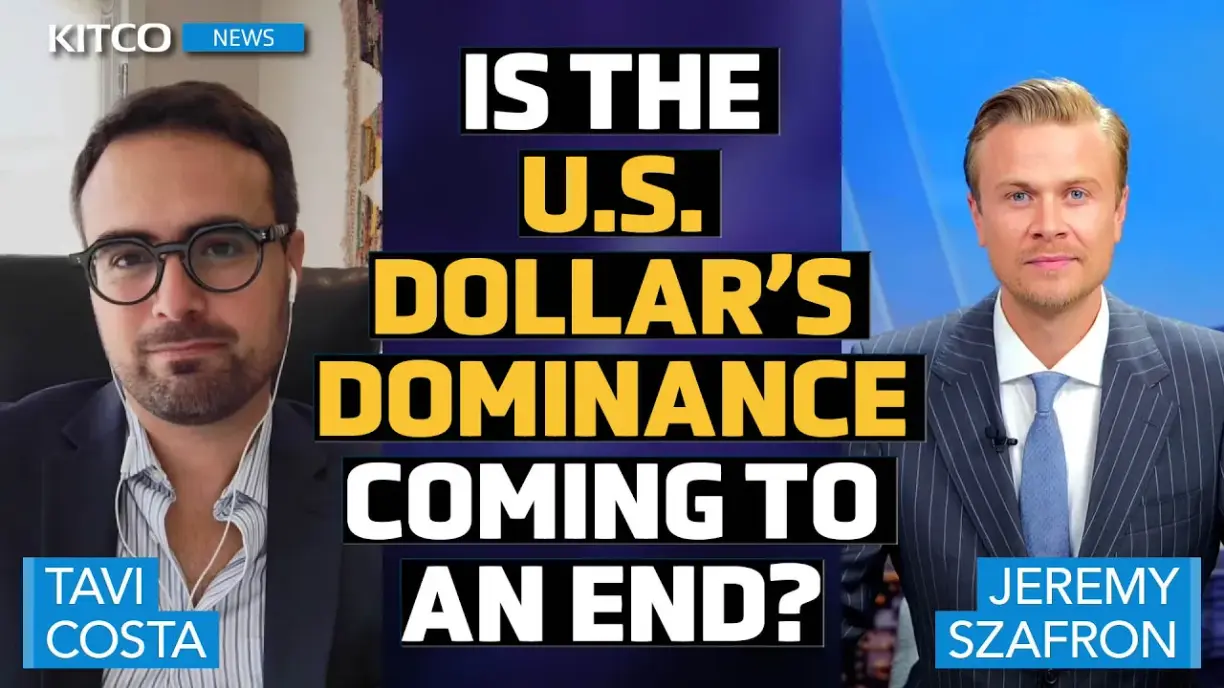
(Kitco News) - The U.S. dollar is facing a potential collapse, driven by ‘transformative developments’ in the foreign exchange markets. Tavi Costa, partner and macro strategist at Crescat Capital, highlighted in a recent interview with Jeremy Szafron, Anchor at Kitco News, that net interest payments as a percentage of GDP are projected to reach their highest level in over two centuries. This shift indicates a looming depreciation of the U.S. dollar relative to other currencies. Costa explained, "The reality is that net interest payments as a percentage of GDP are projected to reach their highest level in over two centuries. The potential benefits of cutting interest rates to alleviate surging debt service payments are beginning to outweigh the fight against inflation. The urgent need for financial repression in the US economy has never been more apparent."
In 2023, the U.S. spent $658 billion on net interest costs, accounting for 2.4% of GDP. Projections for 2024 estimate interest costs will rise to $892 billion, a 36% increase from the previous year. This upward trend is driven by rising interest rates and growing public debt. By 2025, interest costs are expected to reach 3.2% of GDP, and by 2034, they could climb to 4.1% of GDP. This trajectory indicates significant financial pressure on the federal budget, necessitating measures to manage these costs.
Will the Fed Cut Rates to Manage Surging Debt?
Costa stressed the necessity of multiple rate cuts by the Federal Reserve. "I think it's going to be multiple rate cuts. And the reason for that is because three rate cuts would reduce the debt payment by about almost one third. This doesn’t solve the issue but certainly puts us in a better position," he notes. Historical precedents, such as the British Empire's management of its debt, suggest that the U.S. might need to suppress yields to reduce the cost of servicing its debt. Costa added, "This is highly likely in the next two to three years."
Currently, the Federal Reserve has maintained the target range for the federal funds rate at 5.25% to 5.50% since July 2023, marking one of the highest levels in over two decades. Despite maintaining high rates to combat inflation, the Fed is highly attentive to inflation risks and is expected to consider rate cuts once there is greater confidence that inflation is moving sustainably toward the 2% target. The upcoming Federal Open Market Committee (FOMC) meeting on July 30-31, 2024, is highly anticipated, with market expectations leaning towards holding rates steady. However, the CME FedWatch Tool indicates a growing probability of rate cuts by the end of 2024, depending on the trajectory of inflation and economic conditions.
Costa's perspective sheds light on the potential future movements of the U.S. dollar and its broader implications for global markets and commodities- watch the full interview above.
How Dollar Depreciation Could Fuel Gold and Silver
The depreciation of the dollar could have significant implications for commodities, particularly gold and silver. Costa points out that central banks are already accumulating gold, and this trend is expected to continue. "The next leg up for gold prices and silver and copper and so forth is going to come on the back of depreciation of the dollar," he says. "Historically, when the dollar tends to depreciate versus other fiat currencies, it unleashes other ideas. Natural resource companies tend to do very well. Emerging markets doing very well. It wouldn't surprise me if we see another major leg up in gold prices along with silver and other metals and copper and so forth on the back of these trades."
As of the time of publish, spot gold is trading at approximately $2,420 per ounce, while silver is holding steady at around $29.19 per ounce. These prices reflect a robust market driven by factors such as geopolitical uncertainty, central bank buying, and expectations of future rate cuts by the Federal Reserve. Analysts at J.P. Morgan forecast gold prices to average $2,500 per ounce by the fourth quarter of 2024, assuming a Fed cutting cycle commences in November 2024
For an in-depth analysis and detailed insights, watch the full interview with Tavi Costa on Kitco News above.