

(Kitco News) - Manufacturing activity in the New York region showed slight improvement this month but remained firmly in contractionary territory, according to the latest figures published by the New York Federal Reserve.
The regional central bank said on Thursday that its Empire State manufacturing survey came in at -4.7 in May, after posting a -6.6 print in July. The data was better than expectations, as consensus forecasts called for a -6.0 reading.
“Manufacturing activity declined slightly in New York State in August, with new orders falling modestly,” said Richard Deitz, Economic Research Advisor at the New York Fed. “Labor market conditions remained weak, with a small decline in employment and a sharp drop in hours worked. Firms continued to be somewhat optimistic that conditions would improve in the months ahead.”
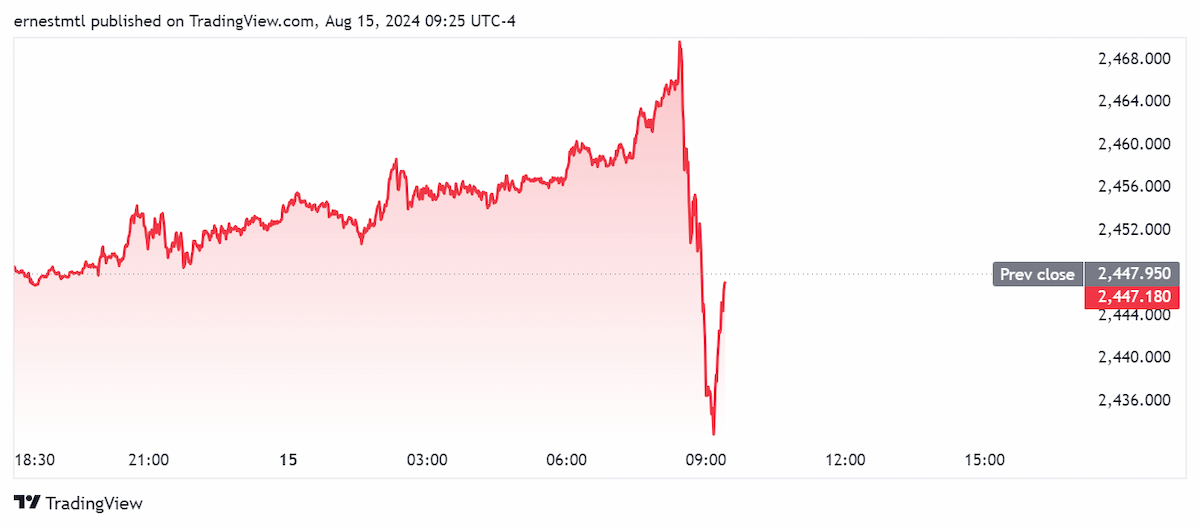
Gold prices declined sharply following the 8:30 am EDT release, which came out at the same time as the U.S. Retail Sales, weekly jobless claims and the Philly Fed index, but prices have bounced since. Spot gold last traded at $2,447.18 per ounce at the time of writing, and is now flat on the day.
The components of the report showed weakness in most areas of the region’s manufacturing sector.
“The new orders index fell seven points to -7.9, pointing to a decline in orders, while the shipments index fell to around zero, suggesting shipments were flat,” the report said. “Unfilled orders continued to decrease. The inventories index fell to -10.6, indicating that inventories moved lower. The delivery times index remained below zero at -3.2, suggesting that delivery times continued to shorten, while the supply availability index came in at -2.1, a sign that supply availability was slightly lower.”
The employment picture in the sector also continued to worsen. “The index for number of employees was little changed at -6.7, pointing to another month of employment reductions, while the average workweek index dropped eighteen points to -17.8, signaling a sharp decline in hours worked,” the report said.
“The prices paid index edged down three points to 23.4, indicating a slight moderation in input price increases, while the prices received index edged up two points but remained low at 8.5, indicating that selling price increases were still modest,” they added.
Despite the negative numbers, firms remained fairly optimistic about the future. “The index for future business conditions came in at 22.9, with 45 percent of respondents expecting conditions to improve over the next six months,” the New York Fed wrote. “The outlook for employment growth picked up, and capital spending plans, while sluggish, firmed somewhat compared to last month.”
