

(Kitco News) – The cryptocurrency four-year cycle is a well-established pattern for experienced crypto traders as it has reliably helped those in the know time their market entries and exits while maximizing the value of their portfolios.
The driving force behind this trend is the Bitcoin (BTC) halvings – when the newly minted supply of BTC in each block is cut in half – which also takes place roughly every four years.
When Bitcoin first launched, each block produced 50 BTC, and with each halving, that amount was reduced by 50%. With four halvings on the record books, the block reward now stands at 3.125 BTC, and 94% of the total 21 million Bitcoin supply has been mined as of August 15.
While past halvings have materially affected the crypto market due to the significant reduction in new Bitcoin supply that came with them, some analysts have suggested this effect will be lessened in the future as the vast majority of Bitcoin that will ever exist is already in the market, while other forces – such as Bitcoin exchange-traded funds (ETF) demand and an ever-increasing money supply – will have more impact moving forward.
Kitco Crypto reached out to several experts in the field to get their take on the uptick in chatter about ‘the death of the four-year crypto cycle’ to see if there is any merit behind the claims.
Long live the four-year cycle
“The cycle isn’t dead, nor will it likely ever die in totality,” said Becky Leighton, content head at Coin Insider. “Other factors are shaking the market and throwing price curves into the mix, with institutional influence having a play in a brand new way, but once this plateaus, the undercurrents of the four-year cycle will show.”
“Looking at how the prices have moved in the past and what the indicators are suggesting, we will probably just see less aggressive swings as a result of the halving compared to historic cycles,” she added. “I don’t think we’ll ever see the magnitude of the swings we’ve seen directly because of the halving, but rather investment surges and drops will be influenced by traditional finance and the state of the market (especially tech indices) outside of cryptocurrency.”
Mike Carson, founder of Spaces Protocol, agreed with Leighton.
“The four-year cycle is not dead nor will it ever be, specifically because of the Bitcoin halving every four years,” he said. “Price is determined by supply and demand, so it will always have an impact on the price. People may price it in ahead of time, but the effects of it are for certain going to be felt. If the amount of any commodities is cut in half, it will always have an impact.”
“As the market gets bigger with more participants, it will certainly become more efficient, resulting in a smoother curve up,” he added. “But because the halving is such a huge event, directly impacting the supply and demand dynamics, there is no way that markets will not react to that.”
Carson said he sees future halvings continuing to play a major role in the overall performance of Bitcoin and the broader crypto market.
“It plays a huge part because eventually there will be no more BTC produced,” he said. “Right now it’s still possible to make Bitcoin, so you don’t have to buy it from someone else if you’re a miner. Eventually, over time, there’s going to be a point where you can’t create anymore so if you want it you have to get it from somebody else.”
“This plays a huge role in the dynamics of the price, unlike any other thing out there,” he added. “This doesn’t happen with any other commodity or investment. Usually, if there's a big demand for something they find a way to make supply. With Bitcoin, you can’t do that. That’s really unique and completely different than anything we've ever seen, so there will always be a huge impact.”
The one area Carson expects to see some impact is the magnitude of bear market pullbacks, also known as a ‘crypto winter.’
“The trend will be that supply goes down and the demand stays the same, which means the price will go up,” he said. “I don’t think it will have a huge effect on crypto winters per se, but overall for the long term, the price will be going up assuming demand stays the same or grows. Basically, it’s a super rare asset and there will probably be more and more demand for it because it’s the first truly decentralized store of value you can transmit as easily as an email.”
Ben Kurland, CEO of crypto research and charting platform DYOR, also remains a firm believer in the four-year cycle.
“The 4-year cycle is still very much alive,” he said. “While it may have seemed that the recent run-up was an early bull run, it more closely resembles the relief rally of 2019 rather than the bull run of late 2020.”
“Many overlook the fact that over $30 billion of Bitcoin buys during 2021 were never settled on-chain by FTX, causing the price to stagnate at its peak instead of reaching higher levels,” he noted. “If these buys were accounted for, the actual all-time high would have been north of $100,000.”
“Considering this, the current cycle aligns more with the previous one, suggesting a true bull run could start in Q4 of this year or Q1 2025,” Kurland said. “Future halvings will still influence the market significantly, as selling pressure strongly correlates with the cost of mining, which doubles every four years, but, as the market matures, this impact will likely diminish, leading to less volatile runs, smaller pullbacks, and reduced cyclical peaks.”
Decreasing influence and volatility
“In my opinion, the 4-year cycle for crypto isn’t completely dead,” said Kadan Stadelmann, Chief Technical Officer at Komodo. “However, it’s to be expected that the influence the Bitcoin halving has on the broader crypto market is poised to decrease over time. Less supply shock equals less FOMO from investors.”
“I think that people who have been involved in the crypto space for a long time are still expecting the past cycles with high volatility will continue the same pattern, yet change is inevitable as the market matures,” he suggested.
That shift has already started, Stadelmann noted, thanks to the launch of spot Bitcoin ETFs and the entrance of institutional investors.
“Large institutions are now dominating the crypto market, and this trend will only continue over the next decade,” he said. “There is a high probability that the price of cryptocurrencies like BTC and Ethereum (ETH) will stabilize to a large degree thanks to this additional liquidity that helps set a higher market floor. The result is that we should see less panic selling and fewer major pullbacks in the future.”
“Let’s look at the August 4th/5th market crash as an example,” Stadelmann pointed out. “The majority of top cryptocurrencies crashed more than 20%, and some more than 30%. Although many top stocks also crashed, the decline was much less severe (i.e. 5 to 10% in most cases). Eventually, crypto market volatility – especially large cap coins – will more closely reflect the present-day stock market volatility.”
“The traditional 4-year cycle in crypto appears to be, if not dead, at least significantly weakened,” said Philipp Zentner, CEO at LI.FI. “Several factors contribute to this shift that includes, but is not limited to, increased institutional involvement and deeper-pocketed investors, evolving market dynamics with less correlation between assets, the growing influence of spot Bitcoin ETFs, and the changing impact of halving events.”
“The crypto market has matured considerably over the past few years, leading to more complex and nuanced behavior that doesn't necessarily align with the previously observed cyclical patterns,” he added. “Future crypto market cycles are likely to most closely resemble traditional financial markets by exhibiting greater correlation with risk-on/risk-off scenarios with extended and less predictable timeframes. They will also display more asset-specific trends rather than industry-wide movements.”
“As the market matures, we may see a gradual extension of cycle lengths and a blurring of clear-cut boundaries between bull and bear markets,” Zentner said. “While halvings have historically played a significant role in Bitcoin's price action and overall market sentiment, their impact may be diminishing due to lesser returns, since each halving has a less dramatic effect on price; priced in expectations where market efficiencies reduce their impact; and other concerns related to regulatory shifts, macroeconomic factors, and more.”
“That said, halvings still serve as important psychological benchmarks for market participants. Their actual impact, though, appears to be diminishing,” he concluded. “Furthermore, future pullbacks might not reach the same magnitude because the peaks and valleys tend to smooth out when markets mature, as stronger fundamentals enable better analysis and more orderly trading sessions due to the diverse mix of both retail and institutional liquidity participating in them.”
Not dead, just evolving
“Is the 4-year cycle dead? Not quite, but it’s shifting gears,” said Stefania Barbaglio, founder and CEO of FinancialFox and Cassiopeia.
“The Bitcoin/Crypto 4-year cycle isn’t exactly dead, but it’s definitely evolving,” she added. “Traditionally, this cycle was fueled by Bitcoin’s halving events, which occur roughly every four years and reduce the block reward by half. These halvings typically led to significant price rallies, followed by corrections known as ‘crypto winters.’”
Barbaglio highlighted several factors that have led to this change.
“First, institutional influence,” she said. “These days, institutional investors and Bitcoin ETFs are shaking things up. With big players entering the scene, the market dynamics are shifting. Institutions bring different strategies, long-term perspectives, and wider product offerings, which can smooth out some of the wild swings we’ve seen in the past.”
“Second, government support and regularity landscape maturity could bring less volatility,” Barbaglio noted. “Finally some important macroeconomic factors like inflation, interest rates, and geopolitical events are starting to play a bigger role. These factors interact with the crypto market in ways that could change the impact of the traditional halving events.”
As for what future cycles will look like, Barbaglio said they will be “a bit longer and more complex.”
“Future cycles might not stick to the classic 4-year rhythm. As the market matures and integrates more with traditional financial systems, the impact of each halving might be less pronounced,” she said. “We might see cycles stretching out and evolving in ways we haven’t predicted.”
“I expect future cycles to be a bit more tangled with complex dynamics,” she added. “Alongside the halving effects, new factors like institutional moves and economic shifts will create a more intricate market landscape.”
Barbaglio said the effect of future halvings will still be present but diminished compared to the historical price action.
“While future halvings will still decrease the Bitcoin supply, their immediate impact might not be as dramatic as in the past,” she said. “As the market becomes more stable with institutional involvement, the price hikes from halvings might be less pronounced.”
“However, they will still be relevant even with a reduced immediate effect, contributing to price pressure over the long term,” she noted, adding, “They’ll be just one piece of a larger puzzle influenced by market sentiment and economic conditions.”
When asked if future crypto winters will reach the same depths as in the past, Barbaglio predicted that future pullbacks will be softer, “with crypto winters likely not as harsh as in the past.”
“We might see milder, more gradual corrections instead of the big swings we’re used to,” she said. “Traders relying on the four-year cycle won’t see the same gains. I also believe Bitcoin’s domino effect on other cryptocurrencies will weaken. The market will start to differentiate, which is a good thing, as there’s still a lot of low-quality projects out there.”
“Also, as the market matures and diversifies, including more use cases and players, it could become more resilient and stable,” she added. “This could mean that while corrections will still happen, they may not be as extreme as those we’ve seen before.”
“To summarise, the BTC 4-year cycle is adapting to a new reality. While the classic cycle isn’t entirely gone, its role is being reshaped by new market players and broader economic trends,” Barbaglio concluded. “Future cycles may be longer and more complex, with a reduced but still notable impact from halvings. And while crypto winters might be less severe, the market will continue to evolve in response to a mix of factors.”
A longer time horizon
Alan Orwick, co-founder of Quai Network, said the best word to describe what will happen to the crypto four-year cycle is evolution.
“The four-year Bitcoin cycle may be evolving rather than dying outright,” he said. “Recent data from the Cambridge Bitcoin Electricity Consumption Index suggests a shift in mining patterns, with energy consumption potentially peaking before the halving. This change could be driven by new primitives like Runes and Ordinals, which have reignited interest in Bitcoin's programmability.”
“Additionally, Bitcoin's increased institutional adoption and maturation as an asset class may be smoothing out the dramatic price swings typically associated with the four-year cycle,” Orwick noted. “While it's too early to declare the cycle dead, these factors point to a more complex and nuanced market behavior that may be less dependent on halving events and more influenced by broader economic factors and evolving use cases.”
He said he sees future market cycles extending to longer periods.
“Future Bitcoin cycles are likely to extend gradually as the market matures. Increased institutional involvement and wider adoption may lead to more stable, prolonged price movements rather than sharp four-year peaks,” he said. “Bitcoin's potential technological stagnation, with protocol ossification possibly limiting base layer capabilities, could result in more predictable cycles.”
“Regulatory developments and Bitcoin's growing correlation with traditional markets may further smooth out and extend these cycles,” he added. “While the four-year pattern may not disappear entirely, future cycles will likely become less dramatic and more aligned with broader economic trends as Bitcoin settles into its established role in the financial ecosystem.”
But with many in the crypto ecosystem hodling strong beliefs about the four-year cycle, Orwick said it could continue to be a major factor based on historical precedent.
“The four-year cycle may persist due to Bitcoin's ongoing halving mechanism, which creates predictable supply shocks,” he said. “Many investors still base their strategies on this cycle, potentially creating a self-fulfilling prophecy. The crypto market's speculative nature, combined with increased media attention and public interest around halvings, continues to attract new capital in a cyclical pattern.”
That said, all markets change with time, and that will be true for crypto as well, Orwick suggested.
“Future Bitcoin halvings will likely have a diminishing yet still significant influence on the crypto market,” he said. “As Bitcoin's inflation rate approaches 0.8% post-halving, its scarcity will increase, reflected in a higher stock-to-flow ratio.”
“However, market maturity, increased institutional involvement, and broader adoption may lead to halvings being more priced in advance,” he noted. “While these events will continue to affect mining economics and reinforce Bitcoin's scarcity narrative, their impact on market cycles may gradually decrease. The diversifying crypto market may also become less reactive to Bitcoin-specific events as other factors gain prominence in driving overall trends.”
As a result, future crypto winters “might not be as severe as past downturns due to the evolving market dynamics,” he concluded. “Increased institutional involvement and a more mature market could lead to less extreme pullbacks. While halvings have traditionally contributed to sharp price changes, a more stable market environment might result in milder declines during downturns.”
The influence of miners
“Historically, Bitcoin has followed a 4-year cycle. These cycles roughly align with the halving. But why exactly does Bitcoin rally after these halvings? The fundamental reason is supply,” said Juan Correa, Senior Strategist at BCA Research.
“Miners are generally net sellers of Bitcoin,” he highlighted. “This is because they need to sell the Bitcoin they mine in order to pay for their electricity as well as other operational costs. As a result, the halving of the block reward results in reduced net selling by miners, which in turn leads to a higher price.”
“However, as more halvings occur, this relief in sell pressure becomes less significant,” Correa noted. “Looking at the trailing 1-year block rewards as a share of circulating supply, we see that they have become smaller through time. Likewise, the difference in supply sold in the year before and after each halving has also shrunk.”
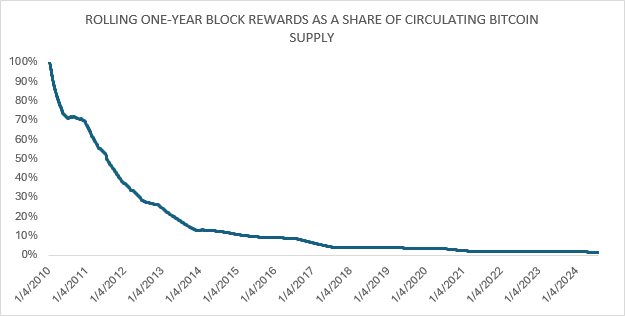
“For example, according to data by Glassnode, roughly 2.75 million Bitcoin (accounting for 26% of circulating supply) were mined on the year prior to the first halving,” he said. “Meanwhile, in the year after the first halving, less than 1.6 million Bitcoin were mined (accounting for 13% of supply). Given that a decent share of Bitcoin mined is eventually sold in order to pay for electricity costs, this implies a net reduction of selling pressure of over a million Bitcoin in one year (or 13% of supply).”
“Contrast that to the third halving. In the year prior, just 680 thousand Bitcoin (accounting for 3.7% of supply) were sold,” he said. “In the year after, this number was just over 330 thousand (accounting for 1.8% of circulating supply). This implies a much weaker net reduction of selling pressure of just 350 thousand Bitcoin (or 1.9% of supply).”
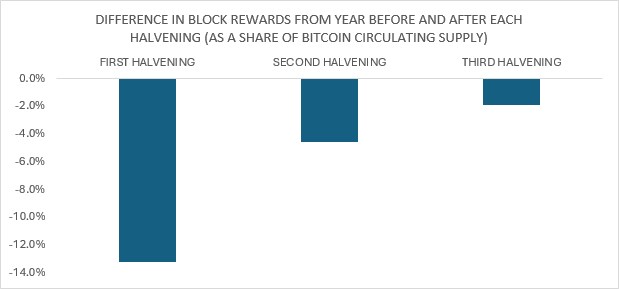
“Given the diminishing sell pressure relief after each halving, we should expect that this event will have less of an effect on price going forward,” Correa surmised. “Macro factors and demand dynamics, such as the ones from the recent ETFs will be more impactful and will become biggest cycle drivers.”
“Notice for example that the net flows into Bitcoin ETFs since their launch have been almost 300 thousand BTC, over double the amount of block rewards over the same time frame,” he noted. “As Bitcoin becomes more macro-driven and more owned by institutional investors, its cycles should begin to mirror those of traditional asset classes (bonds, equities, commodities, gold). Though to what extent it follows risk-on versus risk-off assets is yet to be determined.”
Correa also sees the diminishing effect of the halvings helping to free the altcoins from the high level of influence that Bitcoin has historically had on the market.
“What about other cryptocurrencies? Conceptually the halving should only affect Bitcoin,” he said. “And yet, we know empirically that the rest of the crypto space has moved in tandem with these cycles in the past – the result of the tight correlation across the crypto space. If this high correlation persists, the reduced importance of the halving for Bitcoin should also translate into different cycles for other cryptocurrencies.”
Cycle variation has always been possible
“Is the four-year cycle dead? Most definitely not, as we see it happening again this year,” said Ronan Walsh, Managing Director of Digital Trawler. “The four-year cycle is not a given, previously there was a three-year cycle, and it's possible there may be a five-year cycle the next time.”
“Personally, I’m not a fan of labeling it a four-year cycle,” he said. “Yes, it's typical that a halving occurs every four years, but the number of blocks is more important.”
“To date the cycle has happened roughly every four years but it has had fluctuation,” he added. “With the way Bitcoins manages supply and demand, it’s unlikely to see a halving happen in two years or six years, for example, or if it does it will be some decades before we see six plus years.”
“Labeling the four-year cycle adds more confusion for people whereas if we labeled it as a halving it would add more transparency as to what is exactly happening,” he explained. “It doesn’t matter if the halving happens every 4 weeks or 4 months or 4 years, it’s the halving of the Bitcoin reward we need to pay attention to. We have seen an increase in demand after a halving occurs and the creation of 210,000 blocks is what causes this, not waiting 4 years.”
“It's difficult to say what exactly the trend will be going forward as we learn more about Bitcoin,” he added. “This halving may help us make more sense of the market. Based on history, people's knowledge of cryptocurrencies, and the theory behind how Bitcoin works, we may see the peaks and troughs of the price of Bitcoin stabilize as more halving occurs.”
Walsh said that being mindful of the cyclical nature of the crypto market is most useful in helping to time entries and exits around crypto winters.
“It's worthwhile paying attention to the four-year cycle because the price of Bitcoin increases usually within the first year after a halving,” he said. “However as reward halvings continue, the trend appears to stabilize, we are seeing less fluctuation when it comes to winters and halving cycles.”
Look to the past to determine the future
"No market cycles align perfectly but it is still important to study the past to understand the big picture,” said Peter Eberle, President and Chief Investment Officer of Castle Funds. “I have provided a chart of 2020 for comparison. That year the Bitcoin halving happened on May 11.”
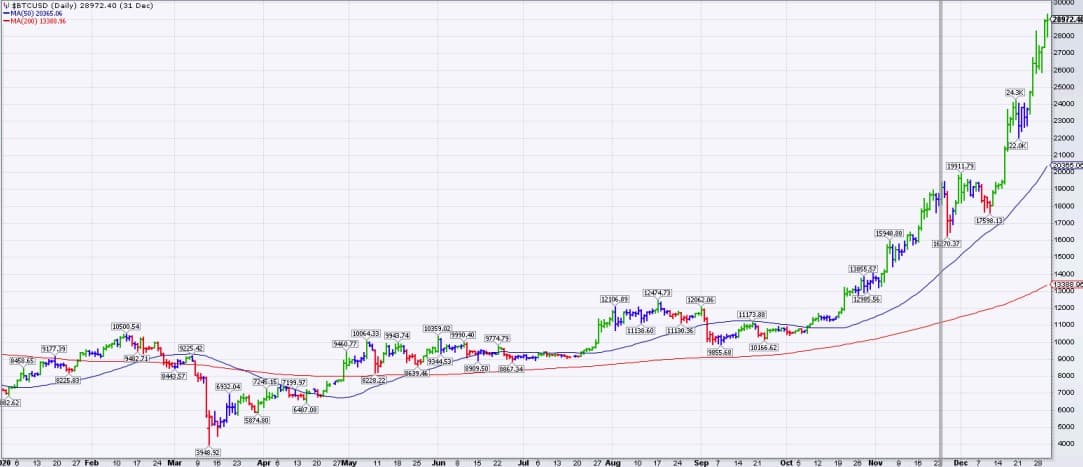
“At the beginning of 2020, BTC rallied from under $7000 to over $10,500 in less than 2 months,” he noted. “It then slowly decreased to $8000 on March 12. On March 13 a global meltdown in equities, commodities, and crypto happened as the world realized what an impact COVID was going to have. On March 13 BTC fell over 50% to under $4000. This had nothing to do with BTC, but rather a global panic attack. This is similar to what happened to the markets on August 4th and 5th.”
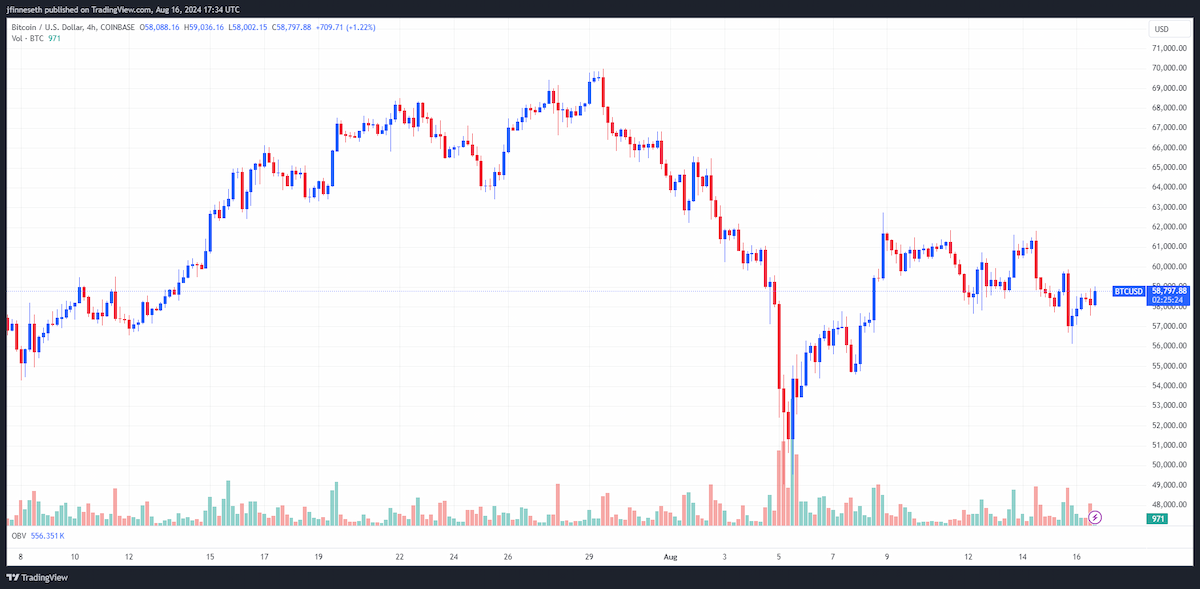
BTC/USD Chart by TradingView
“BTC then rallied back to a range of $8000 to $12,500 from early May (before the having) until late October,” he said. “People were complaining that this time was obviously different and the halving had no impact on price. Then all of a sudden between Oct 20 and Dec 31 BTC rocketed to $29,000.”
The Bitcoin halving every four years “will continue to have an impact on supply which ultimately impacts price,” Eberle concluded. “At the same time, unforeseen macro events can interrupt bull markets and delay the eventual price appreciation. We believe that it is highly likely that BTC will reach all-time highs before the end of the year and we are positioning our portfolios accordingly.”
Key factors beyond the halving
“It's safe to say the ‘traditional’ four-year cycles have changed, with several major events happening in the last few years such as FTX's collapse and the recent bear market ending with Bitcoin spot ETFs,” said Chris Martin, Head of Research at Amberdata. “The latest developments in regulations and ETFs will likely prove to be the most important events that dramatically shift landscape and industry.”
“We're starting to see significant institutional adoption in the market with several traditional finance players taking crypto very seriously, and it's only a matter of time before the market matures and cycles become less volatile (though not likely any time soon),” he suggested.
“Events like the Bitcoin halving played a major role in changing market cycles, but are more likely to be priced in in the future as supply changes are fully predictable – in the future I expect to see major events being more heavily weighted towards regulatory environments, macroeconomics, and catastrophic events (such as a large hack, theft, or collapse of some kind),” Martin concluded. “Crypto winters, in turn, are likely to be far more stable as adoption grows.”
“It is important to note that Bitcoin is no longer considered ‘magic Internet money,” said Michal Pospieszalski, CEO of MatterFi. “Instead, it is now recognized as a legitimate asset class by some of the world’s largest financial institutions and is even being considered as a potential reserve currency for the U.S., according to the latest bill draft from Senator Cynthia Lummis.”
Pospieszalski believes this shift changes the dynamics entirely. “Bitcoin has evolved into a global asset that is more likely influenced by macroeconomic factors, such as quantitative easing or presidential elections, rather than its internal mechanisms for slowing supply growth,” he said.
“Additionally, over 19.74 million out of the total 21 million Bitcoins have already been mined, equating to nearly 94% of its capped supply,” he noted. “The remaining coins will be mined over the next 100 years, meaning changes in the supply rate are expected to have a diminishing impact on Bitcoin's price in the future.”
“As Bitcoin and cryptocurrency continue to move into the mainstream, traditional investors are increasingly taking notice, especially with U.S. ETFs for the two largest coins now available,” Pospieszalski said. “This not only drives prices and demand but also alters the capital structure of the crypto market, as short-term retail investors become less influential.”
“Currently, over 5.15% of the total Bitcoin supply is held by funds and ETFs, and over 1.56% is held by public companies (source: bitcointreasuries.net). These investors typically have a longer time horizon and greater resilience to temporary market downturns,” he concluded. “In the long term, such structural changes are expected to lead to lower volatility and exponential growth in Bitcoin's market cap over the next few years.”
Deeper futures markets
“During earlier periods in-flows represented by the cost of mining were the mainstay,” said James Davies, co-founder of Crypto Valley Exchange. “Since 2018, the market has become increasingly decoupled from the mining cost, occasionally connected but, often, the disconnect has become more related to cash inflows and outflows as the market has professionalized and increasing amounts of institutional money have flowed in.”
Davies noted the launch of spot Bitcoin ETFs “has provided Bitcoin with increased credibility, a broader market, and easier access.”
“This, along with greater on and off-ramp capabilities, has made the market more money-like,” he said. “It tends to look more and more like a very liquid commodities market, where it is a speculative asset but is treated like cash when cash is required for operational needs.”
“We see this with every volatility spike in other assets liquidating crypto holdings, especially Bitcoin to cover short-term needs; this makes it operate like money markets or super liquid commodities such as gold,” Davies explained. “As the narrative pushes Bitcoin in particular as an alternative to holding cash, we should expect it to operate like cash and be an early source of liquidity. We should also expect quick recovery early in an economic cycle, especially when other assets such as cash are placed there as it becomes available.”
More than the halving cycle, Davies said the biggest thing affecting the crypto market is the fact that it remains small compared to other major asset classes.
“One aspect that causes problems here is that the derivatives market is so small relative to the asset class,” he said. “Perps are not good for hedging or building other liquidity from them, so the derivatives market is stunted, growth-wise. Therefore, liquidity can absorb the short-term shocks even as stops and support levels get run through and we see exacerbated crashes.”
“If we want to see more stability (and probably less growth), we need deeper futures markets rather than perps,” he concluded. “These are coming, but it’s still a very young market.”
