

(Kitco News) – Even with gold prices trading near record highs, the precious metal should continue to enjoy support from central banks, investors and the physical market, with Fed policy a source of both support and risk, according to Joni Teves, Precious Metals Strategist at UBS.
“We think gold’s uptrend has legs and see further gains over the next couple years,” Teves noted in a recent presentation. “Strong official sector buying and resilient physical demand imply structural support and have lifted gold’s trading range,” while “Elevated macro uncertainty and persistent geopolitical risks [are] likely to drive a rise in investor gold allocations, which are currently still low.”
Looking at sovereign demand, Teves said UBS believes there’s room for official gold purchases to rise further.
“Though the official sector has already bought a lot of gold in the past decade, we think the trend can continue,” she said, and shared three reasons why she believes this is likely. “There tends to be inertia when it comes to official sector flows. The rationale for diversification is still valid and there is room to continue. Strategic sales are unlikely, given the potential damage to confidence from ‘selling the family jewels.’”

Teves also said that “the proportion of gold to total reserves is still low for many central banks relative to nearby peers,” highlighting India’s high reserve percentage compared to the rest of Asia, and Turkey’s and Russia’s high reserves compared to the countries of Central and Eastern Europe. She acknowledged, however, that “Uncertainty on [the] extent of purchases presents two-way price risks.”
Turning to the physical gold market, Teves noted that physical demand is also helping to underpin the broader market.
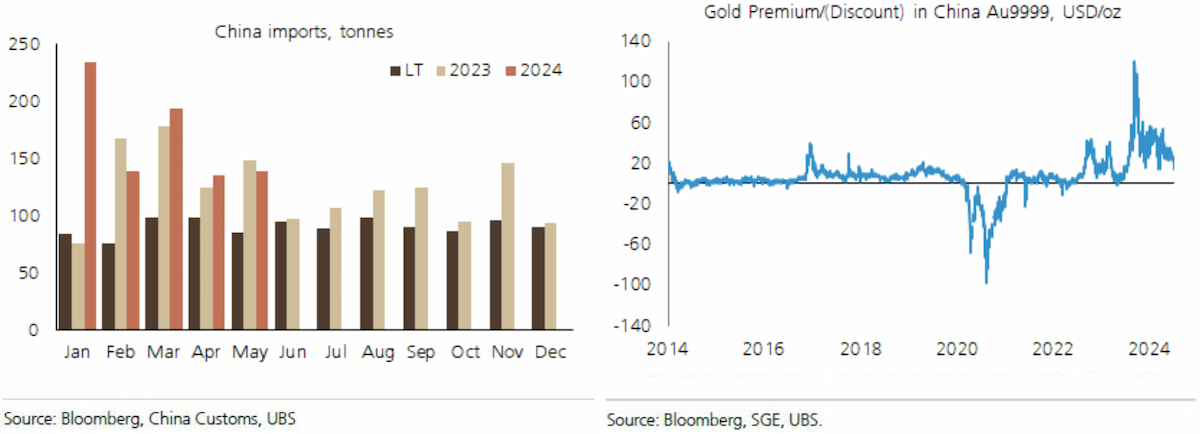
“Consumer demand has proven to be largely resilient over time,” she said, and noted that “India’s gold imports face headwinds from higher prices, but underlying interest remains strong.”

“In China, headwinds on jewellery demand [are] likely offset by strong investment interest,” she said, and pointed out that the country’s “onshore premium has eased.”
Regarding the precious metal’s relationship with interest rates, Teves noted that gold’s relationship with real rates is asymmetric.
“Gold’s sensitivity to real rates declined in the last couple of years vs historical levels,” she said. “This year, the relationship broke down.”

With the Federal Reserve poised to embark on their long-awaited rate-cutting cycle later this month, Teves noted that an easing in Fed policy is another positive for gold.
“In more recent easing cycles, median gains were higher 12 months after the first Fed cut,” she said. “In previous Fed easing cycles, gold gained as much as ~9% over 2-3 quarters after the first cut.”
Turning to the futures markets, Teves said UBS sees room for growth there as well. “We don’t think the market is crowded,” she said, adding that unlike prices, “Speculative positions are not at all-time highs.”
On ETFs and other investment vehicles, Teves characterized positioning as “relatively light.”
“Broader investor positioning has come from a low base,” she said. “There is a much wider investor base, with smaller gold allocations for diversification.”

UBS believes there is still room for investors to build allocations. “ETF outflows likely reflect rebalancing rather than changes in gold views – the value of gold ETFs has been relatively stable,” Teves pointed out. “Gold ETFs have yet to turn and the private wealth community has yet to actively recommend adding/increasing gold allocations.”

Turning to the geopolitical and macroeconomic picture, Teves noted that macro uncertainty encourages diversification, which should boost gold demand.
“In addition to geopolitical risks, the potential for higher macro volatility amid elections in many countries in 2024, especially the US, supports diversification,” she said. “Concerns about US debt and budget deficit could also be themes that add to gold’s long-term appeal.”

Amid all the supporting factors for the gold market, Teves said the key downside risk she sees is a hawkish Fed pivot.
“We are most worried about the threat posed by a hawkish shift in Fed policy driven by reacceleration in growth,” she said. “Dollar strength on the back of US exceptionalism would additionally weigh on gold. During previous Fed hiking cycles gold fell by a median of ~9% 2-3 quarters after the first hike, though post-taper tantrum declines were much larger at -45%.”

