
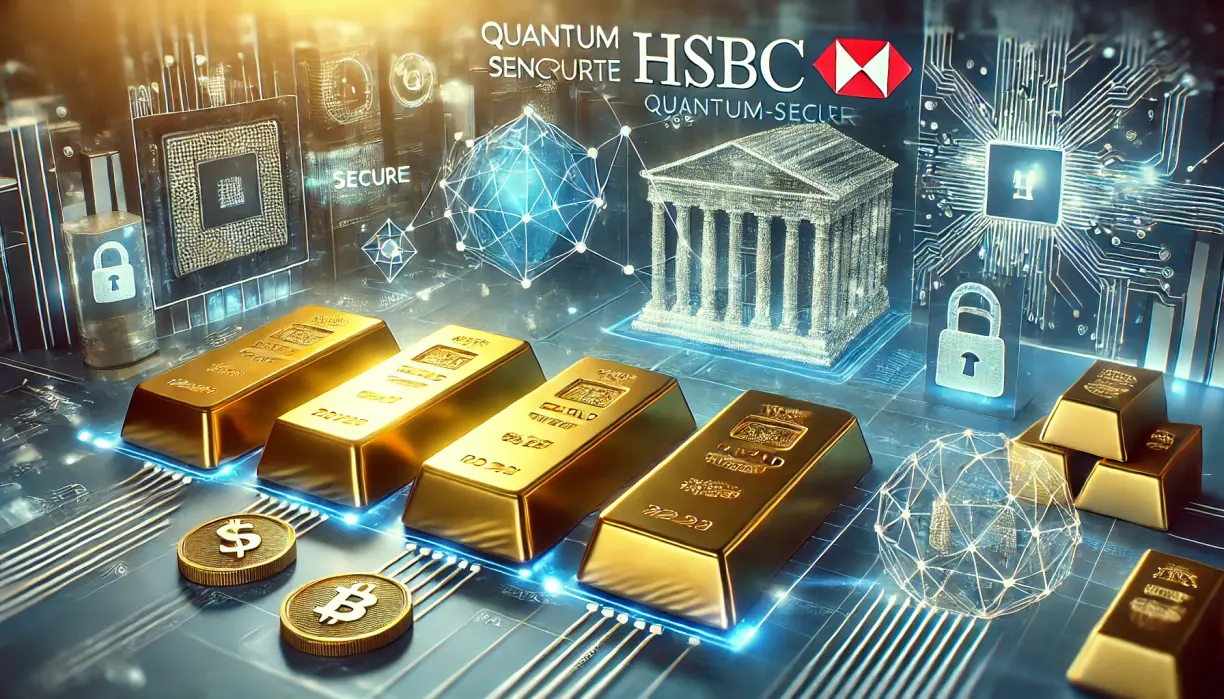
(Kitco News) – Gold has often been characterized as a ‘barbarous relic’ amid the rise of Bitcoin (BTC) and blockchain technology. For many, the yellow metal has struggled to transition to the digital world, but one bank is set to flip that script on its head thanks to the integration of quantum computing and tokenization.
Last week, HSBC announced that it has successfully trialed the first application of quantum-secure technology for buying and selling tokenized physical gold, a significant step toward protecting critical applications from potential future quantum computing attacks.
In 2023, HSBC became the first global bank to offer tokenized physical gold to institutional investors using distributed ledger technology (DLT). Earlier in 2024, they announced the launch of HSBC Gold Token for retail investors in Hong Kong, allowing them to acquire fractional ownership of physical gold denominated in .001 troy ounce fractions.
This latest advancement shows that HSBC is dedicated to expanding the use of its HSBC Orion digital assets platform and is already thinking about the future threat that quantum computing may pose while simultaneously working to get its blockchain-based offerings up to date.
As part of their pilot testing, HSBC also tested the interoperability of its gold tokens using post-quantum cryptography (PQC) to move digital assets safely across distributed ledgers via secure networks, addressing clients’ evolving needs and regulations.
According to the press release, this “included the capability to convert HSBC’s gold tokens into ERC-20 fungible tokens, thereby enhancing distribution and interoperability with other DLTs and digital wallets.”
For the trial, HSBC partnered with Quantinuum, a UK-US joint venture quantum technology provider and the world’s largest integrated quantum computing company.
Quantinuum used PQC algorithms and its Quantum Origin quantum randomness technology in the pilot to “demonstrate holistic protection of digital assets such as HSBC gold tokens from a quantum computing attack, and prevent ‘store now, decrypt-later’ (SNDL) cyber incidents,” the bank said.
PQC refers to a set of cryptographic algorithms designed to withstand attacks by quantum computers, which are expected to be capable of breaking many current encryption methods. SNDL is a cyber-theft technique designed to steal sensitive data now, which is then stored to be deciphered at a later date once quantum computers become more widely available.
The suite of algorithms used in this trial is currently being standardized by the U.S. National Institute of Standards and Technology (NIST) and is designed to be secure against future quantum computing attacks.
The successful trial of quantum-safe technology for tokenized gold trading has substantial implications for financial services, especially in a world where digital assets are becoming increasingly mainstream. As more value is brought into the digital realm, developing robust security measures that can withstand future technological advancements is paramount.
“The convergence of quantum computing and blockchain technology is creating new paradigms in financial security,” said Ilyas Khan, founder and Chief Product Officer at Quantinuum. “Our collaboration with HSBC is at the forefront of this innovation, paving the way for a more resilient digital financial infrastructure.”
Integrating quantum-safe technology with tokenized assets also opens up new possibilities for cross-platform interoperability and could potentially lead to more efficient and secure trading of digital assets across different blockchain networks and traditional financial systems.
“HSBC was the first international bank to offer tokenized physical gold and is now building on that innovation with cutting-edge cybersecurity protection for the future,” said Philip Intallura, Global Head of Quantum Technologies at HSBC. “This pilot successfully demonstrated the viability of deploying these advanced technologies for a real-world business environment.”
“By addressing SNDL threats, we're not just preparing for the future; we're actively shaping it,” Intallura added. “This breakthrough demonstrates that we can future-proof our digital asset offerings against potential quantum computing threats. By combining tokenised assets with quantum-safe technology, we're creating a new standard for security and innovation in digital finance. This isn't just about protecting assets; it's about building trust in the digital financial ecosystem of the future.”
