
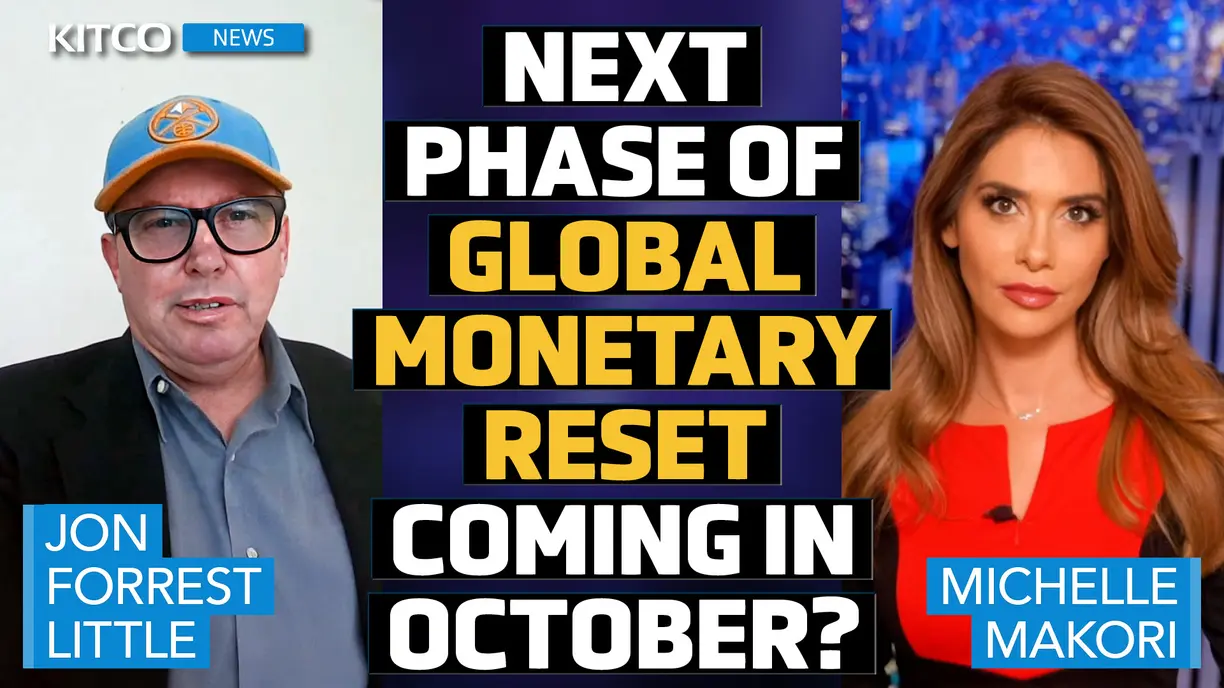
(Kitco News) - BRICS central banks boosting gold reserves is a sign that they are gearing up for a global monetary reset, which could enter a new phase following the BRICS October 22-24 summit taking place in Kazan, Russia, according to Jon Forrest Little, Founder and Director of Content at Silver Academy.
“They're gearing up for this reset coming up in October,” Little tells Michelle Makori, Lead Anchor and Editor-in-Chief at Kitco News. “There'll be so much turmoil during this transition.”
The October summit is taking place under the Russian chairmanship of the BRICS, with Russian Deputy Foreign Minister Sergei Ryabkov confirming the participation of 30 countries at this year’s summit, with new memberships on the table. This could potentially include Turkey, which submitted its bid to join the organization in September, and Thailand, which submitted a formal request to join at a BRICS ministerial meeting held in June.
The BRICS alliance was founded in 2006 by Brazil, Russia, India, and China, with South Africa joining in 2010.
At last year’s summit held in South Africa, BRICS underwent a major expansion and now includes Iran, Egypt, Ethiopia, and the United Arab Emirates. Saudi Arabia was also invited to join but its status remains unclear.
The new currency announcement to watch - what is the ‘Unit’?
BRICS nations have been seeking to reduce their reliance on the U.S. dollar. According to Little, this de-dollarization trend has been driven by the weaponization of the dollar through sanctions, concerns over U.S. debt, and a desire for greater financial autonomy.
There has been a push for trade settlements in national currencies, with BRICS countries developing a wide range of instruments for a new international financial system. The latest reports surround a new currency being referred to as the ‘Unit.’
This was confirmed by Andrey Mikhailishin, the head of the task force on financial services of the BRICS Business Council, in an interview with TASS in Septmeber.
A list of projects likely to be discussed at the October summit will include the unit of account (Unit), a platform for international settlements in BRICS digital currencies (Bridge), a payment system (Pay), a settlement depository (Clear), an insurance system (Insurance), and a BRICS rating alliance, Mikhailishin noted. "We are preparing a presentation of some solutions for the autumn BRICS summit, in the retail and b2b segments," he said.
The ‘Unit’ aims to create an alternative to the dollar-dominated global financial system, Little explained.
“The Unit stands for ‘united new international trade,’ and it's to get away from U.S. dollar dominance,” he said. “If you download the white paper, it's set up through the Bank of International Settlements.”
According to various reports, the "Unit" could be pegged 40% to the value of gold and 60% to a basket of BRICS national currencies, Little added.
For a full breakdown of the Unit and how project mBridge – a multi-central bank digital currency (CBDC) platform – fits in, watch the video above.
Little pointed out that the real impact on the global monetary system will begin to emerge only at the beginning of next year.
“They meet in October, U.S. elections are in November. I think we're looking at the first quarter of 2025, where we'll see evidence of how U.S. Treasuries get offloaded and people accumulate gold. And then we'll see some failures in our system as commercial real estate rears its ugly head and the banks will not be able to absorb those bad loans. The fed will have to come rushing in with some emergency bailout. And then at that point, we'll see some big reset on the global stage,” he said.
For Little’s gold and silver price forecasts in response to this reset, watch the video above.
Little also analyzed historical monetary cycles, noting that major currency resets happen every 150-200 years. Watch the video above for a quick history lesson on currency cycles.
SIGNS OF DE-DOLLARIZATION
- According to the IMF, U.S. dollar represents 58.8% of the share of currencies held in global foreign exchange reserves in the first quarter of this year. This is compared to nearly 73 percent in 2001.
- Russia and China have intensified their efforts to bypass the dollar. Russian President Vladimir Putin says that 90% of their trade is conducted in yuan and rubles, shielding it from U.S. influence.
- Indonesia has established a National Task Force to promote the use of local currency transactions (LCT) with its trading partners.
- Brazil, Argentina, India, and Saudi Arabia, are exploring various strategies to diversify their financial systems and reduce dollar dependency.
- Last year, China and Saudi Arabia signed a local currency swap agreement worth around $7 billion to shift more of their trade away from the dollar.
- According to JPMorgan Chase, an estimated 20% of global oil in 2023 was bought and sold in non-US dollar terms.
- China sold a record volume of U..S bonds in the first quarter, intensifying its shift away from dollar-denominated assets. U.S. Treasury data, cited by Bloomberg, showed that Beijing offloaded $53.3 billion worth of U.S. Treasury and agency bonds from its holdings. This surpassed the substantial volumes China had already been selling last year. Estimates indicate that China has sold approximately $300 billion of US Treasurys between 2021 and mid-2023.
- According to the U.S. Treasury Department, Japan sold $22 billion in Treasury securities in May. This reduced Japan’s holdings to $1.1 trillion and marked the second month in a row that Japan reduced its massive U.S. Treasury holdings. In April, it sold $37.5 billion in treasury securities.
This video is brought to you by Goldback --- Inflation-resistant, 24K gold currency. Learn where to get Goldbacks at https://www.goldback.com/.
