
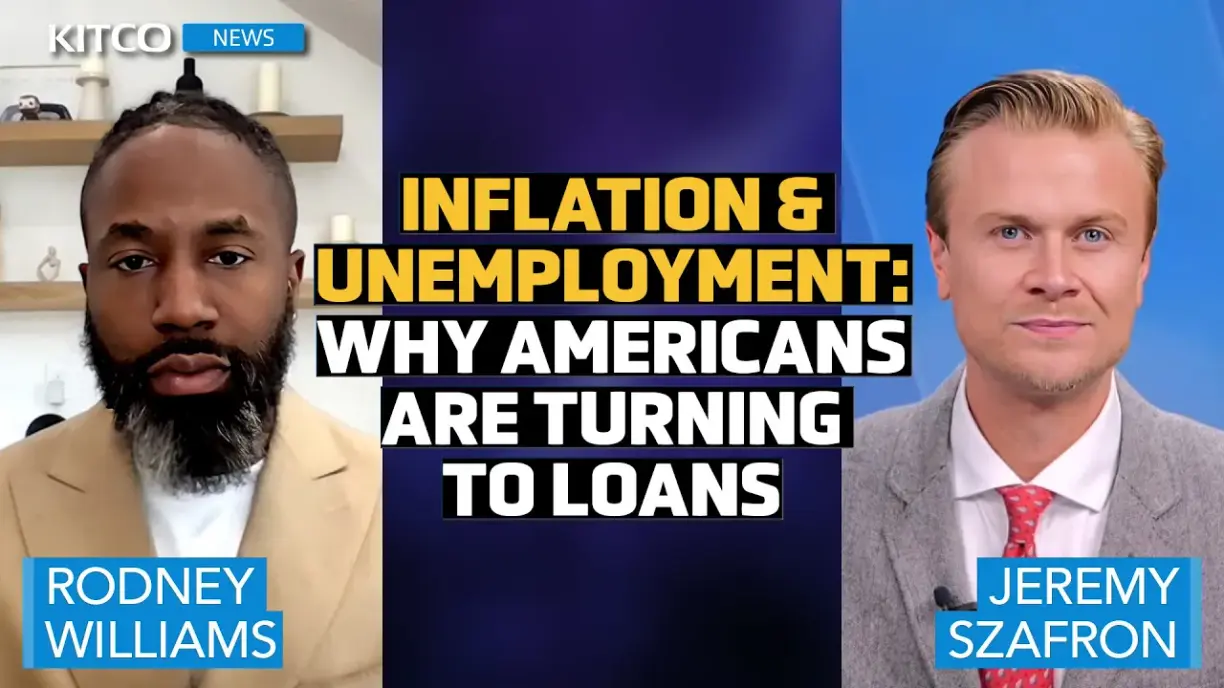
(Kitco News) - As inflation continues to pressure household budgets and unemployment claims rise, Americans are increasingly turning to high-cost loans to make ends meet. Inflation is not cooling fast enough, with overall CPI rising by 2.4% in September, while core CPI—which excludes food and energy—climbed to 3.3%.
These persistent price pressures, particularly in housing and healthcare, are making it harder for consumers to manage their daily expenses, according to Rodney Williams, co-founder of peer-to-peer lending platform SoLo Funds.
The strain of rising housing and healthcare costs, alongside a shaky job market, is contributing to consumers seeking alternative lending options, Williams tells Jeremy Szafron, Anchor at Kitco News.
“What we see on Main Street or the everyday working class, is that they're underemployed, they can't afford emergencies, they can't afford the inconsistencies that a lot of this group tends to experience,” Williams said.
The fallout from inflation and unemployment isn’t just affecting low-income households anymore. Credit card debt in the U.S. has reached a record $1.14 trillion in 2024, and consumers are struggling with average balances of $6,864, according to Lending Tree. This financial strain is pushing even higher-income earners toward borrowing.
“We started to see a significant increase in demand for this product for consumers that make over $100,000 a year… They were over-leveraged, and the rising inflation just wiped out all of their savings,” Williams explained.
For many, rising living costs are outpacing salaries, leading to a growing reliance on credit cards and payday loans, which often come with steep fees and interest rates that leave consumers in even deeper debt. Williams noted, “At that point in time, you’re over-leveraged… but you still have an issue to put food on the table for your family.”
With consumer debt at an all-time high and inflation not cooling as quickly as hoped, the economic divide between Wall Street and Main Street continues to widen. Traditional financial systems are increasingly failing to meet the needs of struggling consumers.
Williams emphasized that fintech innovations like SoLo Funds offer a necessary alternative. “Fintechs were drastically cheaper than a traditional subprime credit card and payday loans, to the point of significant savings for everyday consumers,” he said.
However, Williams believes the regulatory system must evolve to embrace more inclusive financial products that help rather than exploit consumers during times of financial strain.
For a deeper dive into Rodney Williams’ insights on the current economic crisis and how Americans are navigating these difficult times, watch the full interview above.