
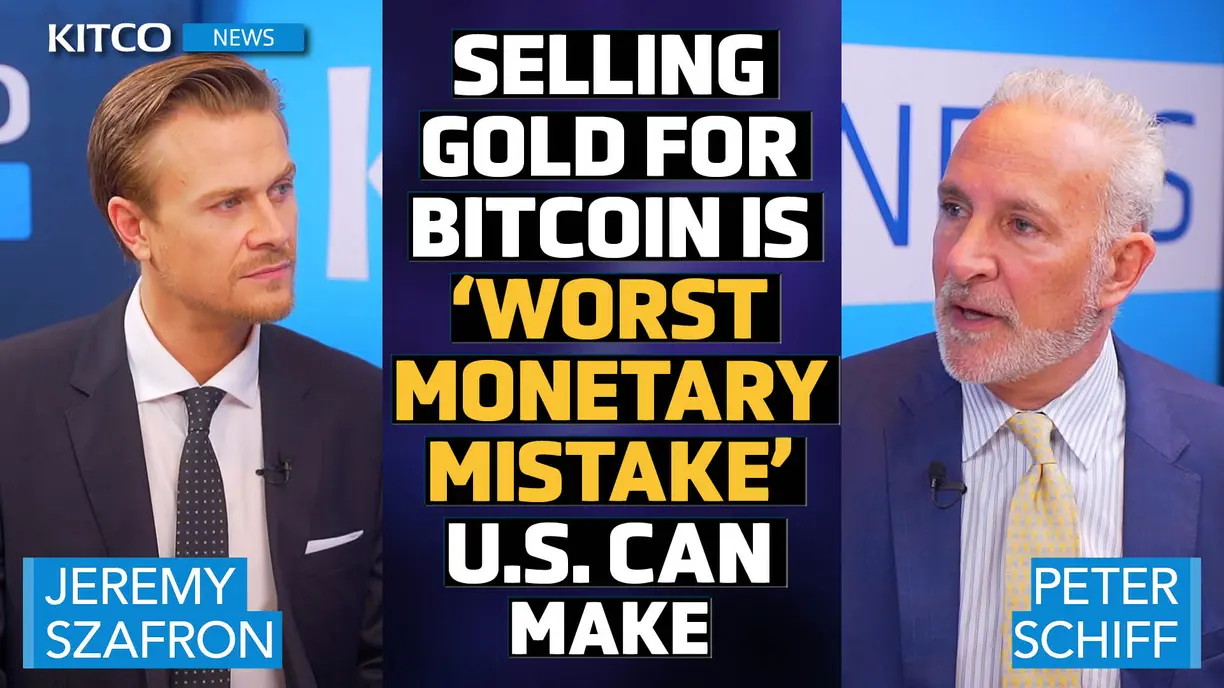
(Kitco News) - Gold prices are not dropping below $2,000 an ounce again in our lifetime following the metal's performance this year, said Peter Schiff, chief market strategist at Euro Pacific Asset Management.
"I don't think gold's going back to $2,000," Schiff told Kitco News anchor Jeremy Szafron on the sidelines of the New Orleans Investment Conference. "That's history now, and we're off to much higher levels without any resistance. The price of gold can double, triple from here, and potentially go much higher than that."
Schiff analyzed previous gold rallies and consolidations, pointing out that gold has broken out from previous levels – now up more than 28% year-to-date.
"Gold went through a long consolidation from 2011 to 2024, where it traded between $1,500 and $2,000. But that was after the big breakout from 2001 to 2011, where gold went from sub $300 to about $1,900," he described.
For Schiff's macro outlook and how it impacts gold in 2025, watch the video above.
"At some point, the price of gold is going to rise high enough that the greed is going to start to replace fear in the market, and then you're going to start to see investor interest picking up in the mining stocks," Schiff added.
Selling gold to buy Bitcoin is the 'worst monetary mistake' the U.S. can make
Wyoming Senator Cynthia Lummis has recently sparked a debate by suggesting that the United States convert a portion of its massive gold reserves into Bitcoin. The U.S. has over 8,000 tons of gold on its balance sheet — the largest gold reserves in the world.
Lummis explained that the conversion could be "balance sheet neutral," meaning no immediate cost to the Treasury. Instead of spending nearly $90 billion to buy Bitcoin outright, Lummis proposed exchanging gold certificates for the digital asset, creating a Bitcoin reserve without impacting government finances.
Unlike Trump's initial proposal, which focused on the 200,000 Bitcoins already seized by the government, her plan significantly expands the scope. Her bill calls for acquiring one million Bitcoins — that's 5% of the total supply — to hold over the next 20 years.
Lummis' proposal is "basically treason," Schiff said, pointing out that creating a strategic Bitcoin reserve by selling some of the gold the U.S. holds would be the "worst monetary mistake."
"Bitcoin is not a viable reserve. What makes gold a good reserve is that if the U.S. government ever needed to sell gold in an emergency to prop up the dollar, a very deep liquid market could easily absorb the selling. But if the U.S. government tried to sell a significant quantity of Bitcoin, the market would crash," Schiff explained. "In fact, the only reason Bitcoin is knocking on the door of a $100k is because everybody expects the U.S. government to buy millions of Bitcoin."
For Schiff's take on other key risks going into 2025, including his outlook on debt, watch the video above.
This video is brought to you by Uranium Energy Corp and U.S. GoldMining Inc.

