
(Kitco News) – Trade tariff uncertainty will continue to support the safe haven bid beneath gold prices in the near term, while the growth of 5G networks and grid electrification are boosting silver’s long-term demand profile, according to precious metals analysts at Heraeus.
In their latest precious metals update, the analysts pointed to new gold investment from China’s insurance giants as a significant development.
“A group of 10 Chinese insurers have been cleared to invest up to 1% of their assets (~$27.4 billion) in bullion. At current gold prices, this equates to 295 tonnes – 34% of 2024’s total bar investment demand,” they wrote. “Bar investment demand rose 10% year-on-year in 2024, reaching 1,185 tonnes.”
“If these insurers act on their allocation, 2025’s investment demand could surge by at least 25% if all other sources remain flat,” they underlined.
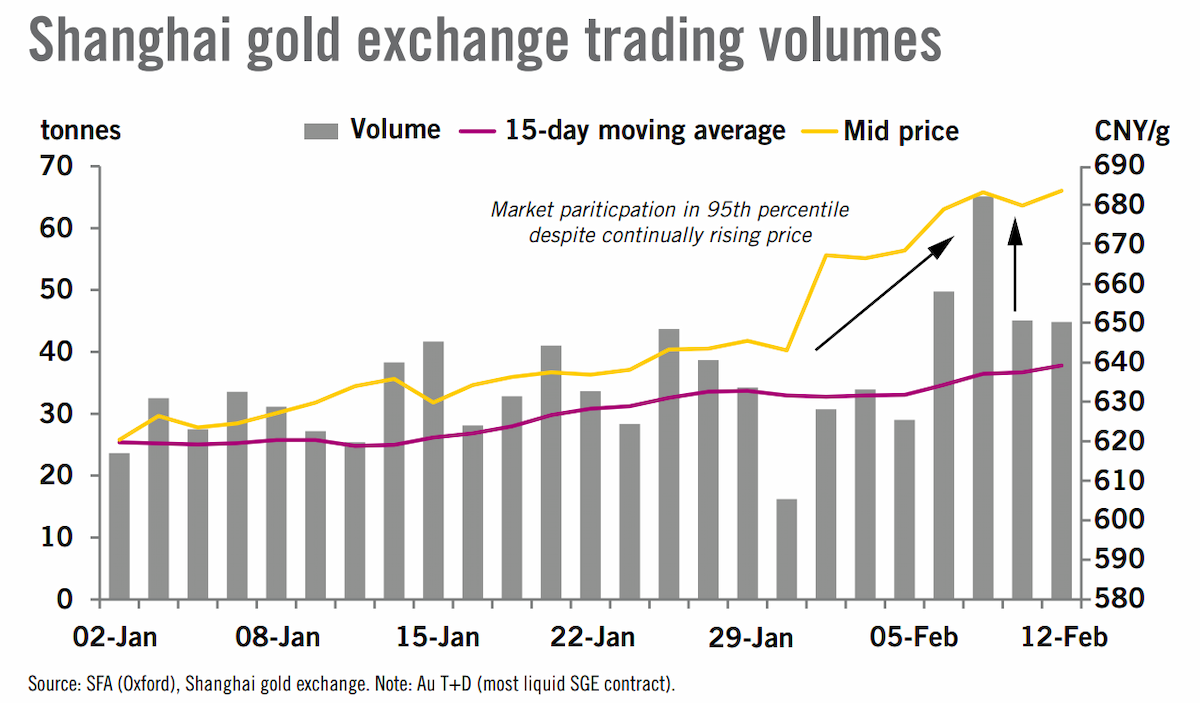
The analysts noted that a 25% rise in total investment demand in 2024 led to 39 fresh record highs for gold prices. “With eight new all-time highs already in 2025, further capital inflows will likely sustain gold’s bullish momentum,” they said. “Moreover, trading volumes on the Shanghai Gold Exchange have surged to 44,000 tonnes over the last week, which is more than 95% of weekly volumes seen over the last four years of trading. This implies that Chinese investors and market participants coming back from the Chinese New Year holiday are not yet being discouraged by new record highs in both US dollar and yuan terms.”
Heraeus also believes that in the long term, Chinese AI upstart DeepSeek could help drive gold demand in the space. “The release of its opensource R1 AI model in January cut graphics processing unit (GPU) requirements for training large language models,” they noted. “However, rather than curbing GPU demand, cheaper, more efficient AI models accelerate adoption, driving hardware consumption. Leaders in the space, including the CEO of Microsoft, reason that lowering the cost of AI will increase demand for the technology. In 2023, NVIDIA shipped 3.7 million data centre GPUs, consuming 2 tonnes of gold – nearly 1% of global electronic gold demand, based on an estimated 0.5 g of gold per GPU.”
The analysts expect gold demand from AI to continue rising despite improving efficiency as the technology expands into automotive and robotics. “However, electronic demand for gold in 2024 remains 15% lower than in 2010,” they pointed out. “Therefore, we are unlikely to see growth that exceeds historical levels, as innovation in computing efficiency will continue to progress and fabricators are increasingly incentivised to reduce exposure to the high cost of gold.”
The analysts also said that while Fed chair Powell acknowledged the strength of the U.S. economy during his congressional testimony last week, the impact of trade tariffs “was sidestepped,” adding uncertainty to the United States’ economic outlook which will likely continue to support strong safe-haven demand for gold.
“As trade tensions persist, gold’s haven demand is likely to stay supported in the mid-term, despite signs of economic strength,” they wrote. “Throughout February, spot gold’s Relative Strength Index (RSI) has remained above 70 (overbought territory) following successive rallies to new all-time highs. In line with this, the gold price has begun to cool, retreating from its peak of $2,941/oz on Tuesday to $2,896/oz on Friday.
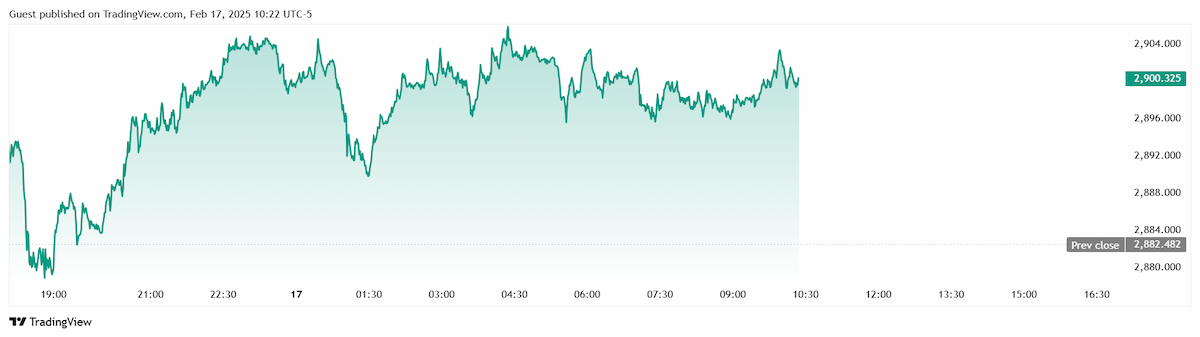
Gold prices have largely recovered from last Friday’s selloff and are attempting to reestablish support at the $2,900 level on Monday morning. Spot gold last traded at $2,900.36 per ounce for a gain of 0.63% on the session.
Turning to silver, Heraeus said that the growth of 5G networks is helping to sustain silver demand.
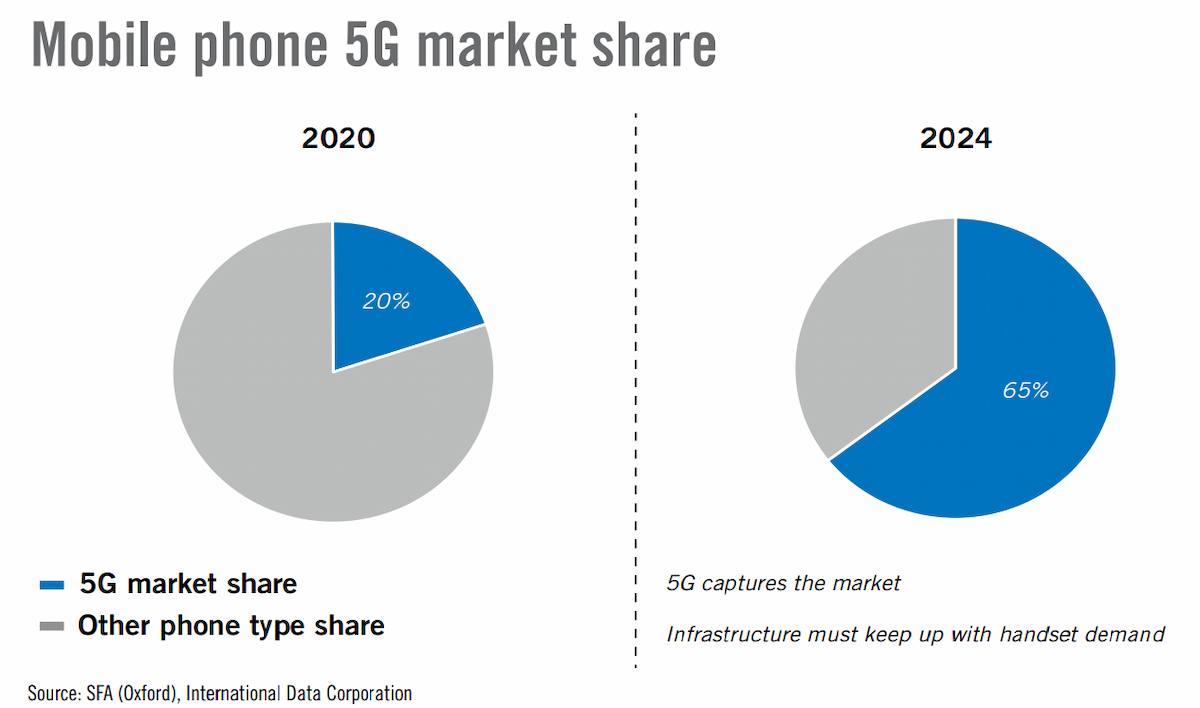
“Global smartphone sales saw 7% year-on-year growth in 2024, totalling 1.22 billion units (source: Canalys). Year-to-date available data (up to Q3’24) on 5G handsets’ share of this total shows that it increased from 58% in 2023 to 64% in 2024 (source: IDC). Extrapolating the data indicates that sales of 5G phones are estimated to have increased by 18% year-on-year in 2024 while sales of other phones decreased by 15%, offsetting overall growth in handsets.”
“While 5G smartphones themselves are not the primary source of silver demand, 5G infrastructure, including base stations, antennas and transceivers, relies heavily on silver for conductivity,” they noted. “In 2025, total silver demand across 5G-enabled segments is estimated at 15-17 moz, with 5G-enabled vehicle connectivity and semiconductor demand comprising 66% of this total (source: The Silver Institute). Additionally, the 5G base station market, valued at $28 billion in 2024, is expected to increase five-fold to $140 billion by 2029 (source: Research and Markets). In 2024, total electronic silver demand (excluding photovoltaics) is expected to reach 253 moz, with 5G infrastructure contributing nearly 7% of this total. Excluding solar, overall electronic silver demand is estimated to have risen by only 0.3% in 2024.”
“As 5G adoption expands and infrastructure deployment accelerates, silver’s industrial demand will remain robust, reinforcing its long-term growth,” they added.
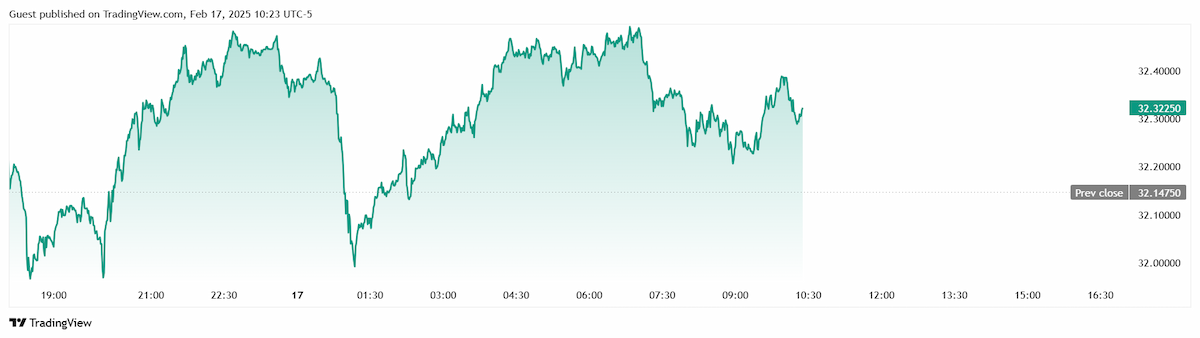
Silver prices are continuing to see heightened volatility following last week’s rollercoaster ride. At the time of writing, spot silver last traded at $32.322 per ounce and is up 0.54% on the daily chart.