
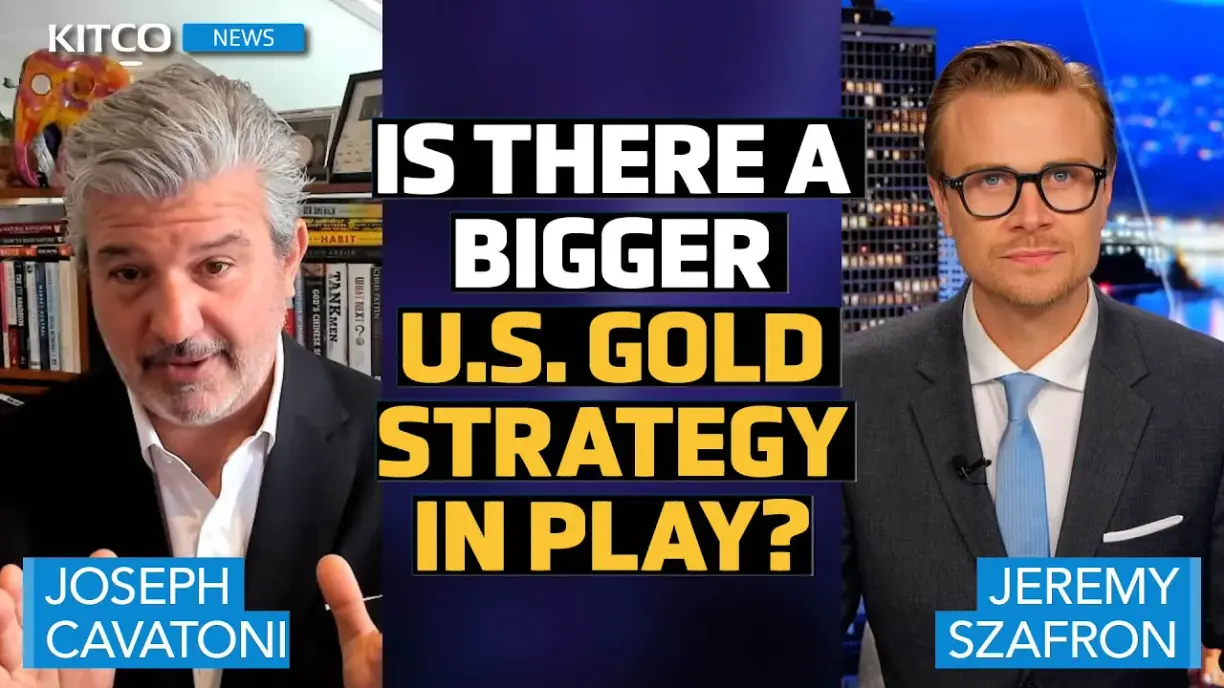
(Kitco News) - Gold's break above $3,000 an ounce is more than a price milestone. According to Joseph Cavatoni, Senior Market Strategist at the World Gold Council, it's a signal that global investors are repositioning amid rising geopolitical and economic uncertainty.
In an interview with Kitco News, Cavatoni said gold is reasserting its role as a "risk-mitigating asset" in a world fraught with trade tensions, inflation ambiguity, and growing demand for safe-haven hedges.
"The rapid rise in price over the last year has been quite telling," said Cavatoni. "People are gravitating back to gold to manage and mitigate increased levels of risk – whether geopolitical or directly political."
The precious metal has climbed 15% year-to-date, rising from $2,500 to $3,000 in just 210 days – a move that pushed it three standard deviations above its 200-day moving average. While technical analysts have flagged the $3,040 to $3,050 zone as near-term resistance, Cavatoni said underlying demand remains robust.
ETF inflows point to Western investor resurgence
According to World Gold Council data, global gold ETFs saw $3 billion in net inflows last week alone – roughly 31 tonnes of gold. That marked the eighth consecutive week of inflows, with North America accounting for most of the buying. Year-to-date, global net inflows have topped $19 billion (207 tonnes), putting 2025 on pace for the strongest Q1 since 2022.
"Risk abounds, and investors are actually saying, 'It's time to put money back into risk-protecting assets,'" Cavatoni said. "Of the $19 billion we've seen, about $12 billion has gone into the U.S."
He added that Europe may pick up pace over the next six months, especially if the macroeconomic outlook worsens or the dollar weakens further. "Right now, people are trying to assess whether the strategy the administration is using will be good or risky for the economy," he noted.
Tariffs and gold: A strategic inclusion, not a target
The April 2 unveiling of the U.S. administration's reciprocal tariff plans could further elevate gold's appeal. While Cavatoni said there are no direct threats of tariffs on gold, he emphasized the strategic thinking behind gold’s recent inclusion in President Trump’s executive order on critical minerals.
"Gold in many ways is a monetary metal, and it plays a very key role in investment portfolios. The administration understands the value of gold," he said. "It might not be 'critical' by definition, but it's strategic. There is a bigger game afoot."
The order, part of the Defense Production Act invocation, aims to boost domestic production of minerals tied to national security. Gold's mention signals Washington's growing acknowledgment of its financial and geopolitical significance.
Physical gold flows still heading to the U.S.
Gold imports into the United States remain elevated. According to Swiss customs data cited by the World Gold Council's Krishan Gopaul, Swiss gold exports in February totaled 214 tonnes, with the U.S. remaining the top destination. Year-to-date Swiss gold exports have hit 449 tonnes, the highest since 2012.
Cavatoni explained that traders continue to move physical gold into the U.S. to back futures contracts amid tariff uncertainty. "Until there's absolute clarity on how tariffs will play out, the gold needs to continue to come to the U.S. market," he said.
Central banks and investment demand lead the charge
Cavatoni underscored that gold’s price strength is being driven by central banks and investors – not consumers. Jewelry demand in Asia and the Middle East has slowed due to higher prices, with retailers reporting an uptick in recycling as consumers cash in holdings.
"Investment is taking on more momentum," he said. "We're seeing insurance companies in China getting approval to invest in gold via the Shanghai Gold Exchange. That's a shift."
Meanwhile, central bank demand remains firm, with China, Poland, Bolivia, and other emerging market nations continuing to add to their reserves, Cavatoni confirmed. "Some are even using their gold reserves to support domestic economic conditions," he added.
What's next for gold?
While the World Gold Council does not issue price targets, Cavatoni noted that some analysts are pointing to $3,100 and even $3,450 an ounce as the next big levels.
"We don’t see a lot of factors on the horizon that are looking to put downward pressure on gold," he said. "The case remains very strong."
Watch the full interview with Joseph Cavatoni, Senior Market Strategist at the World Gold Council, embedded above.