
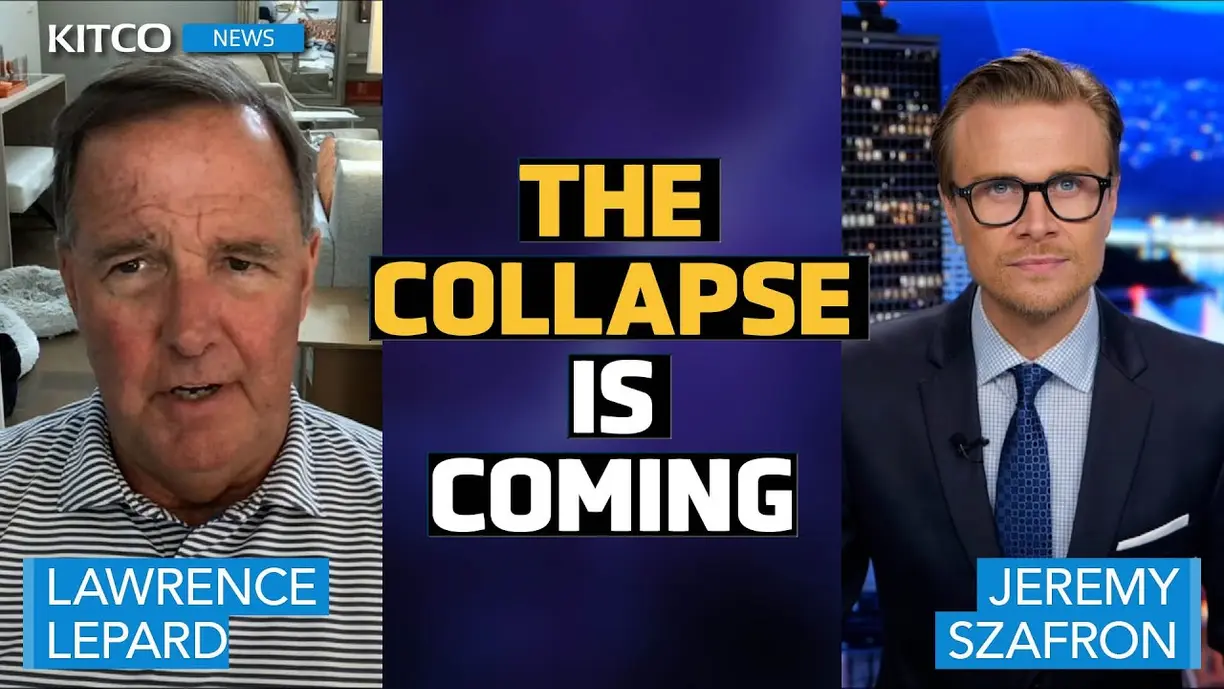
(Kitco News) - The United States is hurtling toward a monetary breaking point, and according to sound money advocate and investor Lawrence Lepard, the clock is running out.
Lepard laid out the core thesis of his book The Big Print: What Happened to America and How Sound Money Will Fix It, offering a scathing critique of fiat currency, Federal Reserve policy, and the political establishment.
"We have built our financial system on a bedrock of sand, not sound money. It is collapsing," Lepard told Kitco News. According to him, the inflation, debt, inequality, and social division that define America today are all symptoms of a deeper monetary disorder that began decades ago.
"The greatest issue of our time is the broken monetary system, which leads to enormous wealth inequality," Lepard said. "It's inherently unfair when someone can click a mouse key and create money."
According to data from the Federal Reserve Bank of St. Louis, the U.S. M2 money supply grew from $663 billion in 1971 to over $21 trillion by late 2024. This represents a compound annual growth rate of nearly 6.8%, a monetary expansion that Lepard says is the true driver of inflation – not corporate greed or external shocks.
Citing economist John Williams of ShadowStats, Lepard argued that the official Consumer Price Index (CPI) underreports real inflation, distorting the public's understanding of economic conditions. "Inflation is always a monetary phenomenon," he said, echoing Milton Friedman's assertion. "And the government has every incentive to lie about it."
Lepard believes America is in the final phase of what he calls "a decades-long monetary experiment" that began with the Federal Reserve Act in 1913 and accelerated when the U.S. abandoned the gold standard in 1971. He sees mounting debt as the accelerant. "We're now at over 120% debt-to-GDP. Historically, once a nation crosses the 130% threshold, a currency crisis becomes a near certainty," he said, citing research from Hirschmann Capital.
The consequences, according to Lepard, could include either a deflationary collapse, rampant inflation, or a full-scale monetary reset. "We're in what I call the debt doom loop," he said. "Interest costs drive deficits, which require more borrowing, which raises interest costs again. It's reflexive."
To understand the moment, Lepard points to the "Fourth Turning" framework by historians William Strauss and Neil Howe. "The question at the heart of this crisis is: What is money?" he said. According to the Fourth Turning theory, every 80 to 100 years, Western societies undergo transformational upheavals. Lepard argues we are deep into that cycle now—and what emerges on the other side will redefine the global monetary order.
While Lepard has historically advocated for gold, he now believes Bitcoin offers the most compelling escape from fiat decay. "Bitcoin is the single most asymmetric bet I have ever encountered," he said. Unlike gold, which is mined at a 1.7% annual rate, Bitcoin has a fixed supply cap of 21 million and operates on a transparent, decentralized ledger. "It's provable, auditable digital scarcity," he explained.
Still, Lepard makes it clear that he supports both gold and Bitcoin as sound money alternatives. "They're both money outside the state," he said. Central banks cannot print them, and that, he argues, is the point.
Lepard also issued a stark warning about the long-term consequences of unchecked fiat debasement. "Hyperinflation happens when people realize the government can never stop printing," he said. According to him, this realization is spreading quickly – from Costco shoppers to global central banks now aggressively acquiring gold.
The solution, according to Lepard, is radical but rooted in history: abolish the Federal Reserve, end FDIC guarantees, and let the free market determine what money should be. "We don't need monetary central planners," he said. "Banks that take risks should fail. We need to return to the rule of law and reward savers again."
As for the average American, Lepard's message is direct: protect your purchasing power now. "The government is in a debt trap. They will print to get out of it. Own what they can't print – gold, Bitcoin, scarce real assets."
The Big Print is available now on Amazon. To watch the full Kitco News interview with Lawrence Lepard and enter for a chance to win a signed hardcover copy of the book, visit @KitcoNewsNOW on X.