
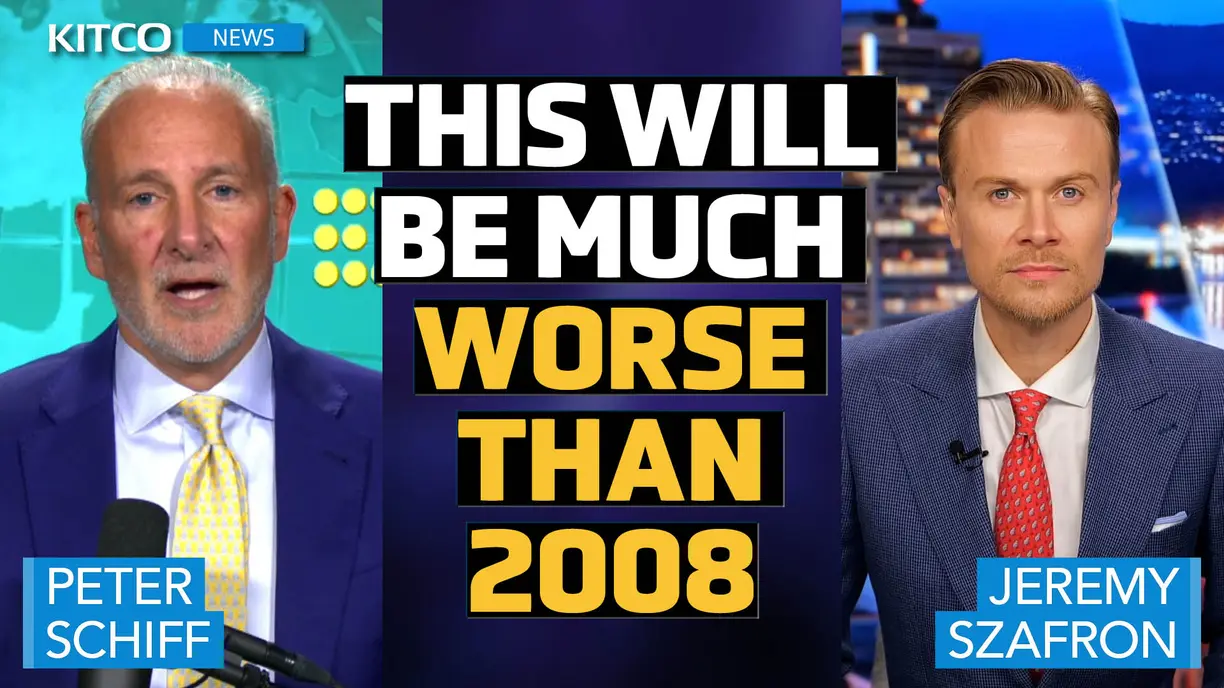
(Kitco News) - Gold has hit an all-time high, the dollar is plunging, and yields on U.S. Treasuries are rising even as equities fall. Markets are flashing warning signs that the global economic order is shifting – and according to Peter Schiff, Chief Market Strategist at Euro Pacific Asset Management, the United States is the epicenter of the crisis.
“This is going to be a financial crisis much worse than 2008,” Schiff said in a new interview with Kitco News. “But it’s not going to be global. It is a U.S. crisis.”
The U.S. dollar has fallen to a three-year low against the euro, while spot gold surged past $3,250 this week, capping its best weekly gain since 2020. The surge in gold, according to Schiff, reflects not a temporary flight to safety, but a structural reordering of global capital.
“Gold was going much higher,” he said. “Back in 2009, 2010, 2011... I was thinking gold would go to like $5,000 when it was like $1,000. But now it’s 2025 and we’ve created so much more money and so much more debt... $5,000 is nothing at this point. That’s just a pit stop on the road to much, much higher prices.”
Central banks have been buying gold aggressively in recent years, a trend Schiff believes confirms the global shift away from the U.S. dollar as the world’s reserve currency.
“They are preparing for a world where the dollar is no longer the center of the monetary system,” Schiff said.
This week’s market turmoil followed President Trump’s announcement of sweeping tariffs, including a 145% duty on Chinese imports. Beijing retaliated with a 125% tariff on all U.S. goods and labeled the administration’s policies “a joke.”
While many economists predicted tariffs would strengthen the dollar, Schiff said the exact opposite is playing out.
“Every single economist, every market strategist kept saying tariffs are going to be good for the dollar,” he said. “I’m the only one that said ‘no, tariffs will actually be bad for the dollar’.”
According to the University of Michigan’s latest sentiment data, released Friday, consumer confidence plunged to 50.8 in April, its lowest level since mid-2022. Inflation expectations surged to 6.7% for the year ahead–the highest reading since 1981 – while 5-10-year inflation expectations hit 4.4%, more than double the Fed’s 2% target.
“The Fed keeps saying long-term expectations remain anchored at 2%. What are they talking about?” Schiff said. “Nothing is anchored at 2%. We’ve been adrift for a long time, and now we’re at 6.7%. And it’s going to be a lot higher than that.”
He warned that the U.S. is entering a period of stagflation far worse than what the country faced during the 1970s.
“We’re going to be in almost like a depression and inflation is going to be much higher than it was back then,” Schiff said. “Very high inflation, I mean a horrible recession. So the worst possible stagflation.”
Schiff argued that the economic fallout isn’t a result of foreign manipulation, but decades of domestic policy failure.
“We as Americans, for decades now, have lived beyond our means,” he said. “We get to live a standard of living that’s higher than what we’re really entitled to based on our collective productivity... We’re going to have to live within our means, which means we have to consume a lot less. We have to save a lot more.”
Asked whether the U.S. could reassert control over its monetary future, Schiff expressed deep skepticism.
“We’re broke,” he said. “We’re running multi-trillion dollar deficits. So how are we going to buy gold? Are we going to just go into deeper debt to buy more gold?”
While central banks continue to buy physical gold at record pace, Schiff emphasized that the smarter trade now lies beneath the surface – literally.
“When you buy gold mining companies, you’re buying gold that’s still in the ground, and gold in the ground has never been cheaper in all of history than gold above ground,” he said.
Despite recent gains, most gold mining stocks remain deeply discounted, Schiff argued – ignored by Wall Street and under owned by institutions.
“Gold mining stocks have never been this cheap – not only relative to gold, but relative to the S&P 500,” he said.
He added that energy prices collapsing relative to gold has improved mining margins significantly, setting the stage for explosive upside.
“Their profits are about to skyrocket because oil has never been this cheap in history relative to gold,” Schiff said. “They’re trading at single-digit multiples… when you triple, quadruple your money in these gold stocks, which I think you could do very quickly, then take some profits and buy more physical.”
Schiff said he expects gold equities to outperform the metal itself by several multiples.
As for Bitcoin, which has risen sharply in nominal terms but lagged behind gold since 2021, Schiff was blunt.
“Bitcoin is just a digital pyramid scheme, Ponzi chain letter. It’s not gold. It’s not digital gold,” he said. “Bitcoin’s peak price in 2021 in terms of gold – it’s down 30% since then. So I think the air is already coming out of the bubble.”
In Schiff’s view, the only path to recovery is through painful restructuring.
“We have to go back to work. We have to stop spending. We have to start saving. We have to build factories and supply chains,” he said. “If we don’t do the right thing, then we’re going to have a lot of pain – but it’s not going to be constructive. It’s just going to lead to long-term, more pain, worse pain.”
To watch the full interview with Peter Schiff, click the video embedded above or visit the Kitco News YouTube channel.