
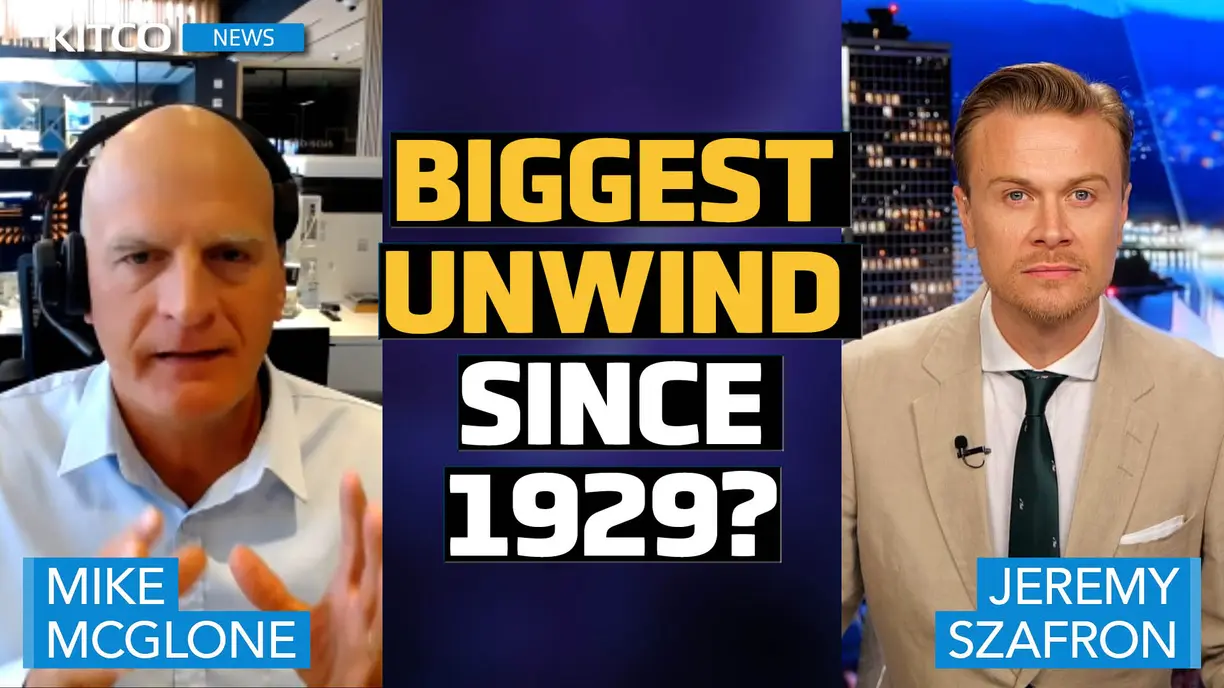
(Kitco News) - Gold’s rally past $3,200 an ounce may only be the beginning of a much larger move, potentially toward $4,000, as traditional safe havens fracture, Bitcoin falters, and the U.S. stock market teeters at historically extreme valuations. That’s the view of Mike McGlone, Senior Commodity Strategist at Bloomberg Intelligence, who told Kitco News in a wide-ranging interview that we are witnessing “the beginning of a bear market in the U.S. stock market” and a paradigm shift that favors precious metals.
“We're putting in a pretty good base now around $3,000,” McGlone said. “It’s going to head into $4,000, the question is time. Anything in between there is for the traders, which I used to do.”
Gold has surged nearly 25% year to date, driven by central bank demand, ETF inflows, and rising macro uncertainty. Goldman Sachs raised its year-end gold forecast to $3,700 this week and said the metal could spike to $3,900 in a downturn.
According to McGlone, the precious metal’s strength reflects deep structural shifts in capital flows away from speculative assets. “Gold is the most expensive ever versus the U.S. long bond market,” he noted. “And that’s a reflection of too much debt and the transition to tariffs creating more inflation.”
While gold soars, Bitcoin and equities have lost steam. McGlone said the U.S. stock market has already shed $6 trillion in market cap this year, half of what it gained in 2023, and warned of further downside. “This year, we've dropped $6 trillion of market cap,” he said. “We rallied $12 trillion last year, so we've taken back half of it. That was the biggest pump in history. Now we're pulling back.”
Bitcoin, too, may have peaked, he said, especially given declining ETF inflows and a deteriorating gold/Bitcoin ratio. “Right now, the ratio is around 26. Our model says it's going to break down below that low around 17 from Q4 and continue lower,” he said, citing Bloomberg data. “Bitcoin’s still a highly volatile, speculative risk asset… it’s just starting to tilt down. Some people say it’s a dip to buy. I say probably not.”
Bloomberg Intelligence’s base case for the S&P 500 is a drop to 4,000, a nearly 25% decline from recent levels, if a U.S. recession materializes. “The U.S. stock market is just at a century high versus the rest of the world and versus GDP in this country,” McGlone said. “Now it has a trigger for reversion, and it’s barely started.”
U.S. consumer inflation expectations are also worsening. The University of Michigan’s one-year inflation forecast jumped to 6.7% last week, the highest since 1981, while the Fed remains on pause. “We’ve created way too much liquidity… and the Fed stayed low for too long,” McGlone said. “They did not start tightening until Q1 2022. So they were behind. Then they tightened too much.”
As the Fed grapples with sticky inflation and mounting deficits, McGlone said the “wealth effect” is now reversing. “We’ve backed up $6 trillion so far this year. That’s the wealth effect. That’s 10% of GDP. Maybe it’s different this time, but I don’t think so.”
McGlone also pointed to the historic mispricing in equities relative to GDP and the rest of the world. “There’s only been two times in history when you get the stock market to two times GDP – 1929 in the U.S., 1989 in Japan. Now it’s 2025 and we’ve hit that level again.”
He added that global deflationary signals, especially from China and Germany, are already materializing. “China’s 10-year yield is 1.66%. The U.S. 10-year is 4.4%. That’s a sore thumb that’s going to revert at some point. I think U.S. bond yields drop to a two-handle, the question is when. Maybe this year.”
Asked where capital should go as stocks and bonds lose appeal, McGlone was unequivocal: “People are starting to get out of U.S. equities and buy gold. You see that in ETF flows, straight up this year.”
As for gold miners, which have lagged behind bullion, McGlone acknowledged investor frustration but sees potential upside if gold continues higher. “Gold is still driving the whole precious metals complex. If the S&P breaks down, then that flips the narrative toward Treasuries and away from gold, but we’re not there yet.”
Ultimately, McGlone said this could be a once-in-a-generation reset. “This is a paradigm shift in austerity, in tariffs, and it’s coming at a time when prices are stretched. We’ve delayed the unwind, but I think it’s happening now.”
To watch the full interview with Mike McGlone, click the video embedded above or visit Kitco News on YouTube. Subscribe for more expert insights on gold, Bitcoin, the Federal Reserve, and what’s next for markets.