
(Kitco News) - Gold prices are trading just off session lows after the latest data showed U.S. consumer sentiment declining further than expected this month.
The Consumer Confidence Index fell to 86 in April, below economists’ consensus forecast for a 87.5 reading and also below the upwardly revised 93.9 print in March, the Conference Board said on Tuesday.
The Present Situation Index, based on consumers’ assessment of current business and labor market conditions, decreased by 0.9 points to 133.5, while the Expectations Index, based on consumers’ short-term outlook for income, business, and labor market conditions, dropped 12.5 points to 54.4, the lowest level since October 2011 and well below the threshold of 80 that usually signals a recession ahead.
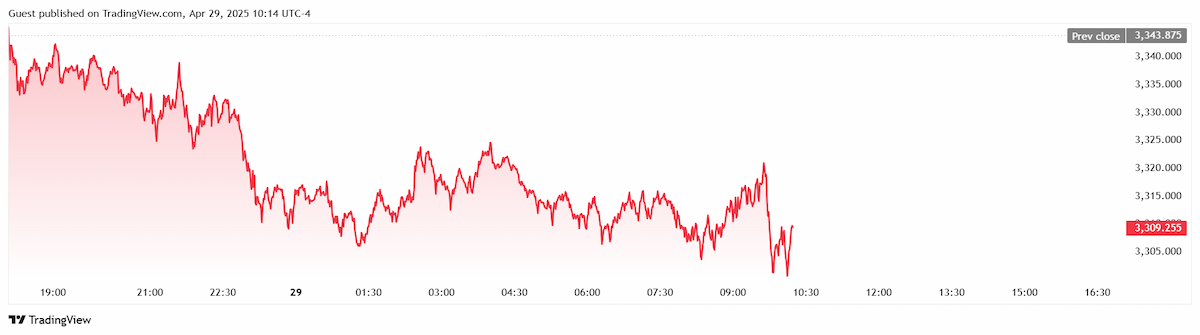
Gold prices fell to session lows following the 10 am EST consumer sentiment data release, with spot gold last trading at $3,309.39 per ounce at the time of writing for a loss of 1.03% on the session.
“Consumer confidence declined for a fifth consecutive month in April, falling to levels not seen since the onset of the COVID pandemic,” said Stephanie Guichard, Senior Economist, Global Indicators at The Conference Board. “The decline was largely driven by consumers’ expectations. The three expectation components—business conditions, employment prospects, and future income—all deteriorated sharply, reflecting pervasive pessimism about the future.”
“Notably, the share of consumers expecting fewer jobs in the next six months (32.1%) was nearly as high as in April 2009, in the middle of the Great Recession,” Guichard added. “In addition, expectations about future income prospects turned clearly negative for the first time in five years, suggesting that concerns about the economy have now spread to consumers worrying about their own personal situations. However, consumers’ views of the present have held up, containing the overall decline in the Index.”
April’s decline in confidence was seen across all age groups and most income groups. “The decline was sharpest among consumers between 35 and 55 years old, and consumers in households earning more than $125,000 a year,” the report said. “The decline in confidence was shared across all political affiliations.”
“High financial market volatility in April pushed consumers’ views about the stock market deeper into negative territory, with 48.5% expecting stock prices to decline over the next 12 months (the highest share since October 2011),” Guichard added. “Meanwhile, average 12-month inflation expectations reached 7% in April—the highest since November 2022, when the US was experiencing extremely high inflation.”
According to the write-in responses on what topics are affecting views of the economy, tariffs are now on top of consumers’ minds, with mentions of tariffs reaching an all-time high.
“Consumers explicitly mentioned concerns about tariffs increasing prices and having negative impacts on the economy,” the report noted. “Inflation and high prices remained important for consumers’ views about the economy: while the majority complained about the high cost of living, there were also some references to declines in the prices of gas and some food items. There were also numerous mentions of stock prices and uncertainty.”
The proportion of consumers anticipating a recession over the next 12 months rose to a two-year high, and the share of consumers expecting higher interest rates over the next 12 months continued to increase while the share of consumers expecting lower interest rates dropped further.
