
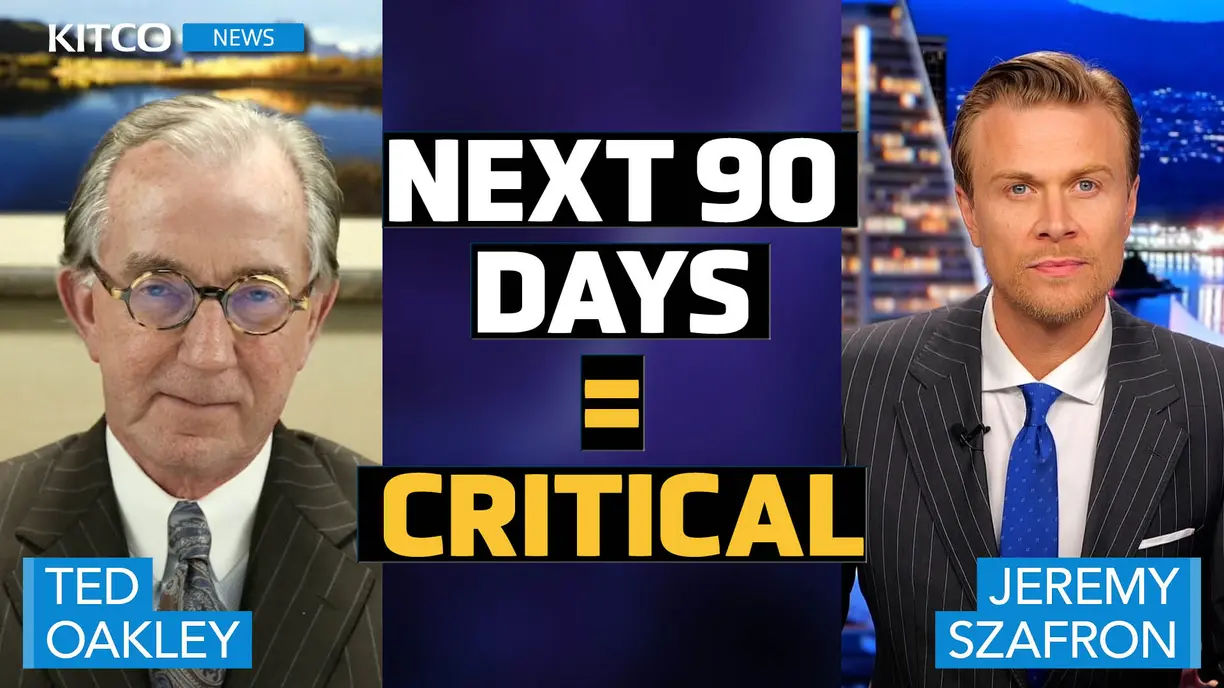
(Kitco News) - A major market correction may be just around the corner, as retail investors remain dangerously complacent and earnings projections begin to crumble, according to veteran money manager Ted Oakley.
“We're probably going to have margins come down, you're going to have earnings come down, and you're still at a 21 multiple on the S&P right now,” Oakley, founder of Oxbow Advisors, a multi-billion-dollar firm managing high-net-worth capital, told Kitco News. “If you have the multiple drop and the earnings drop, you could see that taking to new lows. It wouldn't surprise me.”
Oakley’s warning comes days after hedge fund legend Paul Tudor Jones told CNBC that not even a 50% rollback in President Trump’s proposed China tariffs would be enough to prevent stocks from making new lows. Jones cited the tariffs as “the biggest tax hikes since the 1960s,” warning they could shave 2–3% off U.S. GDP growth.
That concern appears to be playing out in the data. The U.S. trade deficit surged to a record $140 billion in March, according to the latest Commerce Department report, driven by a pre-tariff import wave that helped drag Q1 GDP down 0.3%.
Oakley said the weak growth was masked by the temporary front-loading of inventories. “It looked better than it really was, but they were just getting set up for something to come in this quarter,” he said. “Shipping, trucking, buying things—it's all really tightened up now. That's really the lifeblood of an economy… but that's coming to a halt.”
Despite growing macroeconomic stress, Oakley said the retail investor remains dangerously overconfident. “Retail investors, the individuals out here, they don’t see it… They’ve been so set up to buy the dip in the last 16 years, they think the Fed will always come to the rescue.”
He cited April data showing retail investors poured $40 billion into U.S. equities – the most in any month over the past five years – despite AAII sentiment surveys showing extreme bearishness. “That’s a sign of deep complacency,” Oakley said. “There’s nothing left to happen. But when the prices go down, then all of a sudden you see them start to do the things they shouldn’t do – which is sell at the low.”
Oakley is currently holding more than 50% of his portfolio in short-term Treasuries, earning over 4%. “We’re not trying to time the market,” he said. “But if we can’t buy something right, we’d just rather hold the money in cash right now.”
Still, Oakley is selectively buying. He cited recent purchases of Nutrien and Mosaic in fertilizers, Unilever in consumer staples, AbbVie and Novartis in pharma, and New Gold as a low-priced play on rising gold prices. “New Gold is selling at about three-and-a-half times 2026 cash flow,” he said. “If it were to go to six times cash flow, you'd almost double the stock.”
Gold, Oakley said, is acting as expected in this environment. “We own the miners too… but the bullion, we hold all the way through,” he said. “If you think the dollar’s going to be declining - and I think it will be - I think all of these other countries want to sell the dollar, they want to buy gold. They don’t want to put [reserves] in U.S. assets because they don’t trust us.”
Oakley warned that America’s dollar reserve status remains dominant today, but is “slowly eroding.” He cited the Biden administration’s decision to freeze Russian FX reserves in 2022 as a catalyst. “All the other countries said, ‘Hey, if they do that to Russia… they'd do the same thing for us.’ That started this whole thing.”
He added that demand for gold from Asia is accelerating. “All the yuan they put in the gold - it's done really, really well. All the yuan they put in the dollar, not so well.”
Oakley believes the Federal Reserve is largely out of moves. “The Fed can’t lower rates when you’ve got inflation running on you,” he said. “If they do lower them, that’ll tell you that they’re seeing more weakness than they have been seeing.”
With Fed policy constrained, Oakley said market valuations look unsustainable. “If earnings fall from $270 to $240 on the S&P, and the multiple drops from 21 to 16 or 17, you’re looking at 4,000 or lower,” he said. “And usually you don’t stop at those round points. You go lower and make a low.”
Oakley also issued a stark warning to retirees overexposed to equities. “If you’re 70 years old and you’ve got all this money in the market, and you’re really counting on stocks to go up – but they don’t go up – you’re in trouble,” he said. “We always say: how much money would you need if the market fell 50% over the next three or four years, to not do something stupid?”
According to Federal Reserve data, nearly 60% of family wealth is now allocated to equities – up from just 8% in August 1982.
Finally, Oakley pushed back on the idea of tax aversion among wealthy investors. “If you made a lot of money, you ought to be thankful you can pay the tax,” he said. “I cannot tell you the times in the last 45 years that I’ve seen people not sell securities because they’d have to pay the tax, and then that security goes nowhere for 20 years.”
For more on Oakley’s macro outlook, gold strategy, equity picks, and his views on wealth transfer across generations, watch the full Kitco News interview above.