
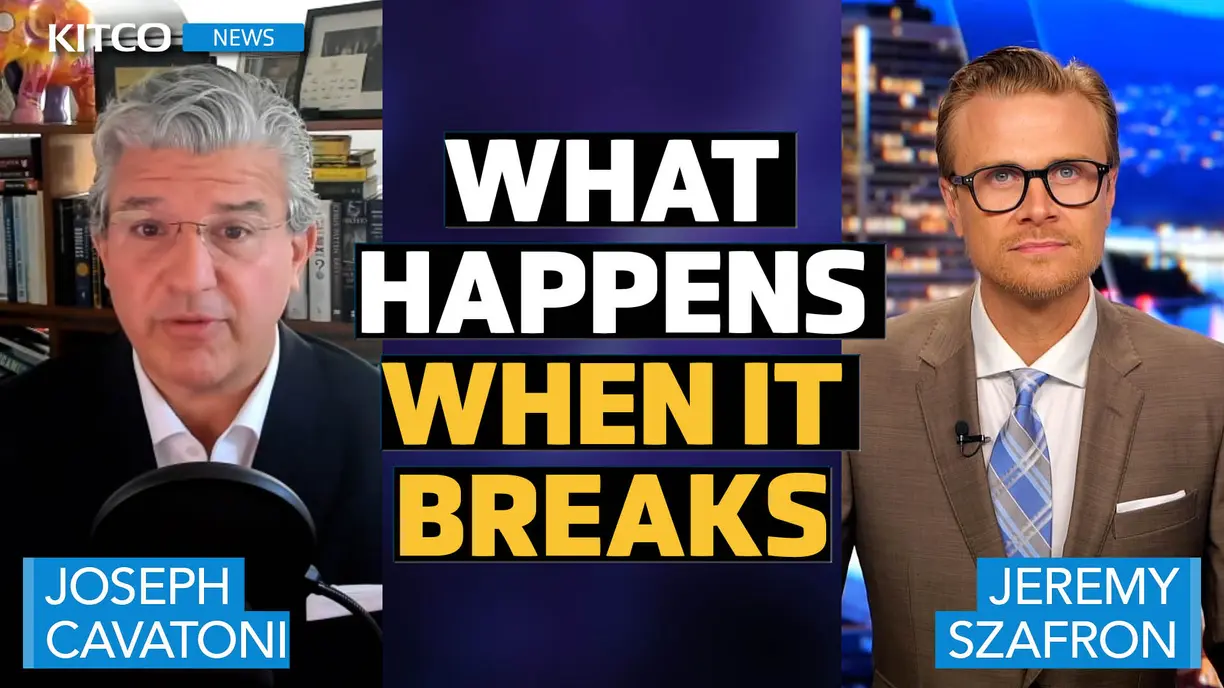
(Kitco News) - Gold demand is resurgent in 2025, with both central banks and investors accelerating purchases against the backdrop of fiscal stress in the United States, inflation uncertainty, and growing skepticism toward traditional financial assets, according to Joseph Cavatoni, senior market strategist at the World Gold Council.
“The picture’s getting more clear and more robust for gold as an investment,” said Cavatoni in an interview with Kitco News. “We’ve got debt levels that are unsustainable in the U.S. and that’s actually being dealt with by the current administration. But it is going to be a painful process and it’s going to be very challenging for the administration to find a way to tackle it.”
According to Cavatoni, the recent downgrade of U.S. debt by Moody’s should serve as a wake-up call. “Moody’s actions on Friday night, the third of the three agencies to downgrade the U.S. … is something that people need to pay much closer attention to. That means dollar assets and the dollar itself are under further pressure and actually only continuing to create more risk on the horizon.”
He noted that investor positioning in gold is broadening geographically. “Allocations are coming in again across the board – North America, Europe, and Asia in the first quarter. Now, we’re looking into the rest of the year. It still looks very difficult for people to get a picture on how things are going to play out.”
The World Gold Council reported total gold demand, including OTC and stock flows, held firm at 1,206 tons in the first quarter – its strongest start to a year since 2016. Two trends stood out to Cavatoni: “Central banks continue to be at the table, and we don’t expect to see that slowing down in a major way at any time over the course of 2025.” He also pointed to the return of investor interest: “Investors and global investors at that are back to the game with respect to adding gold and allocations to their portfolios.”
ETF flows reversed sharply in Q1, led by U.S.-listed funds, with a surge in April flows into China. “Record levels in that market for the month of April alone – more flows into China in April and ETFs than we saw in the first quarter in terms of flow in North America.”
According to Cavatoni, this marks more than just short-term positioning. “It’s time for the rethinking of allocation. People are realizing I need that diversification because correlations between bonds and equities are as high as they’ve ever been. People are starting to realize that maybe we should be looking at a bit more diversification. That’s what’s driving it.”
On the European Central Bank’s warning about rising risks in the gold derivatives market, Cavatoni said, “It’s a well-written piece and it’s actually very informative for sure. But what we would encourage people to do is to refer to our research, where we highlight a couple of key points that historically point to the performance of gold in very much the scenario that the ECB is talking about.”
“If you look at the systemic events that have happened over the last 20 years, whether it’s the dot-com bubble, the global financial crisis, long-term capital’s meltdown – whatever those moments are that you think are material enough to signal a systemic type of event – that the ECB is referring to – we can see from the history that gold’s performance is actually where you want to be.”
On the resilience of gold flows, Cavatoni said, “What we’re seeing through the flows is a lot of the action being with the stickier investor flow – increasing holdings and people holding onto things. That just gives us confidence that people are buying and holding, and there’s no rush to the door to get out.”
Turning to official sector buying, Cavatoni confirmed that demand remains steady. “Yes. Yes. Yes and yes,” he said when asked if central banks were reacting to inflation, geopolitical fragmentation, and de-dollarization. “They’re looking at diversification with a liquid asset that they could have in a reserve portfolio. Gold plays that role completely.”
He noted that “on average, the emerging market central banks – where we’re seeing the most buying and have over the last 14, 15 years – those banks tend to hold less than 10 to 15 percent of their reserves in gold. Whereas in a developed market, for example, the U.S., it’s closer to about 75 to 80 percent.” This gap, he said, shows “there’s definitely room for growth.”
Retail investment demand also impressed. “While we’re not seeing a demise of the coin and bar market – quite the opposite in China and India – you see that sophisticated portfolio allocations are coming together and using ETFs as well. There’s an affinity for gold in markets like China and India.”
Cavatoni said part of that demand reflects long-standing trust in gold. “People are concerned about their wealth, their preservation of wealth. I think we’ve all lived through the global financial crisis, when many people saw portfolios drop pretty dramatically. That hasn’t left the mindset of many people.”
He also addressed the 21 percent year-on-year drop in jewelry demand. “Jewelry is actually a very price-sensitive market. The money’s moving from maybe jewelry, where it looked to be a form of savings but with a little bit more panache to it, but now you see it coming into the form of investment.”
On supply, Cavatoni said, “Great quarter for mining, and actually we expect to continue to see that strong performance. But the signal from recycling is that maybe the recyclers are sitting back and saying, ‘hey, it’s not necessarily the right time to go ahead and cash in on this’.”
Zooming out to the broader macro environment, he added, “Risk assets… have been frothy, probably a bit overvalued, and you’re going to have increased levels of volatility, increased levels of correlation between bonds and equities. That’s why we think gold’s actually very much in the discussion with the investor community right now.”
He warned that “the challenges that are ahead of us are just so significant and not going to be easy to tackle. There are so many tables that need to be dealt with in terms of the negotiations. It’s just very hard for us to see how things are going to be very quickly dealt with.”
Cavatoni said price forecasts for gold going as high as $4,000 are not out of the question. “I think those are all reasonable numbers to take into consideration, even with what we’ve seen so far year to date, which is a near 25 percent return on gold through today. The numbers could be high, the numbers could be strong, and I think the case remains very strong for those use cases to continue to add gold.”
He also highlighted upcoming legislative developments in Washington. “There’s open legislation that we’ve worked to support that talks to the fact that we want to remove an impediment from mutual funds to own gold. That’s actually a bill… looking to be included in tax legislation that could come to us very quickly.”
“This is actually pretty exciting,” he added, “and whether it’s tax, whether it’s removing impediments, whether it’s helping people understand the gold market – it’s very much in the minds of the government today.”
Watch the full interview with Joseph Cavatoni on Kitco News for the complete breakdown of the data, investment trends, and policy insights.