
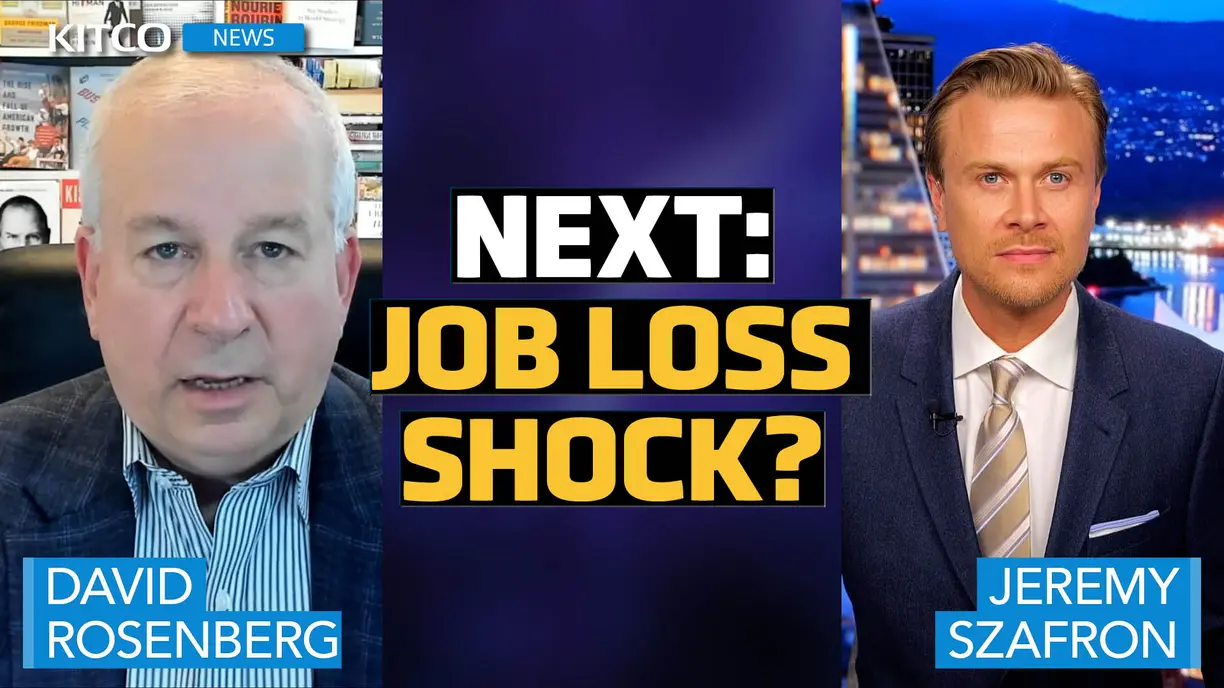
(Kitco News) - The U.S. economy is already in recession, even if markets have yet to wake up to it, says David Rosenberg, founder and chief economist at Rosenberg Research. In a new interview with Kitco News, Rosenberg points to a wide set of deteriorating indicators - including the Federal Reserve’s own Beige Book - to argue that economic contraction is not coming. It’s already here.
“When you get to that diffusion index where three-quarters [of the country] are either flat or negative, a recession is already underway,” Rosenberg said, referring to the Beige Book released in early June. “That’s the most comprehensive assessment of the U.S. economy across geographies and across industries… I put a lot of faith in it.”
The Fed’s June Beige Book noted “little or no growth” in most districts and a rising number of reports of declining consumer spending. According to Rosenberg, this echoes the lead-up to the 2008 recession - a cycle he accurately called.
Despite falling inflation data - the Producer Price Index rose just 0.1% in May and Core CPI slipped to 2.9%, the lowest since early 2023 - Rosenberg argues the focus on disinflation is a distraction from the real story: a weakening economy and an unacknowledged labor market downturn.
“Initial jobless claims are hooking up. The layoff cycle, which had been dormant, is now moving into full gear,” he said. “The hiring rate is collapsing. Continuing claims are over 1.9 million - a four-year high - and it’s becoming increasingly difficult for the ranks of the unemployed to find a job.”
According to Department of Labor data, continuing jobless claims jumped to 1.828 million in early June, up 14% from a year earlier. At the same time, gross domestic income (GDI) - often viewed as a more accurate recession predictor than GDP - has been negative in two of the last three quarters.
“Layoffs have surpassed hirings in each of the past three months,” Rosenberg said, citing Job Openings and Labor Turnover Survey (JOLTS) data. “We’re on the precipice… I think we’re within two, no more than three months before we see the first negative payroll report.”
Rosenberg, who was among the first to warn of the 2008 crash and the 2020 COVID recession, said the current downturn is being masked by pre-tariff inventory stockpiling, residual fiscal stimulus effects, and investor denial.
“People will believe a recession is coming only once employment starts to contract,” he said. “But the labor market is always the last man standing. That’s the mistake people are making - they’re looking at the lagging indicators, not the leading ones.”
According to the CME FedWatch Tool, markets are now fully pricing in two Fed rate cuts by year-end, with the first move likely in September. But Rosenberg argues the Fed is trapped - politically and psychologically.
“They want to make 100% sure that the tariff file is not going to spill over into sustained inflation,” he said, referencing rising pressure from Trump administration officials to lower rates. “But monetary policy is still tight. The funds rate is more than 100 basis points above neutral.”
Rosenberg said a rate cut could come as early as this fall - but only if unemployment rises above the Fed’s 4.4% year-end forecast. “If the unemployment rate had not been artificially suppressed by a drop in the participation rate last month, it would’ve already hit 4.6%,” he noted.
In the interview, Rosenberg also slammed the Trump administration’s tariff revenue claims. The Treasury Department recently said new tariffs would raise $2.8 trillion over 10 years - enough to offset the cost of the GOP tax bill.
“That’s a tax increase on the world,” Rosenberg said. “You are doing an assault on this $30 trillion beast called global trade… There will be all sorts of economic distortions and weaker activity coming out of this. It’s a pie-in-the-sky estimate.”
With the World Bank projecting global growth at just 2.3% in 2025 - potentially the slowest pace since the 1960s - Rosenberg warned that rising geopolitical and fiscal uncertainty could deepen the downturn.
“The whole outlook is fraught with risk,” he said. “And I don’t think risk is appropriately priced into financial assets at the current time.”
Watch the full Kitco News interview with David Rosenberg above for his recession playbook, Fed policy outlook, and strategy on navigating what's next.