
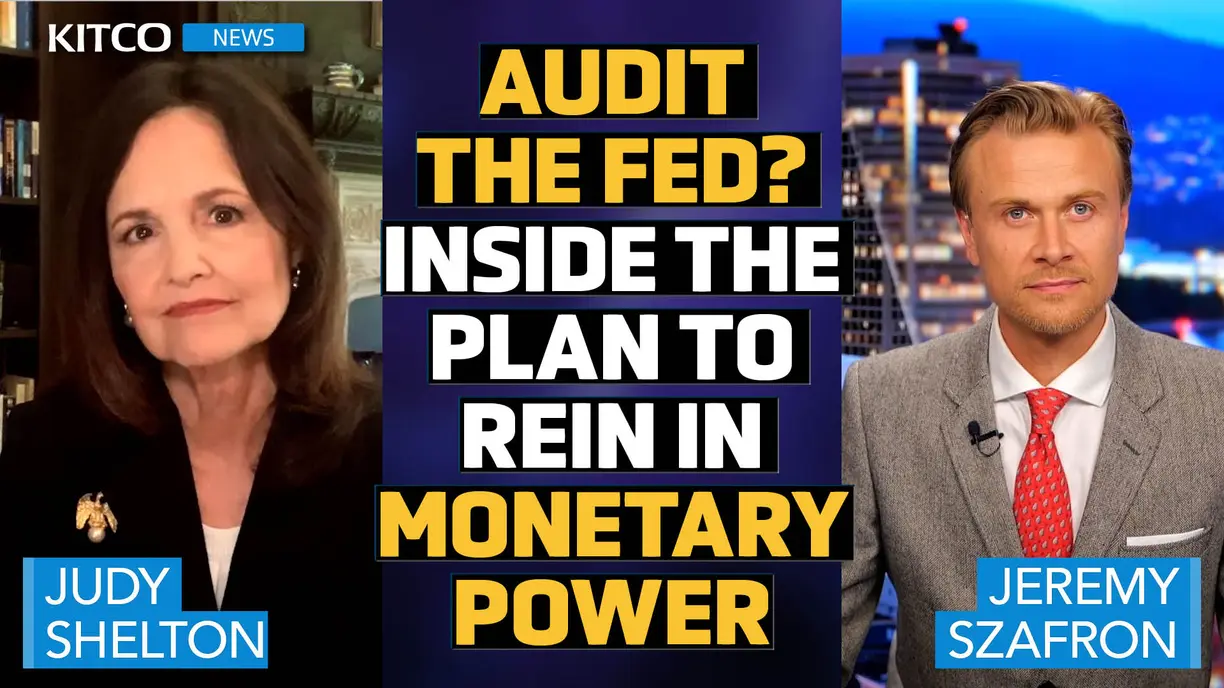
(Kitco News) - Economist Judy Shelton issued a blistering critique of the Federal Reserve’s interest-on-reserve policy on Tuesday, calling it a “quiet subsidy” to Wall Street and foreign banks that is costing U.S. taxpayers hundreds of billions of dollars - and urging Congress to revoke the Fed’s authority and instead re-anchor the dollar to gold.
“Right now, the Fed is paying 4.4% interest - and that’s on $3.4 trillion in cash that is kept by private commercial banks in their deposit accounts at the Fed,” Shelton said in an exclusive interview with Kitco News. “It has gotten out of hand.”
The central bank’s current interest rate on reserve balances - 4.4 percent, according to the Federal Reserve Board’s latest directive - resulted in $226.8 billion in interest payouts last year alone, according to the Fed’s audited financials. That sum exceeded its total income, pushing the institution into a $77.5 billion operating loss - its largest on record.
“You’re talking about a quiet subsidy. These are interest payments that come out of the pockets of U.S. taxpayers,” Shelton said. “And now foreign banks, who get much lower rates at their own home central banks - you know, where their headquarters are - they’re stashing their money at our central bank to get that rate.”
Nearly 40 percent of those payouts went to foreign-owned institutions, according to estimates cited by Congressional critics including Senator Rick Scott and Federal Reserve data.
Congressional Oversight ‘Urgently Needed’
Shelton, a former U.S. Executive Director at the European Bank for Reconstruction and Development and past Federal Reserve Board nominee, said the reserve payout system has shifted the Fed’s role from monetary policymaker to interest rate transfer agent for large banking institutions.
“I believe Congress should revisit it,” she said. “And it’s precisely because the Constitution gives the power to regulate the money to Congress.”
That power, enumerated in Article I, Section 8 of the U.S. Constitution, authorizes Congress - not an independent central bank - to coin money and regulate its value. Shelton argued that lawmakers have for too long deferred to unelected monetary technocrats.
“Congress has been more than willing to say, ‘well, they’re the experts, and this is monetary policy, and we should not interfere,’” she said. “But they’re interfering in our economy. They’re interfering in the availability of capital.”
Fed Chair Jerome Powell is expected to face questions next week following pressure from both parties. According to multiple sources on Capitol Hill, a bipartisan working group is reviewing new guardrails on Fed operations, including audits of its interest rate payments, loss carry-forwards, and balance sheet runoff strategy.
Shelton was clear: “I would say yes - I think ‘audit the Fed’ is important. And not just the accounting, but the models, the constructs, the mechanisms.”
Unrealized Losses Top $1 Trillion
Shelton also warned that the Fed’s balance sheet is loaded with embedded losses - a liability for future U.S. Treasury remittances.
“The Fed’s own portfolio has over $900 billion in unrealized capital losses,” she said. That number reached $1.06 trillion in June, according to the New York Federal Reserve.
“It’s almost like [they’re saying], ‘we’re independent so we don’t have to talk about this.’ Well, it’s public money. It’s the people’s money. So it’s time to have that conversation.”
Shelton said she worries that selling those securities - which the Fed acquired in bulk during the pandemic and subsequent stimulus waves - would lock in steep losses. “Once you crystallize that loss, then that means the Fed would not be remitting any profits to the Treasury for years - maybe decades.”
Proposal: A Gold-Linked Treasury Bond for 2026
To restore credibility and create a new anchor for long-term debt issuance, Shelton is proposing a 50-year U.S. Treasury bond redeemable in gold, timed for July 4, 2026, America’s 250th anniversary.
“It would be very fitting if we launched that on our semiquincentennial,” she said. “You would be establishing a link between the U.S. dollar and gold.”
Such a bond, she added, would be highly attractive to both domestic and global investors. “You would be borrowing at a considerably lower rate of interest because people would pay a premium for that kind of protection of their purchasing power, defined in terms of gold.”
“And that helps to bring back the dollar as a reliable instrument for international exchange.”
Shelton stressed that the proposed instrument would not jeopardize the nation’s gold reserves by triggering physical redemptions. “You’re not offering to pay out in gold until 50 years out,” she explained. “And you’re not suggesting that anyone can come get the gold right now.”
“It’s not a run on gold. It’s a commitment. It’s a promise to pay that helps to build credibility for the dollar by having that gold backing in the future.”
She said the structure would introduce long-term monetary discipline without risking the kind of convertibility panic that destabilized past gold systems. “You’re establishing a pathway to sound money - not through confiscation, not through shocks - but through transparency, time, and trust.”
Main Street Left Behind
Shelton also emphasized how the current Fed structure favors financial institutions while households and small businesses struggle.
“It’s time to have the monetary system and the entire economy work for Main Street as well as it seems to work for Wall Street,” she said. “If you just take the easy, risk-free money from the Fed, there’s no reason to take a chance on a local business … who needs a loan to grow.”
The full Kitco News interview with Judy Shelton - including her gold proposal, critique of Fed secrecy, and blueprint for congressional action - is embedded at the top of this story.