
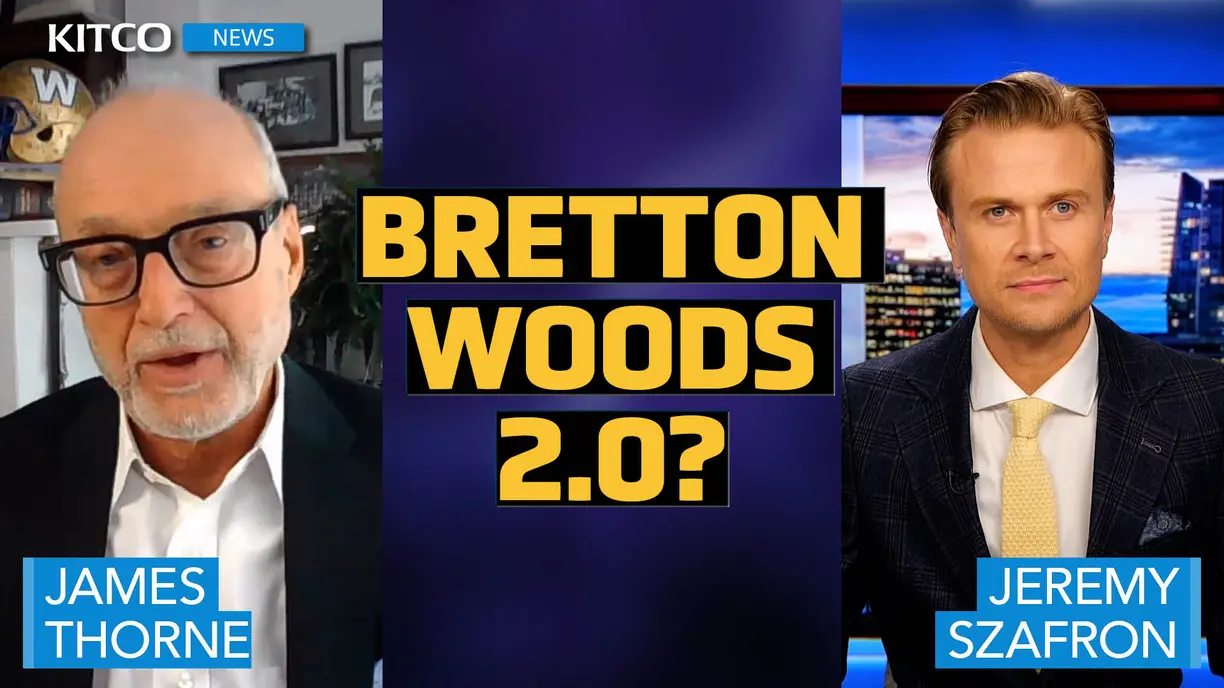
(Kitco News) - The United States has crossed a critical fiscal "Rubicon" that signals the "end of the empire" and is now setting the stage for a "Bretton Woods 2.0" monetary reset where gold will be officially "written up" to help pay down sovereign debt.
That is the stark forecast from Dr. James Thorne, a Ph.D. in economics and Chief Market Strategist at Wellington Altus Private Wealth.
In a wide-ranging interview with Kitco News on Monday, Thorne argued that the U.S. has reached a point of no return, exemplified by the ongoing 40-day government shutdown and a historic fiscal crisis.
"Interest payments... on the debt in the United States... was greater... [than] the expenditure on the military, and that is typically the Rubicon," Thorne stated. "When you cross, that signifies the end of the empire... We're at this point where the system has to be recalibrated."
According to Thorne, that recalibration will be a deliberate reflation policy to manage the "excessive level of debt... at Napoleonic war levels."
He believes the solution, already being hinted at by policymakers, will be a formal re-pricing of assets - including gold - on the government's balance sheet.
"...why wouldn't they write up the assets? ... Why shouldn't they write up the assets and use that to basically pay down the debt?" Thorne asked. "People [are going to] recognize the fact that we are writing Brenton Woods's 2.0... And gold will be a key contributor."
The "S&P 7,500" Supercycle
Despite the sovereign debt crisis, Thorne is exceptionally bullish on markets, forecasting the S&P 500 will reach "somewhere between 74 to 75 hundred... by the spring of 2026."
He argues that the market is in the "early innings" of the "largest CapEx supercycle in modern history," driven by a global arms race for Artificial Intelligence (AI), data centers, and the energy grid.
When asked about bubble fears and criticism from investors like Michael Burry, Thorne dismissed them as a misunderstanding of how new technology waves are priced.
"We are living in a complete and total void of information where we don't know what the intrinsic value is of an asset... a railroad, a canal, AI, a server," he said, citing the "Market for Lemons" economic theory. "What happens is... the individual... that has the best story... that captures the imagination of the market wins."
"We are not [going to] know what the intrinsic value of AI is for decades," he added. "It will not be the last time we hear about this narrative... it just goes with the normal course of business."

The "Lost Decade" and the Fed "Can't Take High Rates"
While Thorne is bullish through 2031—driven by a 100% tax deduction on CapEx spending—he warned that the super-cycle will end in a crash, followed by a "lost decade" for investors.
He offered a hypothetical: "Let's say the S&P peaks at 15,000 in 2031, and doesn't achieve that level until 2041... a lost decade in terms of asset class returns."
Until then, Thorne stated that "valuations will matter. I just think it's not [going to] be until... the middle of the next decade."
The fuel for this, he said, will be a sharp reversal by the Federal Reserve. He dismissed concerns about "higher for longer" interest rates, arguing the system simply cannot handle them.
"I know the central bankers think... that we can take high rates. We can't. We can't take high rates," Thorne said, forecasting the Fed will be forced to cut its overnight rate "below 2.75, somewhere in the low two area."
Gold, Gold Stocks, and the Bitcoin Breakout
For hard asset investors, Thorne's core message was that the public has finally "lost trust" in the fiat system, making gold the primary "go-to trade."
"People are fed up with the... fiat currency. That's why gold is going," Thorne said. "But I think the more profound question there is they're letting it run, and I think they want it to happen. That's my simple interpretation."
He confirmed his long-term target for gold remains between "$5,000 short term and maybe close to $8,000 by the end of the decade," but warned it "has run too far, too fast" and will likely "consolidate between 4,000 [and] 4,400 for a couple of months."
He issued a stunning warning, however, for gold stock investors:
"So the big money in this run has been made," Thorne stated.
He clarified that the "easy money" from the metal's price surge is over, and the focus now shifts to operational risk.
"Now these mining companies have to execute... because [the] gold run from 2000 to 4,000 is over," he said. "The tough part for them is... mining is a very difficult business... to model with [an] Excel spreadsheet... Right. You know, something could happen, a mine could flood, you know, and everybody will freak out and hammer the... gold stocks."
Thorne concluded investors must now make a critical choice: "...what you should be doing now is just picking at the physical and not... the equities that are highly levered to the next move up. I think that's an interesting question."
He argued that as trust is lost, "gold is the go-to trade," and "eventually... once it gets a little bit more mature... Bitcoin" will follow.
He identified Bitcoin as being in a "very, very frustrating consolidating pattern" and issued an urgent warning for those waiting on the sidelines:
"That thing breaks out... it's gone. In a New York minute, it's gone and you won't be able to get in."