
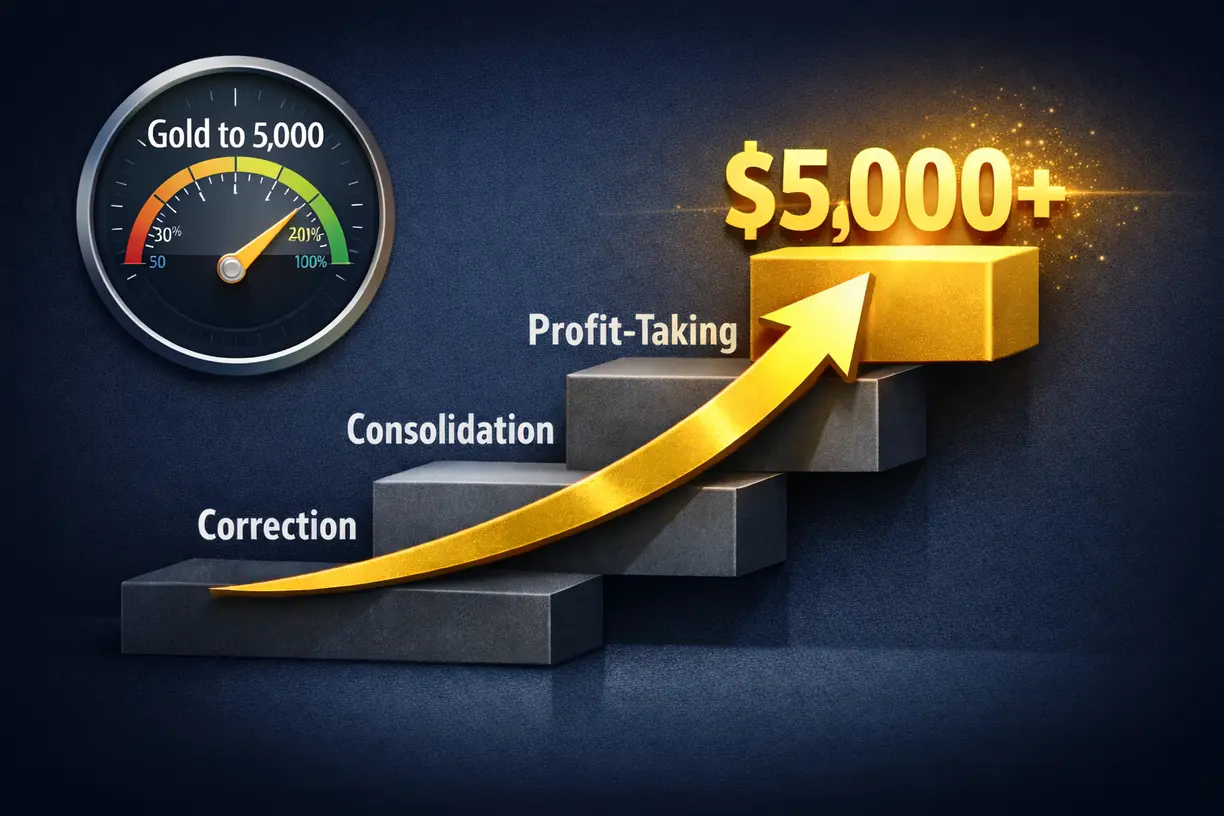
(Kitco News) - At elevated price levels, investors should expect to see some volatility in gold. But according to State Street Investment Management’s Head of Gold Strategy, Aakash Doshi, the broader trend remains firmly intact—and the odds of prices pushing beyond $5,000 an ounce in 2026 are no longer remote.
“A few days of profit-taking or even a month of consolidation doesn’t change the real upward trend,” Doshi said in an interview. “The probability of $5,000 gold over the next six to nine months is now north of 30%—closer to 40%.”
That outlook comes at a time when both gold and U.S. equities are trading near record nominal levels, a combination that, in Doshi’s view, reinforces gold’s role as a portfolio hedge rather than undermining it. “If the S&P 500 had rolled over and gold was at $4,500, I’d be more concerned,” he said. “But with equities near 7,000 and gold also at record highs, that actually gives me more confidence in holding gold.”
Gold’s resilience, Doshi argues, reflects a market increasingly focused on tail risks rather than traditional rate-driven narratives. Stock–bond correlations remain unstable, while geopolitical and policy uncertainty has intensified across multiple fronts.
“This isn’t just headline noise,” Doshi said. “Some of these risks reflect potential regime shifts—a repricing of tail risks that were previously unthinkable.”
State Street’s January Gold Monitor underscores that theme, highlighting rising geopolitical stress, elevated fiscal deficits, and policy uncertainty as structural supports for bullion. The report points to escalating government and corporate debt levels, which reached record highs in 2025, as a key macro driver underpinning gold demand.
Gold’s role as a low-volatility hedge becomes especially relevant in this environment.
“When the distribution of outcomes is this wide, that favors safe-haven assets like gold,” Doshi said.
Despite persistent market speculation about interest-rate cuts, Doshi believes monetary policy is now a secondary influence on gold prices. Inflation, he said, is no longer accelerating—but it is unlikely to return to the Federal Reserve’s 2% target anytime soon.
“I wouldn’t call it disinflation,” he said. “I’d call it inflation stabilizing. We’re above target, but we’re not getting upside surprises either.”
In State Street’s base case, the Fed is likely on hold well into 2026, with any further easing contingent on a material deterioration in the labor market. Still, gold has historically performed well during prolonged pauses.
“Gold can actually do quite well when the Fed is on pause—as long as the bias is still toward eventual cuts,” Doshi noted.
Beyond macro uncertainty, physical and investment demand continue to provide a solid floor under prices. Central bank purchases remain a structural anchor, with State Street noting that official-sector buying is increasingly price-inelastic, reinforcing gold’s long-term support above $4,000 an ounce.
ETF flows also tell a compelling story. Gold-backed ETFs ended 2025 with record inflows, defying their usual year-end seasonal weakness. State Street estimates the cycle could have “significant runway” left in 2026, even under conservative assumptions. Despite the flows, overall gold holdings are still down from the 2020 record highs.
“Gold is not an ‘overall’ asset yet,” Doshi said. “There’s still room for global allocation to increase. Gold looks very comfortable between $4,000 and $5,000 an ounce.”
A period of consolidation, he argues, would not damage the broader bull case. “Flat prices for a couple of months don’t hurt the story,” Doshi said. “If anything, it allows investors to re-engage—especially since dips have been aggressively bought for months.”
