
The Federal Reserve faces impossible math as gold signals approaching debt wall

Kitco Media
By Jeremy Szafron
Published
Updated
Kitco News
The Leading News Source in Precious Metals

Kitco NEWS has a diverse team of journalists reporting on the economy, stock markets, commodities, cryptocurrencies, mining and metals with accuracy and objectivity. Our goal is to help people make informed market decisions through in-depth reporting, daily market roundups, interviews with prominent industry figures, comprehensive coverage (often exclusive) of important industry events and analyses of market-affecting developments.

The Federal Reserve faces impossible math as gold signals approaching debt wall  teaser image

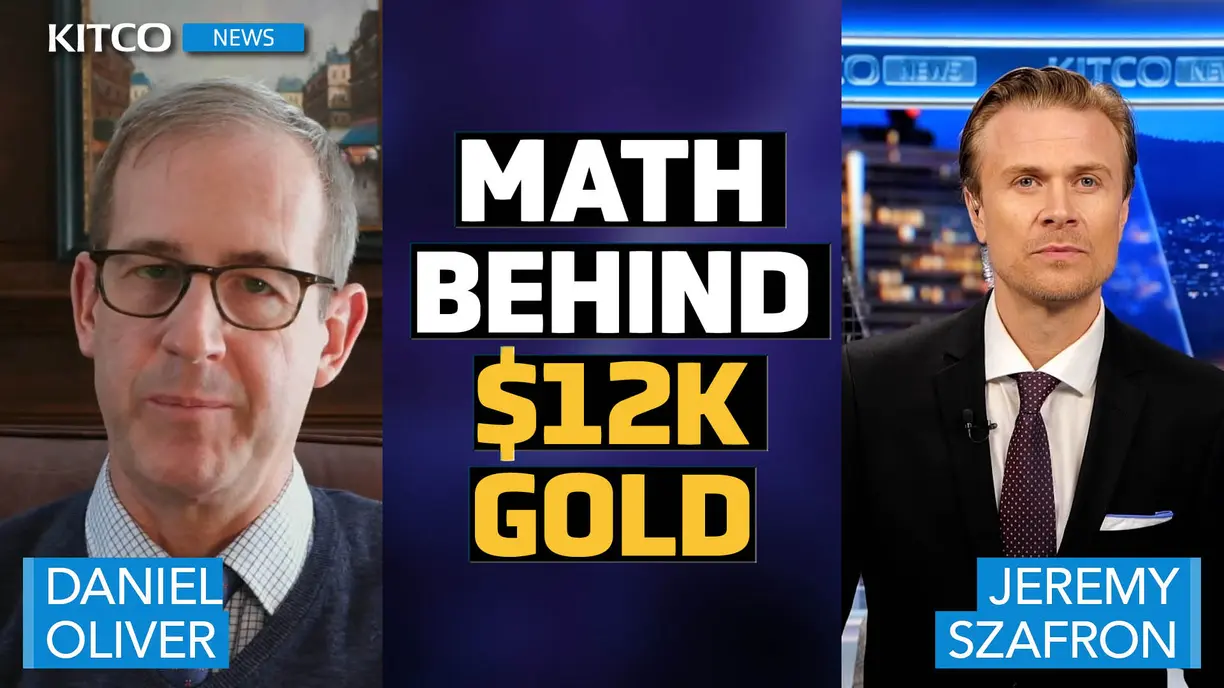
(Kitco News) - The international accumulation phase of the current gold bull market has officially ended, giving way to a volatile second phase driven by stress in the U.S. credit system, according to Daniel Oliver, founder of Myrmikan Capital.

Speaking on Kitco News, Oliver argued that the combination of overleveraged private equity and an expanding U.S. national debt is trapping the Federal Reserve. He outlined the mechanics driving physical gold and silver prices higher, pointing to what he views as fundamental weaknesses in the broader financial system.

The U.S. national debt currently sits above $38.5 trillion. Concurrently, the Congressional Budget Office projects net interest payments on the national debt will more than double to $2.1 trillion by 2036. Oliver stated that the true debt burden, when factoring in the net present value of unfunded liabilities like Medicare and Social Security, is significantly higher. He believes this level of debt is mathematically impossible to repay under current dollar valuations.

"What happens after the end of every great credit bubble is that prices collapse," Oliver said. "What happens instead is that the gold price in dollars has to go up to make the valuations of assets make sense."

This systemic stress is increasingly relevant to private credit markets. UBS analysts recently warned that private credit default rates could surge as high as 15 percent in a worst case scenario, driven by rapid artificial intelligence disruption among corporate borrowers.

Oliver explained that unlike the 2008 financial crisis, where the Federal Reserve could print money to reflate the housing market, bailing out the private equity industry presents a different challenge. He noted that highly leveraged companies facing insolvency due to a lack of consumer demand cannot be saved simply by injecting liquidity into the banking system.

"I don't expect to see a huge stock market crash the way it happened in 29 or 2008," Oliver said. "What I expect instead is for gold to crash higher."

As faith in paper financial instruments wanes due to these macroeconomic pressures, the physical metals market is experiencing structural changes. Oliver observed that industrial silver demand is tightening as manufacturers abandon standard inventory models. Fearing supply chain disruptions, he noted that companies are hoarding physical silver directly at their factories, draining available inventory from the market.

Simultaneously, Oliver highlighted that nervous banks are tightening margin requirements on smelters and refiners. He stated this forces these entities to process less physical metal, acting as a choke point that restricts the flow of gold into the retail and institutional markets.

Historically, central banks were forced by the market to hold gold reserves equal to roughly one third of their balance sheets. Applying this historical ratio to the current Federal Reserve balance sheet yields a substantially higher implied gold price, according to his analysis.

"Gold has to go to a price that rebalances the Fed's balance sheet, and $8,000 currently gets you to about a third, 12,000 gets you around a half," Oliver said.

Watch the full interview below to hear Oliver's complete analysis on the future of the Treasury market, the undervaluation of mining equities, and why he views gold as a critical asset for capital preservation.

Kitco Media

Jeremy Szafron

Jeremy Szafron joins Kitco News as an anchor and producer from Kitco’s Vancouver bureau. 
Jeremy is a seasoned journalist with a diverse background covering entertainment, current affairs and finance.

Jeremy began his career in 2006 as a Journalist at CTV (Canada’s largest network), initially engaging audiences as an entertainment reporter before pivoting to business reporting focusing on mining and small-caps. His macro-financial and market trends analysis made him a sought-after commentator on CTV Morning Live and a regular on CTV News Network.

A notable milestone in Jeremy's career was his 2010 Vancouver Olympic Games coverage, highlighting the Olympic community and hosting segments from various Country Houses at the games.  Building on this experience, Jeremy developed an online video news program for PressReader, launching them into a new direction. PressReader is a digital newsstand with 8,000 newspaper and magazine editions in 60 languages from more than 120 countries.

In 2012, Jeremy ventured into his own digital media project, creating The Green Scene Podcast, swiftly gaining over 400,000 subscribers and establishing himself as a key voice in the emerging cannabis industry. Following this success, he launched Investor Scene and Initiate Research, news platforms providing exclusive market insights and deal-flow opportunities in mining and Canadian small-caps.

Jeremy has also worked as a market strategist and investor relations consultant with various publicly traded companies in the mining, energy, CPG, and tech industries.

A graduate of Concordia University with a BA in Journalism, Jeremy's academic background laid the foundation for his diverse and dynamic career. Now, as an Anchor at Kitco News, Jeremy will continue to inform a global audience of the latest developments and critical themes in finance and commodities.
 

Share

Disclaimer: The views expressed in this article are those of the author and may not reflect those of Kitco Metals Inc. The author has made every effort to ensure accuracy of information provided; however, neither Kitco Metals Inc. nor the author can guarantee such accuracy. This article is strictly for informational purposes only. It is not a solicitation to make any exchange in commodities, securities or other financial instruments. Kitco Metals Inc. and the author of this article do not accept culpability for losses and/ or damages arising from the use of this publication.