
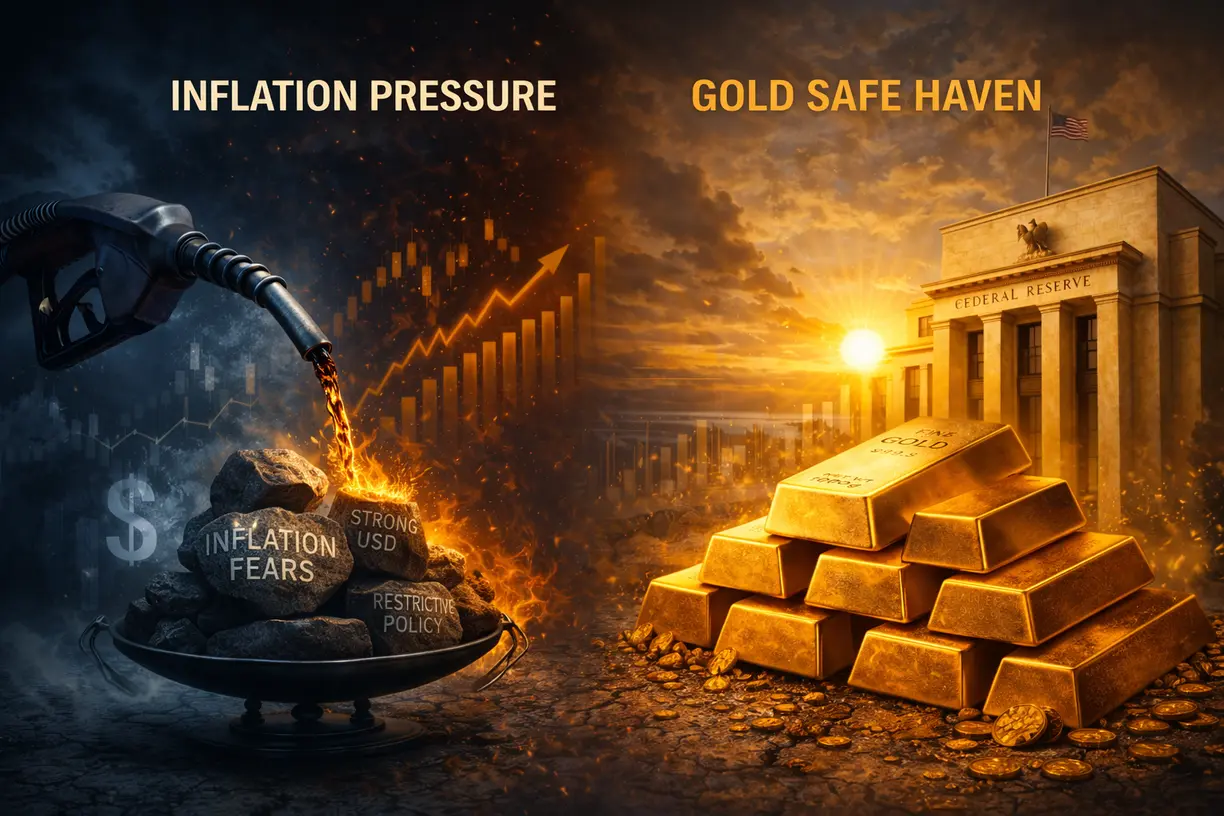
(Kitco News) - Gold prices may be struggling in the near term as rising inflation fears and a strong U.S. dollar weigh on investor sentiment, but the broader macroeconomic backdrop still supports the precious metal over the longer term, according to one Canadian bank.
In an interview with Kitco News, Bart Melek, head of commodity strategy at TD Securities, said that while geopolitical tensions would typically support gold, the market is being dominated by rising bond yields and expectations that central banks will keep monetary policy restrictive for longer.
“In the end, it’s all about interest rates,” he said, adding that gold's failure to rally meaningfully amid a growing geopolitical crisis underscores how sensitive the metal has once again become to real yields.
Although investors often view gold as an inflation hedge, Melek said that inflation alone is not enough to drive prices higher. Instead, it is the relationship between inflation and interest rates that matters most.
“Gold people always say inflation, inflation—that’s true, but it’s not sufficient,” he said. “It’s really the relative value of other assets, mainly Treasuries.”
A key factor shaping that relationship right now is oil.
Melek pointed out that the sharp rally in crude prices, driven by escalating conflict in the Middle East, is adding to inflation pressures and complicating the Federal Reserve’s policy outlook. TD Securities estimates that for every 10% increase in oil prices, inflation rises by roughly 0.2 percentage points.
With oil prices already up about 60%, he warned that a prolonged surge could significantly lift inflation.
“If this lasts for a year… this could add another 100 basis points to inflation,” he said.
That dynamic is critical for gold because higher inflation driven by energy costs does not automatically translate into higher gold prices. Instead, it can force central banks to maintain or even tighten monetary policy, pushing bond yields higher and strengthening the U.S. dollar—both of which are typically negative for gold.
Melek said that in a scenario where the conflict drags on and energy prices remain elevated, the Federal Reserve would be reluctant to cut rates, as policymakers would need to ensure inflation does not become entrenched.
“If inflation is going the other way, it becomes very difficult for the central bank to ease,” he said.
Higher rates also tighten financial conditions more broadly, reducing liquidity and forcing leveraged investors to scale back positions across commodity markets. Melek noted that capital flows are already being constrained, not just in energy markets but across the broader commodity complex.
However, despite the dismal short-term outlook, Melek said that he expects the current oil shock to be temporary. He added that if the geopolitical situation stabilizes and supply disruptions are limited, crude prices could ease back toward the $90–$95 per barrel range, allowing inflation pressures to moderate.
In that environment, central banks would have more flexibility to shift toward easing, potentially reviving the so-called “debasement trade” that supports gold through lower real interest rates and a weaker U.S. dollar.
“If we do get rate cuts and the dollar starts to weaken, then that whole debasement trade comes back,” he said.
TD Securities is maintaining its existing gold forecast, calling for prices to average around $4,831 per ounce in 2026, with gold expected to peak near $5,000 in the second quarter before gradually easing toward $4,650 by year-end.
