
(Kitco News) – Gold will continue to gain relevance as a store of value in a more fragmented and politically sensitive global financial system, but not necessarily through big price increases, according to Nina-Alessa Michel, policy advisor for regulation and economics at the Swiss Bankers Association.
In an analysis published Wednesday, Michel said recent events are proving once again how closely gold prices are linked to global uncertainty.
“Against a backdrop of geopolitical and economic tensions and rising government debt, demand for safe investments is increasing,” she wrote. “Despite its role as a safe haven, however, gold has been proving rather more volatile than we might expect. Its price has recently undergone massive swings in various market phases, such as falling by 14% in the space of three days when Donald Trump nominated the next Chairman of the US Federal Reserve, also placing assets like silver and Bitcoin under pressure.”
“Movements like this clearly show that gold isn’t always the safest of havens and can in fact react sensitively to geopolitical and monetary policy shifts,” she said. “Geopolitical developments act as a strong catalyst for gold demand. Analyses have demonstrated that investors increasingly seek out safe havens while global capital markets are beset by fragmentation, conflicts and changing balances of power.”
And Switzerland, as one of the more important hubs of the gold market, is particularly sensitive to these demand shifts. “Its refineries, trading networks and international links make the banking centre, which finances these, especially sensitive to news flow from global politics,” Michel wrote. “Rising demand, potential export restrictions or international sanctions thus have a direct effect – first and foremost on the real economy.”
This reality is demonstrated very clearly in the country’s trade flows. “[I]n the first half of 2025 alone, Switzerland exported more than 476 tonnes of gold with a value of CHF 39 billion to the US, where uncertainty, inflation and concerns over a further increase in government debt were pushing demand substantially higher,” she noted. “Besides private investors and central banks, stablecoins like Tether also play a key role here. Tether bought around 70 tonnes of gold in 2025, more than most central banks.”
Changes in trade policy – real or suspected – can also trigger massive moves in gold. “The price rose, for instance, when the US government [seemed to suggest] tariffs on gold and then fell back again when it was announced that no such tariffs were planned.”
Moving to gold’s dramatic performance so far in 2026, Michel noted that the year started with a bang for the yellow metal.
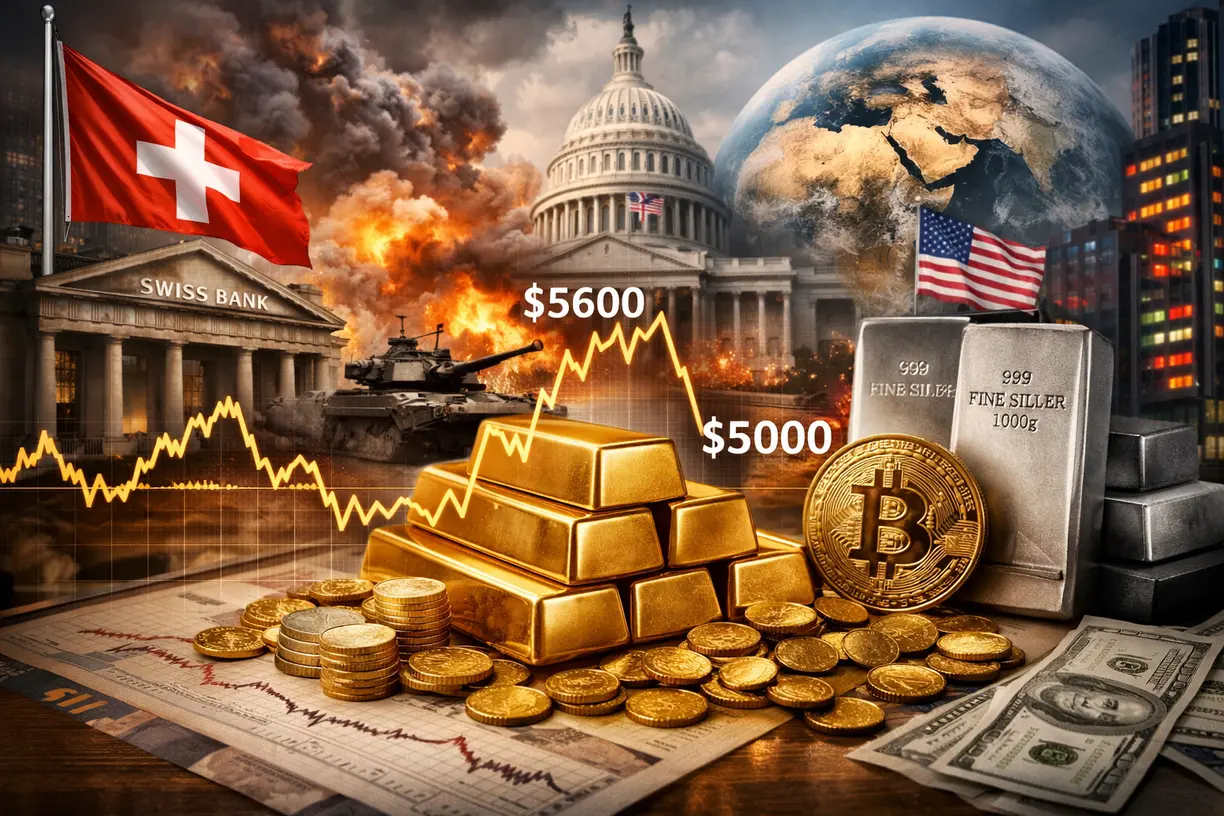
“After an exceptionally strong performance in 2025, the uptrend continued unabated and was even faster and more pronounced than many market players had anticipated,” she said. “As the year began, the price was around USD 4,330 per troy ounce. It shot up in the opening weeks on the back of sustained demand and a market environment that was still fraught with uncertainty. It was breaking records almost daily in mid-January and peaked at an all-time high of almost USD 5,600 on 28 January. The price had thus broken through the psychologically significant USD 5,000 mark quite decisively in just a few short weeks.”
But this outsized upward momentum was sustainable over the long term, with the record intraday high of $5,597.23 per ounce followed by a sharp downward correction and phase of heightened volatility.
“Profit-taking and speculation over the future direction of US monetary policy caused a marked correction at the end of January and the start of February,” Michel noted. “Over a few days, the gold price dipped below USD 5,000 at times before slowly stabilising. Since the outbreak of the Iran War on 28 February, there has been a renewed drop.”
Going forward, the Swiss Bankers Association believes gold’s price trend will likely be determined “not only by isolated events but also by fundamental structural trends.”
“Geopolitical uncertainty will play a central role: the bigger the shifts in global balances of power, the more attractive gold will become as a strategic reserve,” Michel wrote. “At the same time, gold’s importance for central banks will increase further as many of them seek to diversify their currency reserves and reduce their dependency on traditional hard currencies.”
“In this context, monetary policy also remains a key influencing factor, although not in terms of individual interest rate decisions but via its impact on perception of risk and liquidity conditions,” she added. “Fluctuating inflation and changing interest rate expectations continue to favour demand for investments that tend to be stable.”
Michel warned that political signals and regulatory decisions will likely continue to trigger stronger market reactions in the short term than fundamentals. “Last year’s debate over international trade and sanctions policies shows that even rumours of fresh barriers can affect the gold market, regardless of whether or not they’re borne out,” she said.
Overall, there are plenty of reasons to expect that gold will gain relevance as a store of value in a more fragmented and politically sensitive global financial system – not necessarily through big price increases, but instead through its ever greater role as a strategic anchor in portfolios, government reserves and international trade.
Michel said the gold price is telling “a complex story,” one that reflects global uncertainty and sensitivity to political and economic shocks while also playing an important role in decision-making for both institutional and private investors.
“[G]old can be a central component of diversification, but only as part of an overall investment strategy,” she concluded. “These days, stability stems less from individual asset classes than from forward-looking risk management that factors in geopolitical and regulatory developments.”
After breaking below $4,400 per ounce and hitting a session low of $ 4,366.95 shortly after noon Eastern, the yellow metal continues to hover near lows in early afternoon trading.
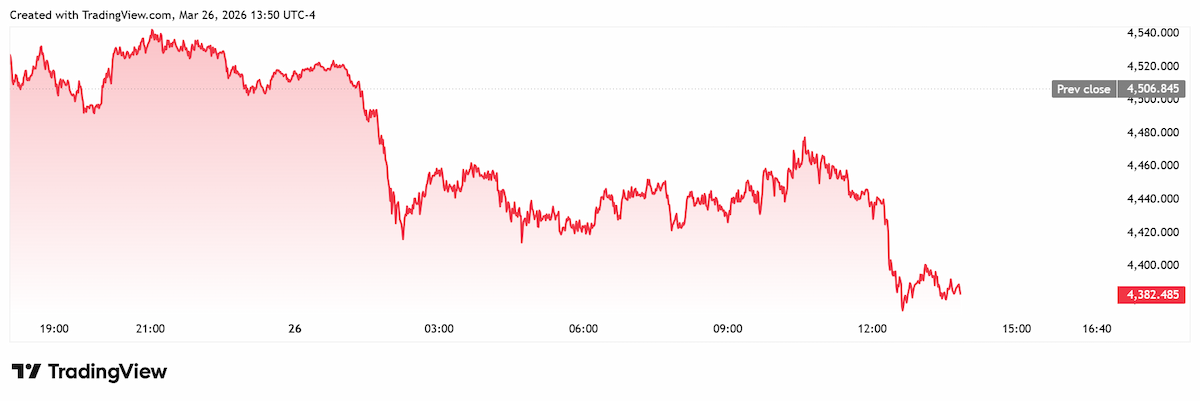
Spot gold last traded at $4,382.48 per ounce for a loss of 2.76% on the session.
