
(Kitco News) – While high yields, dollar strength and profit-taking are combining to create headwinds for gold in the near term, none of the structural factors that pushed the yellow metal well above $5,000 per ounce have gone away, and gold’s long-term trajectory remains upward, according to Emily Avioli, Vice President and Investment Strategist at Merrill.
In the investment giant’s latest Capital Market Outlook, Avioli wrote that with inflation rising and the Iran war worrying investors, one would expect gold to be outperforming, but this has not been the case.
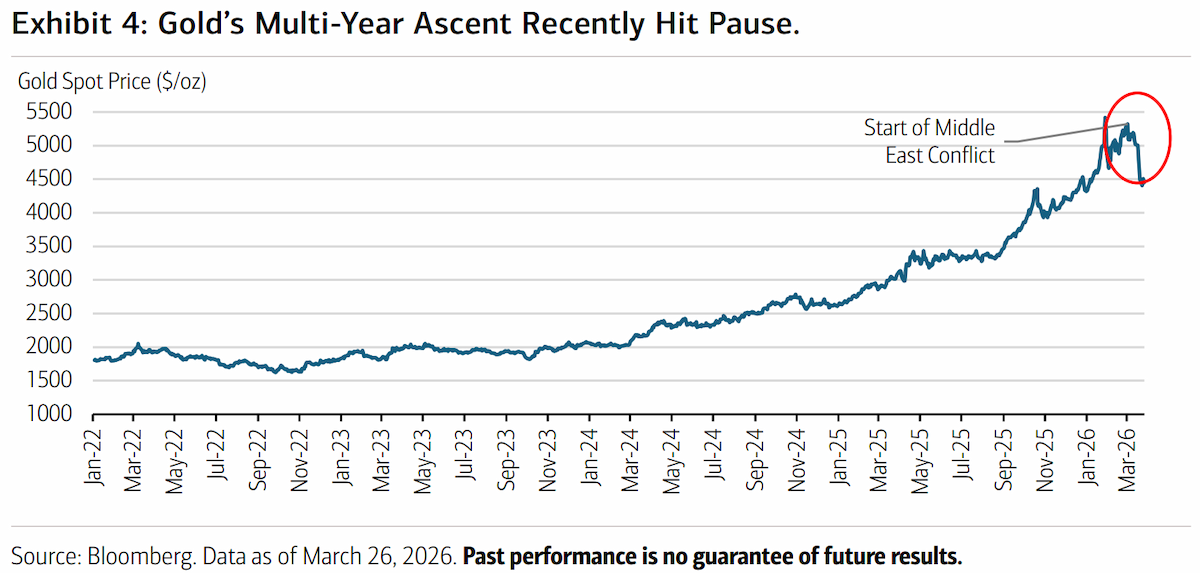
“Instead, the yellow metal’s luster has faded, with the price tumbling by roughly -16.0% since the Middle East conflict began,” she noted. “Gold has moved largely in tandem with risk assets over the past four weeks, defying its conventional role as a geopolitical hedge.”
“The counterintuitive move raises the question—should investors be less bullish on bullion moving forward?”
Avioli suggests that what is happening has more to do with “positioning effects, shifting interest rate expectations, and dollar dynamics” rather than any change in gold’s fundamentals.
“The pullback in gold follows an extraordinary run,” she noted. “Supported by elevated central bank purchases and renewed retail enthusiasm, gold prices have risen sharply since 2022, recently surpassing the $5,400/oz threshold in January. Historically, after large rallies in any commodity price in a short window of time, that commodity usually has a consolidation period or digestion of the abnormally large gains. This has been playing out with the current pullback in gold prices."
Avioli also pointed to market positioning, which had become increasingly extended after the historic rally, and which led to profit-taking when risk-off sentiment rose at the outbreak of the war.
"The move to sell gold to raise liquidity may have been amplified by depleted levels of institutional cash on the sidelines, which had fallen to record lows in January,” she noted
Avioli cited rising yields as another factor contributing to gold’s recent price reversal.
“Higher energy prices have rekindled concerns about inflation and, in turn, altered the outlook for monetary policy,” she said. “Expectations for interest rate cuts have been pushed out, with fed funds futures pricing in a non-trivial possibility that the Fed’s next move could potentially be a hike. As real yields have risen, the opportunity cost of holding nonyielding assets like gold has increased, reducing the relative appeal compared to income-generating alternatives.”
The U.S. dollar itself has acted as another strong headwind for the yellow metal.
“Since the conflict began, the dollar has strengthened as investors have gravitated toward its ‘safe-haven’ characteristics,” Avioli wrote. “Given gold’s historical role as a medium of exchange and a store of value, it has traditionally been viewed as an alternative to the dollar and has tended to move inversely with the exchange rate value of the dollar over recent decades.”
However, these near-term challenges do not negate “the structural forces that have supported the metal in recent years,” she said.
“Lofty fiscal deficits remain a concern, the dollar is likely to resume its moderation trend, and central banks are little incentivized to stop diversifying their reserve assets,” Avioli concluded. “Once uncertainty surrounding the Middle East conflict begins to fade, these underlying demand drivers should once again reassert themselves.”
“Against this backdrop, we continue to see a place for gold as a strategic diversifier in balanced portfolios.”
