
(Kitco News) - Investors should expect to see further volatility and potential liquidity issues in the silver market through the rest of the year as the precious metal is expected to see another significant supply deficit, according to the Silver Institute’s annual Silver Survey.
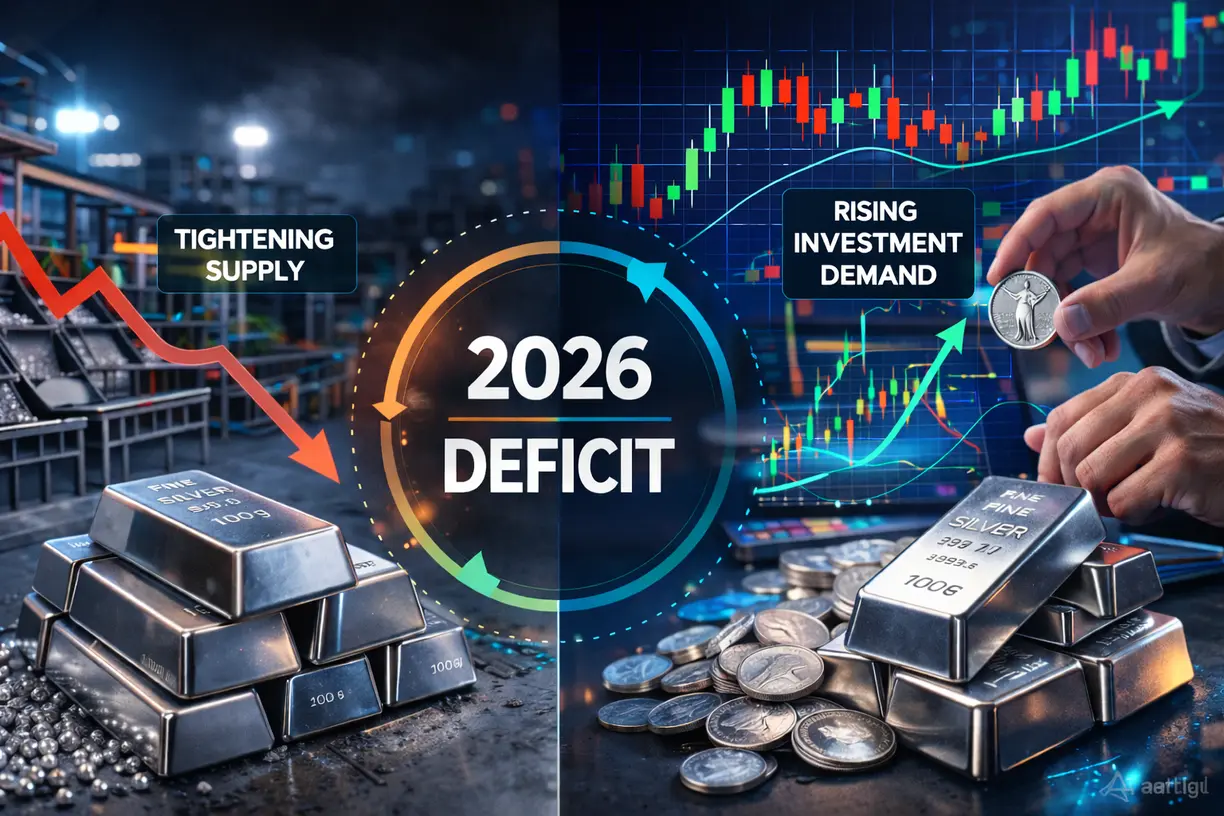
According to the survey, which was conducted by British research firm Metals Focus, the silver market is expected to see its sixth consecutive annual deficit of 46.3 million ounces, underscoring how years of undersupply continue to erode above-ground stocks and leave the market vulnerable to renewed bouts of volatility.
Although supply remains relatively stable, with mine production expected to be broadly flat and recycling rising to multi-year highs, it has not been enough to offset demand. As a result, continued deficits have steadily reduced available inventories, leaving the market increasingly sensitive to shifts in demand and investment flows.
In an interview with Kitco News, Philip Newman, Managing Director of Metals Focus, said that the latest survey points to a market increasingly driven by investment flows, macroeconomic uncertainty and tightening liquidity conditions.
Although Metals Focus remains bullish on silver through 2026, the report noted the outlook is not without risks, as global economic uncertainty—driven by elevated geopolitical tensions and ongoing instability in the Middle East—could weigh on silver’s industrial demand.
Industrial demand for silver is expected to decline by 3% this year to 639.6 million ounces, marking a second consecutive annual drop. However, Newman noted that despite the decline, the sector remains historically strong and well above pre-pandemic levels, underscoring silver’s critical role across a wide range of modern technologies.
The report noted that the weakest link in industrial consumption this year used to be its biggest source of strength. Analysts expect silver consumption in the solar sector to decline 19% this year as higher prices force manufacturers to thrift more of the metal or look for alternative materials in photovoltaic panels.
Newman added that substitution pressures were already emerging well before silver reached extreme price levels, noting that the speed of the rally over the past year has been a key factor pushing manufacturers to adapt.
Despite headwinds from shifting demand in the solar sector, Newman said that resilience in industrial consumption comes from a more diverse landscape. He explained that demand for data centers, the broader electrification of the global economy, and electric vehicle manufacturing are all sources of consumption growth for silver.
And while industrial demand faces some headwinds, Newman said that investment demand has once again become a driving force in the broader marketplace.
“You could see losses in the industrial sectors being mopped up by the retail investment. It’s not out of the realms of impossibility,” Newman said.
One of the most important shifts in the silver market has been the growing influence of investment demand—particularly retail buying and exchange-traded products (ETPs).
ETP holdings are projected to increase again following record inflows in 2025. Metals Focus expects global ETFs to see modest inflows of around 30 million ounces; however, Newman said that the small net gain masks significant swings beneath the surface.
“This is quite a swing from where we are given the sizable liquidations we’ve already seen this year,” he said.
Beyond flows, ETFs are also having a growing impact on the physical market. Large inflows can remove metal from circulation, tightening available supply and contributing to liquidity squeezes, while outflows can quickly release metal back into the market, amplifying price volatility.
The survey highlights that coin and bar demand is expected to rise 18% in 2026, reaching its highest level since 2022. At the same time, physical demand remains a critical pillar of the market, with strong buying interest helping to tighten supply conditions, particularly during periods of price momentum and market stress.
Newman noted that physical demand has proven resilient globally, but emphasized that India remains one of the most important markets for silver. Strong retail buying, limited selling, and steady seasonal demand continue to support global consumption, even as prices remain elevated.
He added that Indian investors have shown a willingness to hold onto their silver rather than sell into rallies, reinforcing tightness in the physical market and limiting available supply.
At the same time, Newman said that while higher silver prices might impact investment volumes, they are not expected to dampen overall demand.
“I think you’re going to see dramatically higher spending by retail investors,” he said.
Looking ahead, Newman said that he expects Indian demand to remain a critical pillar of support for silver. Despite record demand in 2025, Newman said that the Indian market is nowhere near saturated.
“I don’t feel that it’s saturating when you look at the levels of buying that we’ve seen,” he said. “If there’s another decent monsoon season, it can be another positive year.”
