
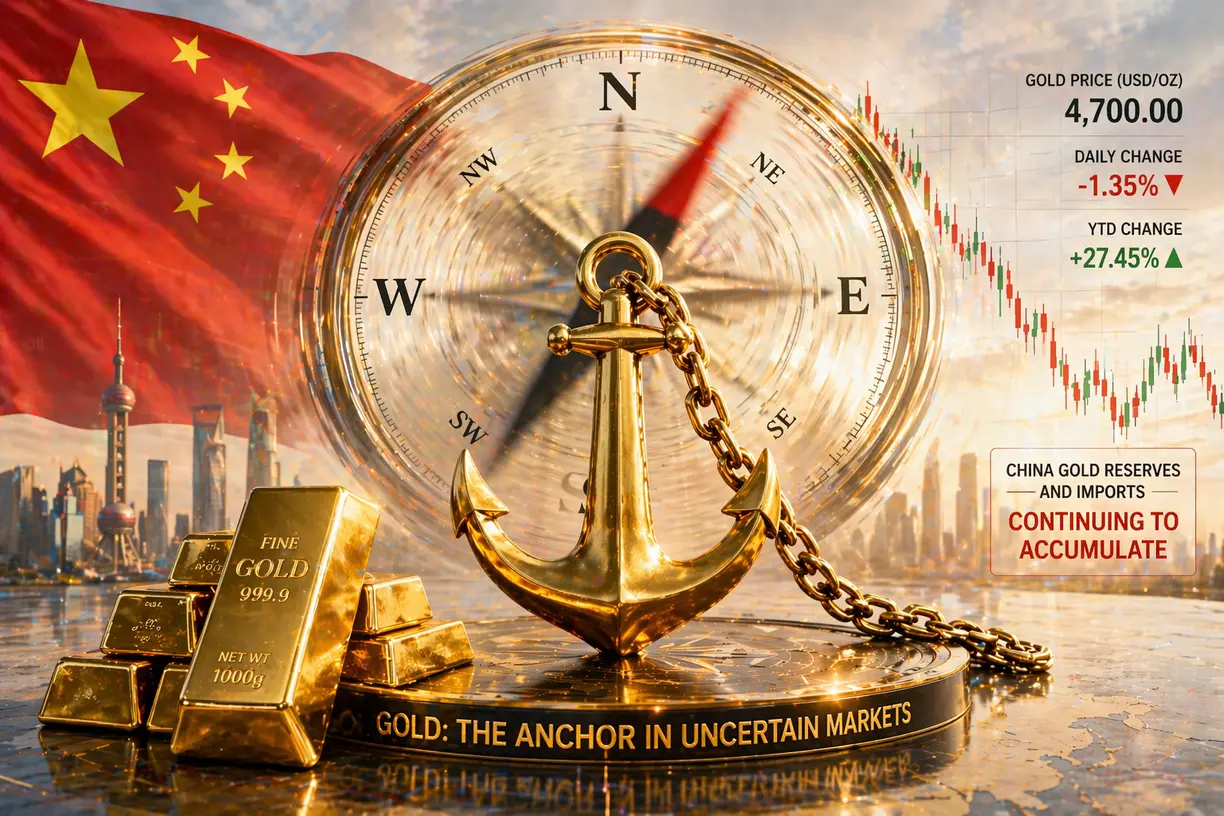
(Kitco News) - Although the gold market looks a little directionless as prices test near-term support near $4,700, it still remains an important diversification tool, and investors should see these lower prices as a buying opportunity, according to one fund manager.
In an interview with Kitco News, Robert Minter, Director of ETF Strategy at abrdn, said that despite gold’s significant drop from its all-time highs in January, he suspects investors continue to see the precious metal as an important safety net in a world where a lot of things don’t make sense.
“There’s a lot of risk that is mispriced in the world in financial assets,” Minter said. “They’re viewing gold as… a key portfolio holding now.”
Minter said that the biggest problem right now is that investors are overreacting to short-term uncertainty and volatility. However, he added that everyone needs to block out the noise and focus on long-term trends and patterns.
“There are a lot of things that don’t make sense. There are a lot of correlations that have changed,” he said. “But if you're reacting too short term, you're going to get the correlations wrong, you're going to get the trade wrong, you're going to get the direction wrong. If you look over a 20-year period, gold's correlation to equities is something like 0.01. Despite all the noise, gold is still very uncorrelated to risk assets.”
Despite gold’s disappointing selloff, Minter said that one of the biggest reasons why it remains a relevant asset is because of solid demand from central banks, including China. He pointed out that China’s central bank saw last month’s correction as a buying opportunity.
“In March, [China] bought the most gold they bought in a month since January of 2025,” Minter said. “We saw a 19.2% pullback from all-time highs in gold. That’s your dip to buy. We haven’t really rallied dramatically… so the market is still in the dip to buy.”
One of the reasons why gold has struggled in the last two months is because of shifting expectations around inflation and interest rates. Again, Minter argued that these are short-term fears that shouldn’t drive long-term outlooks.
The joint U.S.-Israel war with Iran has created a significant supply-chain disruption in global energy markets. A sharp rise in oil prices has driven inflation fears drastically higher. This, in turn, has caused a shift in U.S. monetary policy forecasts, as some analysts have said that it is unlikely the Federal Reserve will be able to cut rates in this environment.
However, Minter said that the mismatch between backward-looking inflation data and forward-looking rates has distorted pricing, creating opportunities for investors. Minter added that it is hard to see how interest rates can go higher as U.S. government debt continues to grow, and that the war, despite the inflation, is exacerbating the rising debt.
He said that for gold, the next phase hinges on whether broader markets begin to fully price in the risks already reflected in commodities. Minter warned that equities may be underestimating the scale of current disruptions, suggesting a delayed reaction could act as a catalyst for gold.
“I think there’s an ‘Oh God’ moment coming,” he said. “That is when we will see renewed demand for gold.”
He added that structural pressures—including higher sovereign debt, energy constraints, and supply disruptions—are likely to persist.
“How can you possibly come out of this crisis without higher debt levels?” he said.
