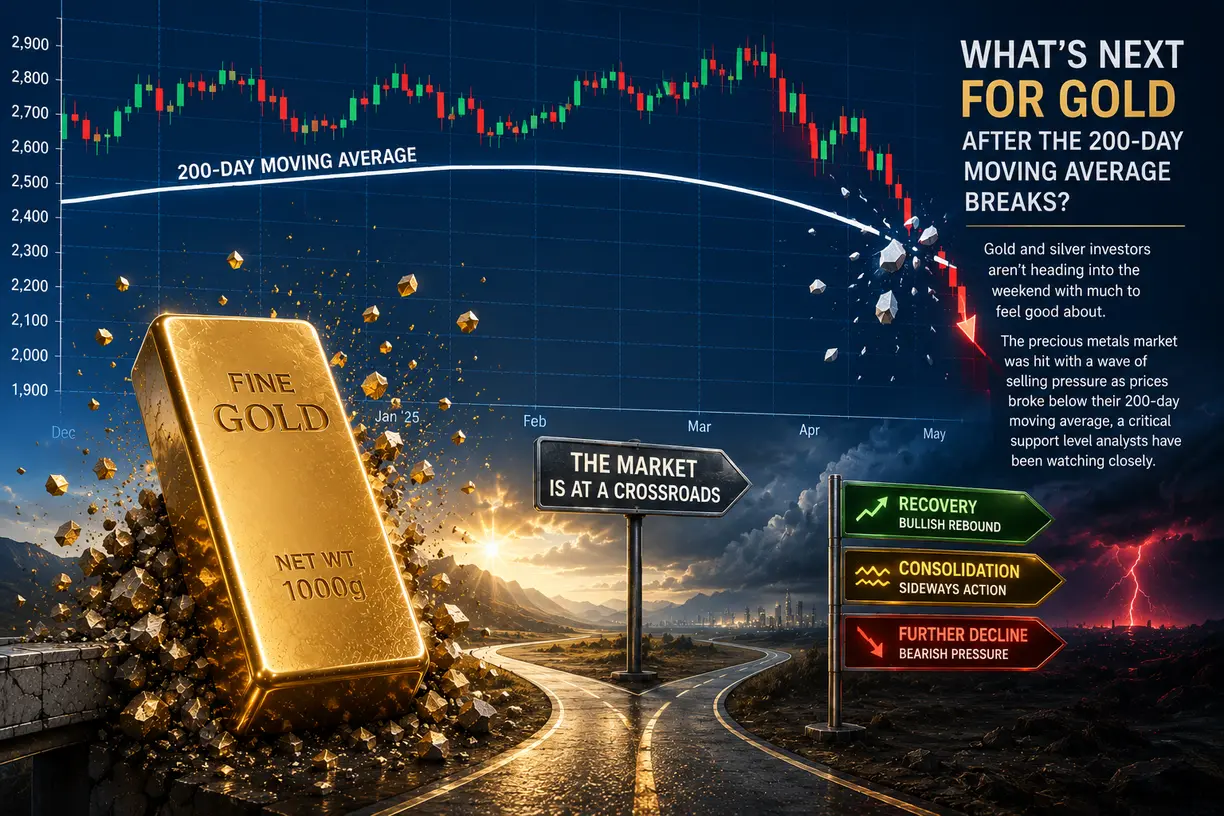
(Kitco News) - Gold and silver investors aren’t heading into the weekend with much to feel good about.
The precious metals market was hit with a wave of selling pressure as prices broke below their 200-day moving average, a critical support level analysts have been watching closely.
In the short term, the risks are undeniable. Momentum has clearly shifted against gold, and it would not be surprising to see additional weakness as traders continue to reduce exposure. It's even too early to start talking about buying the dip.
Market expectations that the Federal Reserve will have to take a hawkish stance to fight inflation have pushed bond yields higher and strengthened the U.S. dollar. Higher interest rates raise the opportunity cost of holding a non-yielding asset like gold, while a stronger U.S. dollar creates another headwind for precious metals.
Sharp moves like this can feel decisive in the moment, but they don’t necessarily change the bigger picture. Gold has been supported for years by deeper, more persistent forces, and those haven’t gone away.
Despite the chart damage, analysts remain confident that this selloff will prove to be a temporary correction. Many have even said that a year from now, they see prices back above $5,000. Several of the forces that have supported gold over the past few years remain firmly in place and, in some cases, they are becoming even stronger.
This week, Kitco News attended the Sohn Montreal conference, and there was a clear message for investors: the global economy will remain fractured for the foreseeable future. The era of globalization, built on efficiency and lowest-cost production, is giving way to a world increasingly focused on resilience, security, and strategic resource control. Hudson Bay Capital CEO Sander Gerber explained at the conference that governments and corporations are no longer making decisions based solely on economics; they are prioritizing supply-chain security and geopolitical considerations. That shift creates uncertainty and inflationary pressures that traditional financial models will struggle to capture.
Gold has always thrived during periods when uncertainty outweighs predictability.
Even if inflation cools in the near term, the long-term outlook points toward structurally higher fiscal spending, elevated deficits, and continued pressure on central banks to accommodate government borrowing. Hard assets like gold and silver remain among the few effective hedges against this scenario.
The current selloff is a reminder that bull markets rarely move in a straight line. Gold may face further downside in the weeks ahead as traders position themselves for potentially higher interest rates. However, for investors willing to look beyond the next quarter, the fundamental case for owning gold remains intact.
The chart may look broken today. The long-term outlook remains solid.
Despite the disappointing start to the month, I hope you have a restful weekend.

Neils Christensen
Neils Christensen has a diploma in journalism from Lethbridge College and has more than a decade of reporting experience working for news organizations throughout Canada. His experiences include covering territorial and federal politics in Nunavut, Canada. He has worked exclusively within the financial sector since 2007, when he started with the Canadian Economic Press. Neils can be contacted at: 1 866 925 4826 ext. 1526 nchristensen at kitco.com @KitcoNewsNOW

Disclaimer: The views expressed in this article are those of the author and may not reflect those of Kitco Metals Inc. The author has made every effort to ensure accuracy of information provided; however, neither Kitco Metals Inc. nor the author can guarantee such accuracy. This article is strictly for informational purposes only. It is not a solicitation to make any exchange in commodities, securities or other financial instruments. Kitco Metals Inc. and the author of this article do not accept culpability for losses and/ or damages arising from the use of this publication.