
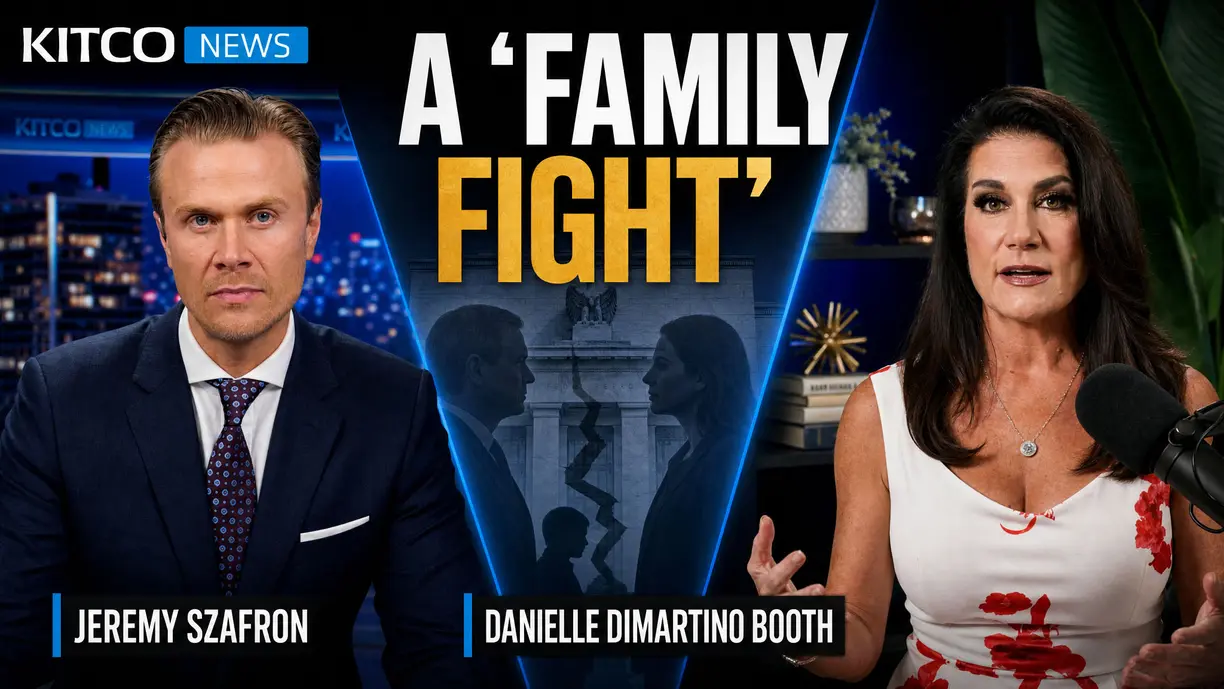
(Kitco News) - The Federal Reserve held interest rates steady Wednesday in Kevin Warsh's first meeting as chair, but its newly released projections exposed a committee sharply divided over whether to raise rates this year - and revealed that policymakers debated a rate cut before settling on a hold.
The Federal Open Market Committee voted unanimously to keep its benchmark rate in a range of 3.5% to 3.75%, dropped its long-standing signal that cuts were coming next, and pledged to "deliver price stability." The post-meeting statement ran about 130 words, down from 341 the prior month - a roughly 62% cut. Warsh, asked about the deliberations, described them as "a good family fight" that "ended up in a better place."
For Danielle DiMartino Booth, CEO of QI Research and a former adviser at the Federal Reserve Bank of Dallas, the unanimity was the headline.
"You have to give Kevin Warsh credit, because he had a unanimous vote. That was absolutely shocking," DiMartino Booth said in an interview with Kitco News.
The accord masked deep disagreement. In the Fed's Summary of Economic Projections, nine of the 18 officials who submitted forecasts penciled in at least one rate hike in 2026, with six expecting two or more; the other nine saw no change or a cut. Warsh declined to submit his own rate projection, breaking with the practice of recent chairs. The median path put rates at 3.8% by the end of 2026, 3.6% in 2027 and 3.4% in 2028.
DiMartino Booth said Warsh likely found it easier to rally the committee than many expected.
"So many officials at the Fed have known for a very long time that QE was a disaster, that using the balance sheet as a tool was a failed experiment, and that Fed speakers speak too much," she said. "A lot of them today were secretly rubbing their hands together and saying, 'God, I've been waiting my entire career for this to happen. Let's do it.'"
She added that some longtime officials welcomed a return to a leaner, quieter Fed: "I suspect that some of the gray hairs in the audience - including Jay Powell - were probably barking like a seal with happiness that he wanted to go back to being a more succinct institution that leaks less."
Markets sold off
The reaction was swift. The two-year Treasury yield jumped about 10 basis points to roughly 4.15%, on pace for its largest move on a Fed day since January 2022, according to Bloomberg. The dollar rose and gold fell about 2.2%, or roughly $94, to about $4,236 an ounce after touching a session high near $4,383. The S&P 500 dropped as much as 0.5% before paring its losses by the end of Warsh's news conference.
"That was the panic we saw in the bond market today," DiMartino Booth said. "To have seen a flattening of the yield curve to the extent that we did was nothing short of surreal."
She pointed to stress already building in the real economy, citing what she said were bankruptcies up 38.4% year over year. "These are enormous numbers," she said.
The Fed's own forecasts turned more hawkish on prices. Policymakers raised their median projection for inflation this year to 3.6% from 2.7% in March, and lifted core inflation, which strips out food and energy, to 3.3% from 2.7%. They left the unemployment rate near 4.3% and described growth as "solid."
Most Wall Street economists still expect the Fed to stop short of raising rates. Kay Haigh of Goldman Sachs Asset Management said his firm's base case is that the central bank "can just about avoid" hikes, though "the path is narrow."

'A new way to measure inflation'
Warsh also announced task forces to review the Fed's communications, balance sheet, data sources, productivity and jobs analysis, and inflation framework, all to conclude by year-end. He affirmed the 2% inflation target.
"He wants to look for a new way to measure inflation, period," DiMartino Booth said. "He says these task forces will be completed by the end of the year at the latest. As a former Fed insider, that is light speed. He's moving to initiate changes within the Fed at the fastest pace in the history of an institution born in 1913."
On the new chair's decision to drop forward guidance and withhold his own forecast, she said the market's discomfort was predictable.
"Wall Street is absolutely addicted to forward guidance," she said. "Less guidance is absolutely more critical." The remark she valued most, she said, echoed his predecessor: "We don't care how the markets react. We are going to act and think independently of them."
Warsh offered a split read on whether policy is restrictive, she noted: "He basically said, when asked, 'Is policy tight?' — 'It depends.' If it's the housing sector, clearly. If it's the financial markets, policy is clearly not restrictive."
Gold and the case for 'where to hide'
DiMartino Booth framed gold's drop as a function of the day's mechanics - higher real rates and a stronger dollar - rather than a verdict on the metal, noting that central banks are not selling. Margin debt, meanwhile, hit a record $1.42 trillion in May, according to FINRA data, leaving investors more leveraged against their cash than at any point on record.
"If Warsh is going to be the new sheriff in town and maintains higher-for-longer, and thereby helps facilitate a blowup in the private credit market that bleeds into the private equity market, then yes, this was a great buying opportunity for gold," she said. "It doesn't matter where inflation is per se, because in times of financial crisis, gold is where to hide."
She argued the cracks are already showing. "Private credit is already blowing up. Private equity is following it," she said, pointing to mounting losses on commercial real estate and borrowers unable to refinance. A market accident, she said, could force the Fed's hand faster than expected.
Asked for the single data point investors are overlooking, she did not hesitate: "The market should be paying very close attention to the volatility in the Treasury market right now. Things are going to be very bumpy."
For all her warnings, DiMartino Booth said she came away encouraged. "I'm hopefully optimistic," she said, adding that Warsh's debut "closely resembles the last chapter of 'Fed Up,'" her 2017 book. "These are things I've been arguing for, for a decade now."